URETHRAL
CATHETER INSERTION FORCES: A COMPARISON OF EXPERIENCE AND TRAINING
(
Download pdf )
BENJAMIN K. CANALES, DEREK WEILAND, SCOTT REARDON, MANOJ MONGA
Department of Urology (BKC), University of Florida, Gainsville, Florida, USA and Department of Urology (DW, SR, MM), University of Minnesota, Minneapolis, Minnesota, USA
ABSTRACT
Purpose:
This study was undertaken to evaluate the insertion forces utilized during
simulated placement of a urethral catheter by healthcare individuals with
a variety of catheter experience.
Materials and Methods: A 21F urethral catheter
was mounted to a metal spring. Participants were asked to press the tubing
spring against a force gauge and stop when they met a level of resistance
that would typically make them terminate a catheter placement. Simulated
catheter insertion was repeated fives times, and peak compression forces
were recorded. Healthcare professionals were divided into six groups according
to their title: urology staff, non-urology staff, urology resident/ fellow,
non-urology resident/ fellow, medical student, and registered nurse.
Results: A total of fifty-seven healthcare
professionals participated in the study. Urology staff (n = 6) had the
lowest average insertion force for any group at 6.8 ± 2.0 Newtons
(N). Medical students (n = 10) had the least amount of experience (1 ±
0 years) and the highest average insertion force range of 10.1 ±
3.7 N. Health care workers with greater than 25 years experience used
significantly less force during catheter insertions (4.9 ± 1.8
N) compared to all groups (p < 0.01).
Conclusions: We propose the maximum force
that should be utilized during urethral catheter insertion is 5 Newtons.
This force deserves validation in a larger population and should be considered
when designing urethral catheters or creating catheter simulators. Understanding
urethral catheter insertion forces may also aid in establishing competency
parameters for health care professionals in training.
Key
words: urinary catheterization; urethral catheter; educational
models
Int Braz J Urol. 2009; 35: 84-9
INTRODUCTION
The insertion of a urethral catheter is one of the most commonly performed hospital procedures. For the year 2000, the Center for Disease Control estimated that over five million urethral catheterizations were attempted in the United States (1). In most hospitals, this procedure is performed without a standardized training protocol and by a variety of healthcare workers with varying degrees of experience. We hypothesized that we could establish competency parameters for professionals in-training by measuring urethral catheter exertion forces and comparing healthcare provider experience. In addition, we would gather information that may affect not only the future design of catheters and virtual simulators but also the rate of urethral trauma and stricture.
MATERIALS AND METHODS
Healthcare
personnel at the Veterans Affairs Medical Center and the University of
Minnesota in Minneapolis, MN, USA, were invited to participate in our
study if they could be stratified into one of six groups: Group 1 - Urologist
MD; Group 2 - Non-Urologist MD; Group 3 - Urology Resident / Fellow MD;
Group 4 - Non-Urology Resident / Fellow MD; Group 5 - Medical Student;
and Group 6 - Registered Nurse. Participants were asked, “Push in
the catheter until you feel a level of resistance that would make you
stop if you were putting in a real urethral catheter”. Participants
held the catheter at the same marked area and were instructed and monitored
by the same two researchers to ensure procedure conformity. The procedure
was repeated five times serially by all groups.
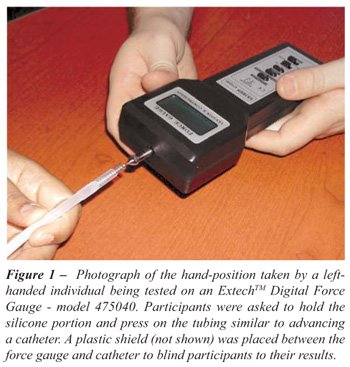
The tube used in simulation was a polyolefin
catheter (21F outer circumference, 9F inner circumference) with a metal
spring (7/32” x 1” x 0.28” wire thickness) mounted on
the distal end of a compression force gauge (Extech™ Digital Force Gauge
- model 475040) (Figure-1). Peak compression forces in Newtons (N) were
recorded, and participants were blinded to their own results.
The statistical software package SAS was
used for all calculations (SAS Institute Inc., Cary, NC, Version 9.0).
Group mean comparisons were calculated by an unpaired, two-sided, Student
t-test. Analysis of variance (ANOVA) was applied to compare different
groups with respect to continuous variables. Change in force over years
of experience was estimated by regressing the force applied by each subject
and obtaining a best fit line by linear regression. Results were considered
significant if the p-value was < 0.05.
RESULTS
Fifty-seven
healthcare workers participated in this study (Figure-2). Individual urethral
catheter insertion force was averaged by group and ranged from 6.8 to
10.1 N. Urologists (Group-1) had the lowest average force insertion forces
(6.8 N ± 2.0 N), while medical students (Group-5) had the highest
average insertion forces (10.1 N ± 3.7 N). The difference in the
amount of simulated force used to insert a catheter was significantly
higher for the medical students compared to every other group (p <
0.01). The difference in p values was also significant when comparing
urologists to urology residents (Group-3, p = 0.03) and registered nurses
(Group-6, p < 0.01).

To evaluate for subject-expectancy effect,
one way ANOVA was performed comparing force versus attempt for attempts
#1 - 5 (Figure-3). No statistically significant difference was found between
means of groups (range 8.14 N - 8.62 N; p = 0.96). Experience was then
plotted independent of medical group in a bivariate fit graph versus force,
and results were examined using ANOVA (Figure-4). In this linear correlation,
participant experience alone (r = - 0.78) explained approximately 78%
of the observed variation in force (p < 0.001). Health care workers
with more than 25 years experience (n = 9) had the lowest average force
insertion forces (4.9 N ± 1.8 N) compared to those with less than
25 years experience (8.4 ± 2.5 N, p =< 0.01).


COMMENTS
The
urethral catheter is an instrument as old as the field of urology. Evidence
of catheter use in Greece can be found in the Hippocratic Writings (~400
BC) (2). In 1929, Dr. Frederick E.B. Foley described the first modern
urethral catheter by dipping coagulating latex onto metal forms to create
a dual-port balloon catheter (3). Components of modern urethral catheters
have evolved into a combination of silicone and latex-free rubber (mixed
in varying proportions to vary catheter rigidity) coated with an elastomer
to aid insertion (4).
Despite the publications of a nurse clinical
practice guideline (5) and the impact of nursing educational programs
(6), no standardized method for training health care workers in catheter
placement exists. Most new health care employees, whether they are students
or residents, are guided through the process of patient preparation and
catheterization by someone with catheter experience. During the actual
procedure, however, only the health care worker advancing the catheter
can feel the resistance given by the catheter. Although improvements in
catheter design and composition have occurred, iatrogenic urethral injury,
in particular urethral stricture, continues to occur far too commonly
(7,8). Fenton et al. found that urethral catheter placement was the cause
of approximately 30% of all urethral stricture disease (9). In addition,
urethral-rectal fistulas, urethral perforation, prostatic bleeding requiring
surgical intervention, and bladder perforation have all been reported
as consequences of improperly inserted urethral catheters (10-12). Therefore,
we attempted to generate a “normal curve” of catheter forces
that could be used for modeling purposes and potential competency parameters.
From a design standpoint, it is important
to emphasize that we have measured only one element of catheter insertion:
force used. Because our method of simulation does not involve resistance,
we chose to use the polymer “polyolefin” as it is more firm
than a silicone or latex catheter and does not buckle prior to the participant
reaching the point of maximal force. Analysis by attempt (Figure-3) indicated
that no more force was applied on the first attempt than on the last attempt,
suggesting that both the material used and the study design yielded reproducible
and precise results.
Intuitively, it makes sense that a properly
placed catheter should not require a great deal of force to traverse the
urethra. In support of this, the experienced urologists had the lowest
catheter insertion forces of all our groups (6.8 ± 2.0 N). More
surprising was the finding that health care workers with more than 25
years experience had even lower forces (4.9 ± 1.8 N) with statistical
significance. Because of this, we propose that the range of 4.9 ±
1.8 N be considered the standard-of-care model in regards to urethral
catheter insertion force. Future clinical studies should evaluate not
only force but also the ability for providers to appreciate and adapt
to variances in a clinical presentation, such as catheter resistance,
anatomy, bloody return, or patient discomfort.
Several catheter methods of simulation have
been devised, but no simulation method fully recreates the sense of catheterization
of the female or male. Despite their shortcomings, catheter simulators
have been shown to reduce both risk and pain experienced by patients in
addition to avoiding urethral injuries (13). Since many U.S. medical schools
have the insertion of a urethral catheter as a core clinical competency
(14), simulators could likely help students learn this core concept before
actually practicing on a real patient. As the use of simulated medical
trainers rises in this country, it is our hope that this data can be used
to help industry sector and medical programs in designing simulation devices
that give feedback during urethral catheter insertion. From a cost standpoint,
Morgan et al. showed that medical simulator training devices are worth
the extra expense in regards to both student and faculty satisfaction
(15). Although most of the medical simulator published data involves medical
students, this technology could easily be applied to nursing students
(who are much more likely to place routine catheters than physicians are),
new surgical or medical residents, and/or as competency testing for physicians.
Our study has some limitations. Though utilization
of an in vitro model allows standardization of technique and measurement,
it does not account for signs of excess force that could be noted in a
clinical trial, such as patient reporting of discomfort, blood at the
urethral meatus, or catheter tip resistance. In addition to force, urethral
injury rates may increase by higher catheterization intervals or in high
risk male populations, such as benign prostatic hyperplasia or prostate
cancer (6). Polyolefin material is slightly stiffer than silicone and
latex materials used in catheters and was selected specifically so the
catheter would not buckle during testing. It would be of value to validate
the force range defined in this study in a clinical trial of a larger
group of providers using commercially available catheters.
CONCLUSION
In conclusion, as health care workers acquire more experience, significantly less force is used during urethral catheter insertions. Based on our findings, we propose that the maximum force that should be utilized during urethral catheter insertion is 5 Newtons. This force should be considered the “upper limit” utilized for urethral catheter insertion. Future validation in larger populations, such as measurements in cadavers or anesthetized patients undergoing non-urologic surgery, would be warranted to evaluate the range of forces used during normal circumstances. However, clinical measurements of this type may not necessarily help refine the “upper limit” that should be avoided unless they are collected from experienced practitioners. Overall, understanding urethral catheter insertion forces may aid in the design of future catheters, in the creation of catheter simulators, and in establishing competency parameters for health care professionals during training and/or recertification.
ACKNOWLEDGEMENT
To Dr. John J. Carlow who assisted in the statistical analysis.
CONFLICT OF INTEREST
Financial support by PercSys® (Percutaneous Systems, Inc.; Mountain View, CA)
REFERENCES
- Maki DG, Tambyah PA: Engineering out the risk for infection with urinary catheters. Emerg Infect Dis. 2001; 7: 342-7.
- Moog FP, Karenberg A, Moll F: The catheter and its use from Hippocrates to Galen. J Urol. 2005; 174: 1196-8.
- Newman DK: Managing indwelling urethral catheters. Ostomy Wound Manage. 1998; 44: 26-32.
- Carr HA: A short history of the Foley catheter: from handmade instrument to infection-prevention device. J Endourol. 2000; 14: 5-8.
- Clinical Practice Guidelines Task Force; Society of Urologic Nurses and Associates. Male urethral catheterization. Urol Nurs. 2006; 26: 315-7.
- Kashefi C, Messer K, Barden R, Sexton C, Parsons JK: Incidence and prevention of iatrogenic urethral injuries. J Urol. 2008; 179: 2254-7; discussion 2257-8.
- Dobrowolski ZF, Weglarz W, Jakubik P, Lipczynski W, Dobrowolska B: Treatment of posterior and anterior urethral trauma. BJU Int. 2002; 89: 752-4.
- Igawa Y, Wyndaele JJ, Nishizawa O: Catheterization: possible complications and their prevention and treatment. Int J Urol. 2008; 15: 481-5.
- Fenton AS, Morey AF, Aviles R, Garcia CR: Anterior urethral strictures: etiology and characteristics. Urology. 2005; 65: 1055-8.
- Nouri M, Tazi K, el Fassi J, Ibn Attya A, Hachimi M, Lakrissa A: Treatment of urethro-rectal fistulas. Apropos of 5 cases. Prog Urol. 1999; 9: 137-41.
- Donovski L, Ormanov I, Ziad Sh, Farakh N: A case of iatrogenic rupture of the urethra with a retrovesical urinoma. Khirurgiia (Sofiia). 1989; 42: 72-4.
- Basha M, Subhani M, Mersal A, Saedi SA, Balfe JW: Urinary bladder perforation in a premature infant with Down syndrome. Pediatr Nephrol. 2003; 18: 1189-90.
- Gordon JA, Wilkerson WM, Shaffer DW, Armstrong EG: “Practicing” medicine without risk: students’ and educators’ responses to high-fidelity patient simulation. Acad Med. 2001; 76: 469-72.
- Sanders CW, Edwards JC, Burdenski TK: A survey of basic technical
skills of medical students. Acad Med. 2004; 79: 873-5.
15. Morgan PJ, Cleave-Hogg DM: Cost and resource implications of undergraduate simulator-based education. Can J Anaesth. 2001; 48: 827-8.
____________________
Accepted after revision:
October 13, 2008
_______________________
Correspondence address:
Dr. Benjamin K. Canales
Dept of Urology, University of Florida
1600 SW Archer Rd, Rm N-213
PO Box 100247
Gainesville, FL, 32610-0247, USA
Fax: + 1 352 273-7515
E-mail: benjamin.canales@urology.ufl.edu
EDITORIAL COMMENT
This
work is a highly valuable unprecedented initiative towards systemization
of urethral catheter insertion. Although urethral catheter insertion is
a common procedure, to date there is no definitive standardization.
The use of diverse groups in the study serves
to show that aptitude in catheter placement implicates an extremely long
learning curve for all healthcare providers, independent of their specialization.
Ultimately, this study shows that even if other factors can lead to late
complications, the force used in the placement of the catheter is the
principal factor leading to acute complications.
Lastly, this study serves as a starting
point for creation of catheter simulators designed for healthcare workers.
However, as documented by the authors, more studies must be conducted
in order to validate all these data.
Dr.
João P. Martins de Carvalho
Section of Urology
Fluminense Federal University (UFF)
Niteroi, Rio de Janeiro, Brazil
E-mail: carvalho.jpm@gmail.com