SLIGHTLY
MODIFIED TECHNIQUE OF THE ORIGINAL ESSED PLICATION PROCEDURE FOR CONGENITAL
PENILE DEVIATION
(
Download pdf )
C. VAN DER HORST (1), F.J. MARTINEZ PORTILLO (1), C. SEIF (1), A. MUSIAL (2), P. ALKEN (2), K.P. JÜNEMANN (1)
Department of Urology, University Hospitals of Kiel (1) and Mannheim (2), Germany
ABSTRACT
Purpose:
The Schroeder-Essed plication procedure is a standard technique for the
correction of penile curvature. In a retrospective analysis we compared
functional results and quality of life (LQ) of the original technique
with inverted sutures as described by Schroeder-Essed and our slight modification
consisting of horizontal incisions into the tunica albuginea.
Materials and Methods: Twenty-six patients
with congenital penis deviation were treated for penile deviation by the
original Schroeder-Essed plication with inverted sutures (11 patients)
and by the described modification (15 patients). In case of modified technique,
horizontal and parallel incisions 4 mm to 6 mm apart and about 8 mm –
10 mm long were made through the tunica albuginea. The outer edges of
the incisions were then approximated with permanent inverted sutures (Gore-Tex®
3-0). Mean age was 21.6 years in the first group and 23.2 years in the
second group. Average follow-up was 28 months and 13 months, respectively.
The preoperative penile deviation angle was > 25o in all patients without
difference between the 2 groups.
Results: All patients in both groups reported
an improvement in their quality of life and full ability to engage in
sexual intercourse. Nine patients (88%) in the first group and 14 patients
(93%) in the second group were satisfied with the cosmetic result. In
contrast, 10 patients (91%) of the first and 13 patients (87%) of the
second group complained of penile shorting. Recurrence of deviation was
only noticed in 2 males in the first group (18%).
Conclusions: Our results indicate that this
simple modification of the Schroeder-Essed plication offers good functional
and cosmetic results. Most patients were satisfied with the penile angle
correction results.
Key
words: penis; congenital defect; curvature; tunica; reconstructive
surgical procedures
Int Braz J Urol. 2003; 29: 332-5
INTRODUCTION
Independent of its etiology, penile deviation may disturb sexual intercourse by difficult vaginal intromission. A simple standard method of congenital curvature repair is the Schroeder-Essed plication procedure (1). We describe and examine a slight modification of this technique consisting of horizontal incisions into the tunica albuginea avoiding cavernous tissue damage and improving adhesion of plicated tunical layers as similar performed by Baskin & Duckett (2). The 2 techniques were analyzed retrospectively by comparing the functional results and life quality (LQ) using standardized questionnaires on their quality of life.
MATERIALS AND METHODS
Between June 1996 and July 2000, 26 patients with congenital penile deviation underwent the original Schroeder-Essed plication with inverted sutures (11 patients) and the described modification (15 patients). Mean age was 21.6 yrs in the first group and 23.2 yrs in the second group. Average follow-up was 28 months and 13 months, respectively. The preoperative penile deviation angle was > 25° in all patients without differentiation between the 2 groups, documented by means of auto-photography. Detailed information about possible post-operative discomforts or pain from suture knots, initial irregularities of the penile shaft and shortening of the penis was given to the patients preoperatively. A standardized questionnaire was sent to all patients. Retrospectively we examined quality of life, sexual intercourse, penile deviation, penile shortening, penile sensation, quality of erection, cosmetic result and recurrence.
SURGICAL TECHNIQUE
Surgery
was performed under general anesthesia. A tourniquet was set at the base
of the penis. An artificial erection was induced by injection of sterile
saline solution into the corpora cavernosa through a 19G butterfly needle
to determine the degree of deviation. The outer preputial layer is circumferentially
incised at the level of the coronal sulcus to facilitate the drop back
of the penile shaft skin. The plain of dissection is kept just outside
of Buck’s fascia in order to preserve the vascular pedicle to the
dorsal hooded foreskin. Buck’s fascia is elevated on the convex
side by avoiding the neurovascular bundle of damage. To straighten the
penis, the effect of the tunical plication was simulated by using Allis
clamps under careful protection of the dorsal neurovascular bundle and
its branches. In case of the original Schroeder-Essed technique plication
is made by inverted sutures (1) (Gore-Tex® 3-0). In case of modified
technique, 2 parallel horizontal incisions 4 – 6 mm apart and about
8 - 10 mm long are made through the tunica albuginea. The outer edges
of the incisions are approximated with permanent inverted sutures (Gore-Tex®
3-0) (Figure-1). A straight penis is confirmed by repeated intra-operative
artificial erection. The overlying penile fascia was closed in layers,
and a circular dressing with light pressure was applied for a maximum
of 2 days.

RESULTS
All
patients in both groups undergoing plication for congenital deviation
of the penis reported an improvement in their quality of life and full
ability to engage in sexual intercourse. The penile deviation was abolished
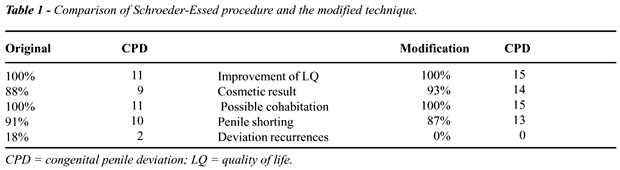
completely in all patients (< 15°). Nine patients (88%) in the
first group and 14 patients (93%) of the second group were satisfied with
the cosmetic result. No patients reported any changes in penile sensation
or in the quality of erections. In contrast, 10 patients (91%) of the
first and 13 patients (87%) of the second group complained of penile shorting.
Recurrence of deviation was only observed in 2 males in the first group
(18%) (Table-1). Statistical analysis showed no significant difference
between the 2 groups.
COMMENT
The
basic surgical strategy for treating mean with disabling penile curvature
and adequate erectile function entails lengthening the concave side of
the curvature or shortening the convex side of the curvature. Whereas
the first technique has the major problem of prolonged postoperative recovery
time and possible subsequent erectile dysfunction (3,4) the second technique
leads to shortening of the penis. Nesbit described in 1965 the use of
plication sutures in combination with removing elliptical segments of
the tunica albuginea (5). Essed & Schroeder plicated the tunica albuginea
without incision (1). Our data show, that the incisions are less invasive
in comparison with the removing of an elliptical segments of the tunica
albuginea but may strengthen the plication by proper healing. We did not
see any deviation recurrence or any changing in penile sensation.
CONCLUSIONS
Our results indicate that this simple modification of the Schroeder-Essed plication can provide good functional and cosmetic results for patients with congenital penile deviation. The technique is simple, bloodless, safe and reliable. Most patients were satisfied with the penile angle correction results.
REFERENCES
- Essed E, Schroeder FH: New surgical treatment for Peyronie disease. Urology 1985; 25: 582-7.
- Baskin LS, Duckett JW: Dorsal tunica albuginea plication for hypospadias curvature. J Urol. 1994; 151: 1668-71.
- Levine LA, Lenting EL: A surgical algorithm for the treatment of Peyronie’s disease. J Urol. 1997; 158: 2149-52.
- Jordan GH, Angermeier KW: Preoperative evaluation of erectile function with dynamic infusion cavernosometry/cavernosography in patients undergoing surgery for Peyronie’s disease: correlation with postoperative results. J Urol. 1993; 150: 1138-42.
- Nesbit RM: Congenital curvature of the phallus: Report of 3 cases with description of corrective operation. J Urol. 1965; 93 :230-2.
_________________________
Received: December 27, 2002
Accepted: March 5, 2003
_______________________
Correspondence address:
Dr. F. J. Martínez Portillo
Department of Urology
University Hospital Kiel
Christian-Albrechts-University Kiel
D-24105 Kiel, Germany
Fax: + 49 621 597-1957
E-mail: fmartinez@urology.uni-kiel.de
This
retrospective study compares 2 cohorts of men with congenital penile deviation
(chordee without hypospadias). The first group (n = 11) had the original
Schroeder-Essed plication using a technique described by Duckett for hypospadia
repair. Average follow-up was 28 months for group 1 and 13 months for
group 2.
The
original Schroeder-Essed plication places non-absorbable sutures into
the tunica albuginea in such a manner as to shorten the long axis of the
penis when these sutures are tied. The problem with this type of plication
is that there is no permanent remodeling of the tunica albuginea, and
the curvature will recur if and when these sutures ever break. The modification
involves making incisions in the tunica albuginea and securing then with
sutures. Once healing takes place, even if the sutures break or are absorbed,
the curvatures should not recur. The authors found no outcome differences
in outcome between the 2 groups. The problem is that follow-up in each
of the 2 groups is too short for the presumed benefit of the modification
become evident.
__________________
Dr. Drogo Montague
Glickman Urological Institute
The Cleveland Clinic Foundation
Cleveland, Ohio, USA