BILATERAL
AND SYNCHRONIC SEMINOMATOUS TESTICULAR NEOPLASIA
(
Download pdf )
ADEMAR SCHMITZ
Maicé Hospital, Caçador, Santa Catarina, Brazil
ABSTRACT
Testicular
neoplasia is rare, especially when it is bilateral, and even more when
it is synchronic, with its incidence being only 0.17% of germinative tumors
of testicles.
We present here the case of a male, 32-year
old patient, without children. Patient underwent a bilateral radical orchiectomy,
following previous sperm harvest, in a sperm bank. Surgery was performed
in 2 stages, with a 12-day interval, with implantation of a silicone testicular
prosthesis. The result of anatomicopathological examination revealed bilateral
classical seminoma, pT2 on the right side andT1 on the left. He was submitted
to bilateral complementary radiotherapy, with 2,500 cGy on each side.
Patient had a good outcome from a medical
and oncologic perspective, but a follow-up with psychotherapy was needed.
Key
words: testis; testicular neoplasms; seminoma; synchronous neoplasms
Int Braz J Urol. 2003; 29: 330-1
INTRODUCTION
The
incidence of germinative testicular tumors in the general population is
0.005%, and accounts for 1% of all tumors that affect men. The risk of
a patient having a successive (metachronic) bilateral tumor ranges between
1 and 5% (1). As for synchronic tumors, they are even more rare. Recently
a report was described on 2,431 germinative testicular tumors diagnosed
and treated from 1978 to 1999, and only 24 of these cases were bilateral,
and among them 20 were metachronic, that is, 1% of all tumors. Synchronic
tumors were described in only 4 cases (0.17%) (2). The histological type
is usually the same in both testicles, however in metachronic ones, histological
types can be different.
Synchronous testicular tumors require a
bilateral surgical therapy, leading to the patient’s sterility.
CASE REPORT
Male,
32-year old patient, married with no children. He had 5-month history
of bilateral, hardened, slightly painful, testicular mass, involving practically
the entire glands. Ultra-sonography revealed a right testicle measuring
7.8 x 8.4 x 4.2 cm and left testicle measuring 5.4 x 4.0 x 2.7 cm. The
main hypothesis was bilateral neoplasia, without excluding a granulomatous
process. Tumoral markers were normal. Thorax radiography and abdominal
computerized tomography did not reveal metastases. The magnetic resonance
imaging of scrotum suggested bilateral testicular neoplasia.
Surgery was indicated following adequate
sperm harvests, in sperm banks, for subsequent use. Surgery was scheduled
in 2 stages, for reasons of patient safety. The right radical orchiectomy,
with previous approach of the spermatic cord, was followed by a silicone
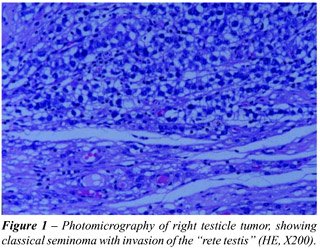
testicular implant. The anatomicopathological result was classical seminoma
(Boden I-B stage or pT2N0M0), with focal invasion of the tunica albuginea,
transposing it and the “rete testis” (Figure-1). The same
procedure was performed on the left side, 12 days later, already with
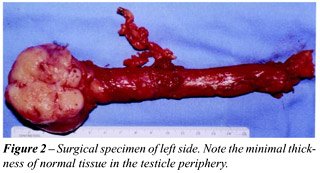
a definitive diagnosis. There was only a lymph node measuring 0.5 cm in
the spermatic cord (Figure-2). The anatomicopathological diagnosis was
seminoma as well (I-A stage or pT1N0M0), with focal invasion of the tunica
albuginea, without transposing the capsule. The lymph node was negative
for neoplasia.
As a complementary treatment, the patient
was submitted to a conformational radiotherapy, with 2.500 cGy at each
side (bilateral iliac and para-aortic chains), 60 days after surgery.
He presented a good outcome, and is receiving hormone replacement.
DISCUSSION
Bilateral germinative testicular tumors are rare and, when diagnosed synchronically, they are even rarer. Seminoma is the most common histological type. Current indication for treating such tumors begins with the clinical staging, with orchiectomy being the first step (3). It is hard to evaluate whether a conservative surgery, in bilateral cases, followed by chemotherapy and/or radiotherapy, could provide good results without bilateral testicular ablation, due mainly to the reduced number of cases of studied synchronic tumors. In this particular case, such procedure could not have been possible, since both testicles were involved by the neoplasia, in more than 90% of the normal tissue, with only a small band of tubules with normal aspect (Figure-2). In this case there was a great resistance from patient and his wife, in accepting the bilateral surgical treatment, with a freeze biopsy only, choosing thus to perform a surgery in 2 times, even though we had the clinical diagnosis of neoplasia pre-operatively. Complementary treatment was radiotherapy, due to staging and bilaterality.
_____________________________
Figure-1 was supplied by Drs. Maria
CN Zerbini and Claudia RGCM Oliveira,
from Fleury Laboatory, SP
REFERENCES
- Yokomizo S, Tsujimura A, Nonomura N, Kirime S, Takahara S, Okuyama A: Metachronous bilateral testicular tumors in a child. J Urol. 2001; 166: 2341.
- Che M, Tamboli P, Ro JY, Park DS, Ro JS, Amato RJ, et al.: Bilateral testicular germ cell tumors: twenty-year experience at M.D. Anderson Cancer Center. Cancer 2002; 95: 1288-33.
- Richie JP: Neoplasms of the Testis. In: Walsh PC, Retik AB, Vaughan ED Jr, Wein AJ (eds.), Campbell’s Urology, 7th ed. New York, WB Saunders. l998; pp. 2411-52.
________________________
Received:
February 28, 2003
Accepted after revision: May 9, 2003
_______________________
Correspondence
address:
Dr. Ademar Schmitz
Rua Herculano C. de Souza, 727 / 202
Caçador, SC, 89500-000, Brazil
Fax: + 55 49 563-0678
E-mail: ademar@conection.com.br