COEXISTENCE
OF PROSTATE NEOPLASIA IN PATIENTS UNDERGOING RADICAL CYSTOPROSTATECTOMY
DUE TO VESICAL NEOPLASIA
(
Download pdf )
FREDERICO R. ROMERO, MARÍLIA G. DE CASTRO, ADALBERTO ANDRIOLO JÚNIOR, ALEX H. DE MENESES, RONI C. FERNANDES, MARJO D.C. PEREZ
Sections of Urology and Pathology, School of Medical Sciences, Santa Casa de São Paulo, São Paulo, Brazil
ABSTRACT
Objective:
To assess the incidence of bladder carcinoma infiltrating the prostate
and prostate adenocarcinoma in patients undergoing radical cystoprostatectomy
due to bladder cancer, as well as to assess if the characteristics of
the bladder neoplasia influence the prostatic involvement by this neoplasia.
Materials and Methods: We retrospectively
assessed 60 male patients, who underwent radical cystoprostatectomy between
July 1997 and December 2003. Mean age was 66.7 years (40 and 93 years).
The product of radical cystoprostatectomies was checked for involvement
of urethra and prostate parenchyma by the primary neoplasia, and for the
presence of associated prostate adenocarcinoma. Bladder neoplasia characteristics,
such as localization, size, multifocality, association with in situ carcinoma
and histological grade, were studied in order to assess the possibility
of using such characteristics as predictive factors of prostate infiltration
by bladder urothelial carcinoma.
Results: We observed the presence of 20%
of patients with bladder carcinoma infiltrating the prostatic urethra,
23.3% of patients with infiltration of the prostate parenchyma and 28.3%
of patients with associate prostate adenocarcinoma, resulting in a total
of 55% of patients with prostatic involvement (infiltrative bladder carcinoma
and/or adenocarcinoma). We also observed a statistically significant correlation
between tumor location in the trigone, the presence of in situ carcinoma
and the histological grade of the bladder tumor with prostatic infiltration
by the vesical neoplasia.
Conclusion: The coexistence of prostatic
neoplasia in patients operated for bladder neoplasia was frequent in our
sample (55%). We observed that the prostatic infiltration by bladder tumors
occurs more frequently with tumors located in the trigone, with associated
in situ carcinoma and with high histological grade. There was no correlation
between neoplastic infiltration of prostate and multifocality or size
of the bladder tumor in the studied sample.
Key
words: bladder neoplasms; neoplasm invasiveness; prostatic neoplasms;
cystectomy
Int Braz J Urol. 2004; 30: 296-301
INTRODUCTION
Radical
cystoprostatectomy with urinary reconstruction represents the most efficient
treatment for invasive or refractory bladder cancer, with cure indexes
up to 80% of treated cases (1). However, due to the high incidence of
complication with this procedure, alternative techniques have been recently
described, preserving the prostate apex, or even the prostate capsule,
aiming to preserve sexual and urinary functions of operated patients (1-3).
Due to the increasing number of patients
undergoing procedures with urethral preservation, more attention has been
given to prostatic invasion by bladder neoplasia, which certainly increases
the risk of urethral recurrence and death from the neoplasia (4), particularly
in those patients with invasion of the prostate parenchyma (5).
Additionally, several studies have shown
the high incidence of incidental prostate adenocarcinoma in specimens
from cystoprostatectomies performed for treating bladder cancer (3,6-9).
Some of them reported a predominance of tumors in the prostate apex (3,6).
Patients with bladder neoplasia can present prostate neoplasia with a
relative risk up to 19 times higher than what would be expected (10).
However, incidental prostate tumors present characteristics that are similar
to latent tumors found in autopsy series, some have a proven potential
of progressive disease (3).
The objective of this work is to verify
the incidence of tumoral infiltration (urethra and/or parenchyma) in the
prostate of patients who underwent radical cystoprostatectomy for bladder
urothelial carcinoma, as well as the presence and histological grade of
the incidental prostate adenocarcinoma. The characteristics of bladder
tumors invasive to urethra or prostate parenchyma were also assessed,
in separate groups, with the objective of predicting those patients with
higher predisposition to associated prostatic disease.
MATERIALS AND METHODS
We
conducted a retrospective study of all patients undergoing radical cystoprostatectomy
for management of bladder urothelial (or transitional cell) carcinoma
during the period from July 1997 to December 2003. The inclusion criteria
comprised male patients, who underwent radical cystoprostatectomy for
management of bladder urothelial carcinoma, whose surgical specimens were
histologically examined.
Female patients were excluded, as well as
patients undergoing partial cystectomy, patients with different histological
diagnosis other than bladder urothelial carcinoma and/or patients with
irresectable tumors. Among a total of 84 patients who underwent open surgery
for management of bladder carcinoma between 1997 and 2003, 60 fulfilled
the inclusion criteria. Mean age of patients was 66.5 years, with age
limits ranging between 40 and 93 years. All patients underwent radical
cystoprostatectomy.
Staging and histological grading, according
to the TNM system of the International Union Against Cancer (UICC) and
grading system of the World Health Organization (WHO), respectively, are
illustrated in Table-1. In relation to urinary reconstruction, 48 (80%)
patients underwent ileal conduct, 11 (18.3%) orthotopic neobladder, 2
(3.3%) ureterosigmoidostomy and 2 (3.3%) wet colostomy.

The product from the radical cystoprostatectomies
was fixed in 10% formalin solution and processed according to the usual
standards for fixation and inclusion routinely employed in pathology services.
The specimens were weighted and measured.
The majority of specimens were opened through the anterior bladder wall.
In average, 2 to 5 sections were made to each tumor (depending on the
size), in addition to random sections in the following bladder regions:
dome, right and left lateral walls, posterior e anterior walls, triangle
and urethral margin of the bladder.
The prostate was sectioned in quadrants,
similarly o the processing for radical prostatectomy specimens. Sections
from transitional and peripheral zones of the prostate, and from apical,
middle and basal regions in both lobes were included, resulting, in average,
in 6 blocks per case. The margin of prostatic urethra was represented
separately. The blocks were sectioned in slices with 3- to 5-micrometers
in thickness and the resultant histological slides were stained by hematoxylin-eosin.
In relation to the characteristics of bladder
neoplasias, the variables included in the analysis were tumoral location
in bladder, assessing invasion, or not, of the vesical triangle, tumoral
multifocality, presence or absence associated in situ carcinoma in the
adjacent vesical mucosa, and histological grade, according to the classification
system of the WHO (11).
The correlation between these characteristics
and the incidence of neoplastic infiltration of bladder carcinoma to prostate
were assessed by Fisher’s exact test.
RESULTS
Of
the 60 who underwent radical cystoprostatectomy for bladder neoplasia,
we observed that 18 (30%) patients presented urethral (20%) and/or parenchymal
(23.3%) invasion of the prostate. Due to the extremely distinct prognostic
connotations between the infiltration of urethra and prostate parenchyma,
since parenchymal invasion results in poorer survival (5), we separated
the groups and assessed the characteristics of bladder tumors with these
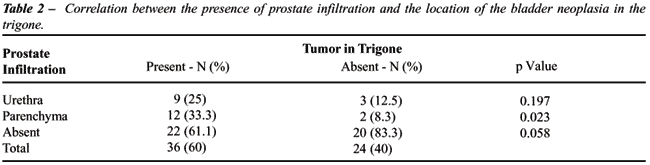
different forms of invasion. Among the total of assessed patients, 36
(60%) presented tumor in the trigone, including 9 (25%) with infiltration
of the prostatic urethra and 12 (33.3%) with infiltration of prostatic
parenchyma by the bladder urothelial carcinoma.
On the other hand, 3 (12.5%), of the 24
patients with tumors sparing the trigone, presented urethral infiltration,
while only 2 (8.3%) of them presented parenchymal infiltration. This result
did not show statistically significant differences in relation to invasion
of the prostatic urethra, but was significant in relation to infiltration
of the prostatic parenchyma (Table-2). Similar results were observed when
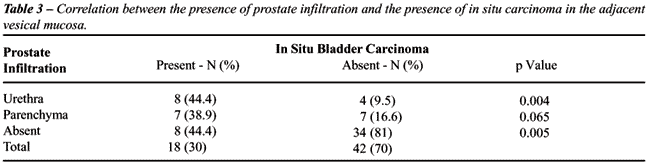
the presence of in situ carcinoma was observed in the adjacent mucosa
vesical.
Of the 18 (30%) patients with in situ carcinoma
in vesical mucosa, 8 (44.4%) presented invasion of prostatic urethra and
7 (38.9%) presented infiltration of prostatic parenchyma, while only 4
(9.5%) of 42 patients without associated in situ carcinoma showed prostatic
urethral involvement and, 7 (16.6%), prostatic parenchymal involvement
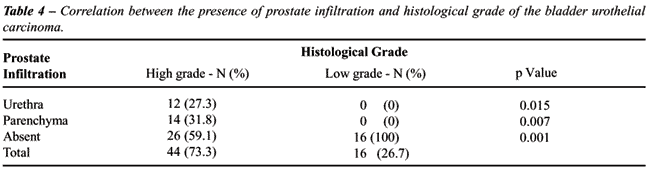
(Table-3). Additionally, patients with high-grade bladder carcinoma also
presented higher incidence of prostatic infiltration, both urethral and
parenchymal, when compared with those with low-grade tumor. Of the 44
(73.3%) patients with high-grade tumors, 12 (27.3%) presented infiltration
of prostatic urethra and 14 (31.8%) infiltration of parenchyma, while
none of the 16 patients with low-grade tumor, presented this particularity
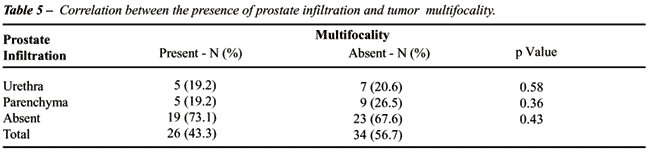
(Table-4). Prostatic involvement was evaluated in patients with multifocal
bladder tumors as well (Table-5), but there was no statistically significant
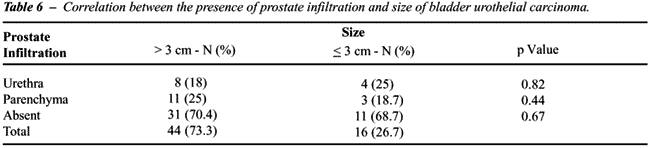
difference in this sample. Similarly, the association between size of
the vesical tumor (smaller, equal or larger than 3 cm) and the presence
of prostatic infiltration was not statistically significant, as shown
in Table-6.
Prostate adenocarcinoma was an incidental
finding in 17 (28.3%) patients. Of these, 16 (94.1%) had a combined Gleason
score lower or equal to 6 and only 1 (5.9%) presented Gleason score equal
to 7 (3 + 4).
When grouping all patients with infiltrative
urothelial carcinoma in prostate and/or primary prostate adenocarcinoma,
33 (55%) presented coexisting prostatic neoplasia.
COMMENTS
It
was determined that 20 to 40% of patients undergoing radical cystoprostatectomy
due to bladder urothelial carcinoma can present infiltration of urethra
and/or prostatic parenchyma by the bladder neoplasia (4,12). In our series,
30% of patients were diagnosed with tumoral invasion of prostate, and
this incidence reached 55.5%, in patients with associate in situ carcinoma.
Additionally, we found an increase in the
incidence of prostatic infiltration in patients with tumors located in
the vesical triangle and in those with high-grade urothelial neoplasias,
with incidences of 41.6% and 41%, respectively. The high risk of prostatic
involvement by bladder tumors located close to the bladder neck, multifocal
or associated with in situ carcinoma has been previously reported (5,13).
The assessment of such factors is important because it can help when deciding
whether to partially preserve or to completely resect the prostate, when
treating patients with infiltrative bladder neoplasia.
Recent reports indicate that the invasion
by urothelial carcinoma to the prostatic urethra does not alter survival,
contrarily to parenchymal invasion of the prostate (5).
However, the infiltration of prostatic urethra
can be associated with higher risk of urethral recurrence. In the present
study, we observed a statistically significant correlation between urethral
infiltration of the prostate and the presence of in situ carcinoma of
vesical mucosa as well as a high histological grade. On the other hand,
the incidence of infiltration of the prostatic parenchyma was significantly
higher in patients with tumor located in the trigone and in those with
high-grade urothelial neoplasia.
The diagnosis of incidental prostate adenocarcinoma
in these patients was reported in 16% to 46% in cases, in the reviewed
works (3,6-9). In our patients, 28.3% of operated patients presented prostatic
adenocarcinoma.
Though the discrepancies between studies
could be related to the method of pathologic evaluation employed, all
indicate the presence of a significantly high incidence of associated
disease (3). Several authors observed a relative risk of patients with
bladder cancer developing prostate cancer that is 9 to 19 times higher
than the expected rate (3,4). These incidental tumors are usually small,
well or moderately differentiated and limited to the prostate. Almost
all our patients (94.1%) presented combined Gleason score lower or equal
to 6.
Only one patient (5.9%) presented Gleason
7 (3 + 4). These studies represent the closest correlation as possible
between living patients and autopsy series that study incidental or latent
prostate adenocarcinoma. However, in the modern age of orthotopic bladder
replacement, where some authors have proposed preservation of prostatic
tissue or prostatic capsule, the precise location, histological grade
and size of these tumors are important factors to be considered. Several
studies observed a high frequency of prostate tumors close or located
in the prostate apex, so that an incomplete radical surgery of prostate
could impair the principles of oncologic surgery (3,6). In our sample,
it was impossible to determine the precise location of tumors due to the
relatively recent standardization of surgical specimens processing.
When assessed together, invasive urothelial
carcinoma in prostate and adenocarcinoma can be found in 40 to 80% of
patients (2). In the present work, we found prostatic involvement in 55%
of patients, by prostatic invasion either by the bladder tumor (30%),
or by the presence of an associated prostate adenocarcinoma (28.3%).
Thus, in addition to a proper patient selection
in order to rule out prostate adenocarcinoma in patients who are candidates
to surgery with preservation of the prostate apex, through clinical examination,
serum levels of prostate specific antigen, transrectal ultrasound and
prostate biopsy, a detailed assessment of the bladder neoplasia’s
characteristics must be performed, with urethrocystoscopy, endoscopic
resection and randomized biopsy of bladder. In this way, the possibility
of missing a diagnosis of coexisting prostate neoplasia is reduced (3,6-9).
Additionally, it is possible to perform an intra-operative freezing biopsy
of the urethral margin in order to further reduce this possibility (13,14).
Though several works have concluded that
the resection of the prostate apex is mandatory during cystoprostatectomy
for bladder cancer (3,6,9), the preservation of the prostate apex can
reduce the morbidity and significantly improve the patients’ quality
of life through improving social, sexual and psychological implications
of the radical cystectomy (1). The proper selection of patients through
a detailed pre-operative evaluation can allow this procedure to be performed,
but prospective studies will be required to follow these patients’
outcome in order to assess if the preservation of prostate apex really
impairs survival and the risk of urethral recurrence in these patients.
CONCLUSION
The presence of prostatic involvement by local infiltration of bladder neoplasia and/or synchronous prostate adenocarcinoma was frequent in our sample (55%). We observed that the infiltration of prostatic urethra by bladder urothelial tumors occurs more frequently in tumors with in situ carcinoma in the adjacent vesical mucosa and in those with high histological grade. The parenchymal infiltration of prostate by urothelial carcinoma was more common among tumors located in the trigone and in high-grade tumors as well. We found no association between multifocality and size of bladder tumor with the presence of urothelial carcinoma in the prostate.
REFERENCES
- Spitz A, Stein JP, Lieskovasky G, Skinner DG: Orthotopic urinary diversion with preservation of erectile and ejaculatory function in man requiring radical cystectomy for nonurothelian malignancy: a new technique. J Urol. 1999; 161: 1761-64.
- Srougi M, Dall’Oglio M, Nesrallah LJ, Arruda HO: Radical cystectomy with preservation of sexual function and urinary continence: description of a new technique. Int Braz J Urol. 2003; 29: 336-44.
- Moutzouris G, Barbatis C, Plastiras D, Mertziotis N, Katsifotis C, Presvelos V, et al.: Incidence and histological findings of unsuspected prostatic adenocarcinoma in radical cystoprostatectomy for transitional cell carcinoma of the bladder. Scand J Urol Nephrol. 1999; 33: 27-30.
- Iselin CE, Robertson CN, Webster GD, Vieweg J, Paulson DF: Does prostate transitional cell carcinoma preclude orthotopic bladder reconstruction after radical cystoprostatectomy for bladder cancer?. J Urol. 1997; 158: 2123-6.
- Nixon RG, Chang SS, Lafleur BJ, Smith Jr JA, Cookson MS: Carcinoma in situ and tumor multifocality predict the risk of prostatic urethral involvement at radical cystectomy in men with transitional cell carcinoma of the bladder. J Urol. 2002; 167 (2 pt1): 502-5.
- Kabalin JN, McNeal JE, Price HM, Freiha FS, Stamey TA: Unsuspected adenocarcinoma of the prostate in patients undergoing cystoprostatectomy for other causes: incidence, histology and morphometric observations. J Urol. 1989; 141: 1091-4.
- Pritchett TR, Moreno J, Warner NE, Lieskovsky G, Nichols PW, Cook BA, et al.: Unsuspected prostatic adenocarcinoma in patients who have undergone radical cystoprostatectomy for transitional cell carcinoma of the bladder. J Urol. 1988; 139: 1214-6.
- Montie JE, Wood Jr DP, Pontes JE, Boyett JM, Levin HS: Adenocarcinoma of the prostate in cystoprostatectomy specimens removed for bladder cancer. Cancer.1989; 63: 381-5.
- Winfield HN, Reddy PK, Lange PH: Coexisting adenocarcinoma of prostate in patients undergoing cystoprostatectomy for bladder cancer. Urology 1987; 30: 100-1.
- Chun TY: Coincidence of bladder and prostate cancer. J Urol. 1997; 157:65-7.
- Eble JN, Sauter G, Epstein JI, Sesterhenn IA: IARC World Health Organization classification of tumours: pathology and genetics of tumours of the urinary system and male genital organs. Lyon, 2004.
- Wood Jr DP, Montie JE, Pontes JE, VanderBrug Medendorp S, Levin HS: Transitional cell carcinoma of the prostate in cystoprostatectomy specimens removed for bladder cancer. J Urol. 1989; 141: 346-9.
- Nabeeh A, Gomha M, Shaaban AA, el-Baz M, el-Dosoky I, Ashamallah A, et al.: Orthotopic bladder substitutes: histopathologic risk factors. Scand J Urol Nephrol. 1995; 29: 463-7.
- Vallancien G, el Fettouh HÁ, Cathelineau X, Baumert H, Fromont G, Guillonneau B: Cystectomy with prostate sparing for bladder cancer in 100 patients: 10-year experience. J Urol. 2002; 168: 2413-7.
___________________
Received: May 4, 2004
Accepted after revision: July 29, 2004
_______________________
Correspondence address:
Dr. Frederico Ramalho Romero
Rua Dona Veridiana, 167 ap. 184-B
São Paulo, SP, 01224-060, Brazil
Fax: +55 11 3226 7000 ext 5946
E-mail: fredromero@globo.com