CALCIUM
CHANNEL BLOCKER AND RENAL MITOCHONDRIAL FUNCTION IN WARM RENAL ISCHEMIA
(
Download pdf )
SILVIO TUCCI JR, TIAGO J. BORELLI-BOVO, ADAUTO J. COLOGNA, RICARDO B. TIRABOSCHI, ANTONIO C.P. MARTINS, JOSE E.S. ROSELINO
Laboratory of Experimental Surgery, Department of Surgery and Anatomy, Ribeirao Preto School of Medicine, University of Sao Paulo, Ribeirao Preto, Brazil
ABSTRACT
Objective:
Ions, particularly calcium ions, play an important role in ischemia-reperfusion
cell injury. In this study, we investigated the action of verapamil on
the mitochondrial function of kidneys submitted to ischemia without blood
reperfusion in order to study isolated early and late ischemic effects.
Materials and Methods: 44 rats were submitted
to bilateral warm renal ischemia for 30 minutes. The kidneys were then
immediately reperfused with saline or Euro-Collins (EC) solution, with
and without previous administration of 0.35 mg/kg of verapamil. Mitochondrial
function was assessed at the end of renal perfusion and after 24 hours
of cold preservation.
Results: In kidneys perfused with saline,
verapamil allowed a significant early preservation of state III mitochondrial
respiration, a result that was no longer evident after 24 hours. In kidneys
perfused with EC solution, verapamil did not change state III for either
early or late evaluations. Comparison of the groups showed that the results
obtained for kidneys perfused with EC were always superior to those obtained
for the saline group, except for the initial analysis of kidneys treated
with saline and verapamil, which showed results similar to those obtained
with EC perfusion alone.
Conclusion: Administration of verapamil
before warm ischemia provides partial and short-lasting functional protection
of the mitochondrial function in kidneys perfused with sodium rich saline.
With Euro-Collins solution, verapamil did not show any additional beneficial
effect. This fact permits us to conclude that protective action is effective
only under conditions that facilitate increased sodium uptake and/or potassium
loss.
Key
words: kidney; mitochondria; ischemia; function; verapamil
Int Braz J Urol. 2005; 31: 384-9
INTRODUCTION
Despite
the care taken to preserve vital functions in brain dead patients and
candidates for organ donation, organs removed from them may pass through
a variable period of hypoxia and/or ischemia secondary to a low renal
blood flow with a consequent deleterious effect on renal cell metabolism
that may affect function after transplantation (1).
In an attempt to reduce renal cell damage,
kidney preservation for transplantation currently consists of arterial
perfusion with solutions whose composition is similar to that of the intracellular
medium used at low temperature. Hypothermia is mandatory because it decreases
the cellular metabolic rate, reducing the renal oxygen demand by 84% at
20° C and by 95% at 10° C (2).
In addition of hypothermia and different
preservation solutions, several drugs have been used to maintain cell
integrity and to preserve the organs for transplantation (3,4). Among
them, calcium channel blockers have shown reduction of cell damage induced
by oxygen deprivation. Verapamil has shown a protective effect on renal
function in animal models, specifically acute ischemic renal failure when
administered before an ischemic episode ranging from 40 to 60 minutes,
usually with blood reperfusion after the period of ischemia (5-9), as
well as in renal transplantation (10). In addition, there is an anti-oxidant
protective effect against tissue injury attributable to oxidative stress
(11).
Considering these aspects, the objective
of the present study was to assess the action of verapamil on the mitochondrial
function in kidneys of rats submitted to 30 minutes of warm ischemia and
then immediately perfused with two different solutions at low temperature
with no blood reperfusion of the kidney in order to study isolated early
and late ischemic effects.
MATERIALS AND METHODS
This
study was approved by the Institution Committee on Animal Research, following
the recommendations for animal research by the National Institute of Health.
Forty-four male Wistar rats weighing 300
to 345 g were used. Of these, 37 underwent bilateral warm renal ischemia
and were divided into 4 groups (A, B, C and D).
Warm renal ischemia: after thionembutal
anesthesia (40 mg/kg, intra-peritoneal) and laparotomy, the aorta and
vena cava were dissected and renal arterial blood flow was interrupted
for 30 minutes by placing vascular clamps in the aorta above the emergence
of the renal arteries. Groups B and D animals received 0.35 mg/kg of verapamil
intravenously 15 minutes before the beginning of ischemia. After that,
the aorta and the vena cava were ligated above and below the renal vessels.
A small incision was made in the vena cava and in situ renal perfusion
was started with 20 mL of a solution stored on ice and slowly injected
by puncturing the aorta. The injected solution varied between groups,
as described below. The incision in the vena cava permitted the drainage
of blood and perfusion fluid. One of the kidneys was then randomly removed
in order to obtain mitochondria and determine their function. The contralateral
kidney was removed and kept in a flask immersed in ice (0 to 4° C),
which contained the solution with which the kidney had been perfused.
This organ was used 24 hours later for a new determination of mitochondrial
function.
Perfusion solutions: Groups A (n = 8) and
B (n = 5) - saline (0.9% NaCL); Groups C (n = 12) and D (n = 12) - Euro-Collins®
solution. Seven additional rats were used for the determination of control
mitochondrial function. Euro-Collins was used in this study due to its
frequent use as the main solution for organ perfusion in cadaveric and
live donor kidney transplant at our institution.
Determination of mitochondrial function:
to obtain the mitochondrial fraction, the kidney is washed in 0.9% saline
solution conserved on ice and then fragmented in appropriate medium (0.25
M sucrose, 1 mM EDTA, 1 mg/mL albumin, pH 7.4) using a Potter Elvehjem
blender 3 times for 3 seconds at 1 minute intervals. The fraction containing
the mitochondria is obtained by centrifugation of this tissue, first at
750 x g for 3 minutes, and then twice at 15000 x g for 10 minutes. All
centrifugations were done at 4° Celsius. A Himac CR21 refrigerated
Hitachi® centrifuge was used. The final
precipitate was suspended and used to determine the protein content and
the respiratory activity of mitochondria. The protein concentration was
assayed by means of the biuret modified reaction (12,13). The polarographic
method involving oxygen electrodes using a Gilson oxygraph was applied
to determine the respiratory activity of mitochondria (14).
The parameters of mitochondrial function studied were state III (oxygen
consumption in the presence of ADP) and state IV (basal respiration after
the mitochondria had converted to ATP all the ADP available in the assay).
With these two parameters, the respiratory control ratio (RCR) was calculated
for each respiratory assay. This ratio measures the coupling of oxidative
phosphorylation and is used as the quality control of the mitochondrial
preparation. In the present study, the only data used were obtained in
the experiments in which the RCR of the control mitochondrial preparation
presented a value higher than 3.5.
The paired and unpaired Student t-test was
used for parametrical variables and the Wilcoxon-Mann-Whitney test for
non-parametric variables, with level of significance set at 5%.
RESULTS
Data
of mitochondrial function obtained for 73 organs were used, considering
the mitochondrial RCR as the quality control of the preparations.
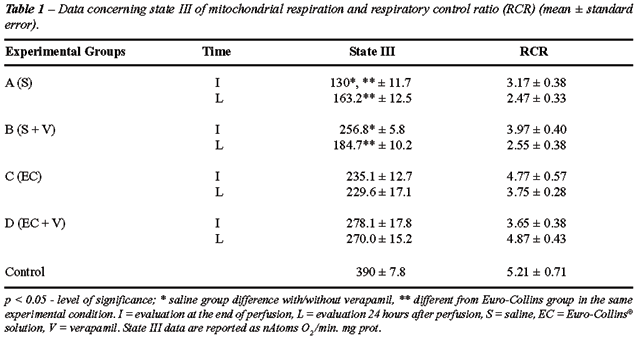
Kidneys perfused with saline and verapamil
showed a significant preservation of state III mitochondrial respiration
in the evaluation performed immediately after the perfusion period when
compared with kidneys without verapamil (p < 0.05). However, this difference
was not observed after 24 hours of cold kidney preservation.
In organs perfused with Euro-Collins®
solution, the administration of verapamil before ischemia did not significantly
alter the state III values either at the immediate or at the 24-hour evaluation
periods. However, there was a tendency to higher values of these parameters
in the animals that received this drug.
When the groups were compared, the results
obtained after perfusion with Euro-Collins® solution were always superior
to those obtained for the kidneys perfused with saline (p < 0.05),
except for the animals which received verapamil in combination with saline,
whose results were similar to those obtained with perfusion of Euro-Collins®
alone (p > 0.05).
State III and RCR values are listed in Table-1.
COMMENTS
In
aerobic organisms, oxidative phosphorylation is the major source of ATP
for all vital processes needing a supply of chemical energy. The variation
in free energy to maintain these processes originates from carbon substrates
and from the corresponding electron transport in the respiratory chain
that occurs inside the mitochondrial membrane. Oxygen is required as the
final electron receptor for the maintenance of these metabolic processes.
During ischemia, anoxia prevents this efficient form of ATP production,
consequently impairing cell functions.
The cause-effect relationship between the
processes for obtaining chemical energy is still quite obscure and depends
on membrane integrity (such as integrity of the mitochondrial membrane)
and on renal function, which depends on cell organization. In the kidney,
one of the consequences of ischemia is the loss of tubular cell polarity
and the redistribution of the Na+, K+ ATPase enzyme,
which represents cellular disorganization and compromises renal function.
The relation of this disorganization to the fall in ATP levels has been
proposed by other investigators (15). In the absence of oxygen, the anaerobic
glycolytic pathway is activated, with glycogen degradation, lactate and
H+ production, increase in the number of particles with a consequent
increase in osmotic pressure, and development of cellular edema (16,17).
Not only the lack of oxygen but also the interruption of tissue removal
of metabolites contributes to this condition.
Several studies have indicated an important
contribution of calcium ion to cell damage in the process of renal ischemia-reperfusion
(18,19). Usually, the rapid accumulation of H+ permits the
exchange of this ion with Na+ and concomitantly the exchange
of Na+ with Ca++. The ion calcium activates
phospholipases and proteases (17,20) and a further increase in plasma
membrane permeability with a massive calcium influx into the cytoplasmic
and the mitochondrial compartments. This process leads to irreversible
cell injury.
The beneficial effects of verapamil in the
processes of kidney ischemia-reperfusion have been demonstrated. However,
this protection may be due both to its vasodilating action and to its
effect as a calcium channel blocker (5). Electron microscopy studies have
shown that verapamil also acts to preserve the ultra structure of the
mitochondrial membrane (21), and possibly reducing the infiltration of
neutrophils into the ischemic kidney (22). In the present study, we assessed
the action of verapamil on the mitochondrial function of renal cells when
administered in combination with two different perfusion solutions. Any
vasodilating effect was excluded, since nephrectomy was performed with
no blood reperfusion of the kidney.
The evaluation performed at the end of perfusion
showed that in organs perfused with saline, the administration of verapamil
before ischemia allowed a significant preservation of state III mitochondrial
respiration compared to the group that did not receive the drug. This
beneficial effect may correspond to the maintenance of structural membrane
integrity observed by Alvarez et al. (21). In addition, the similarity
in state III values for groups B and C (p > 0.05) in the evaluation
performed immediately after nephrectomy suggest that the protection of
the mitochondrial membrane provided by Euro-Collins® perfusion was
qualitatively similar to that obtained with verapamil.
These data confirm the inadequacy of sodium
saline solution alone for renal preservation (allowing for the manifestation
of the action of verapamil) and, more importantly, indicate that the ionic
effect, i.e., the short duration effect, may be exerted by both the verapamil
and the Euro-Collins® solution. This suggests that the prevention
of the sodium increase by EC is as beneficial as the initial prevention
of the increase in calcium, without synergistic effects of the two maneuvers
on prolonged preservation. In acute and short duration episodes of ischemia
during which the effects of the changes in ATP levels affecting the functioning
of the cellular ion pumps may be initially and partially prevented by
the anaerobic production of ATP, the use of verapamil may permit renal
membrane preservation in addition to preserving vascular endothelium obtained
with the use of sodium rich saline (23).
The disappearance of the protective effect
of verapamil on organs assessed 24 hours after renal perfusion with saline
may suggest that the action of the drug is short lasting, or that blockade
of calcium entry by verapamil occurs only initially. Thus, if sodium continues
to be offered through the 0.9% saline solution, the ischemic injury will
increase and cell and mitochondrial function will fall over time even
under conditions of hypothermia.
The results obtained for the kidneys perfused
with the Euro-Collins® solution showed higher values of state III
mitochondrial respiration after previous administration of verapamil.
These values did not reach a statistically significant level, but may
indicate a protective tendency of the drug in addition to that provided
by the Euro-Collins® solution. The analysis performed after 24 hours
of cold ischemia revealed the persistence of this tendency and favors
the hypothesis that the results obtained for the group perfused with saline
solution may really represent a worsening of cell injury. It should be
pointed out that by not permitting renal reperfusion, we limited the action
of verapamil exclusively to the period of ischemia.
This aspect of the experimental design permits
us to exclude from the discussion some blocking action of the drug on
the calcium elicited phenomena and its eventual vasodilating effects that
might be observed at the time of reperfusion. Administration of verapamil
before warm ischemia provides partial- and short-lasting functional protection
of the mitochondrial fraction in kidneys perfused with sodium rich saline.
When the kidneys were perfused with Euro-Collins®, a high potassium
solution similar to the intracellular medium, verapamil did not show any
additional beneficial effect. This fact allows for the conclusion that
the protective action of verapamil is effective only under conditions
that facilitate increased sodium uptake and/or potassium loss.
Values of state III mitochondrial respiration
closer to those observed in controls suggest that the mitochondrial membranes
were functionally more efficient with a greater capacity for synthesis,
and therefore were able to re-establish, at least theoretically, ATP stores
after organ reperfusion, contributing to the return of cell function.
Recently, the study of prolonged periods
of total ischemia in skeletal muscle whose dimensions were maintained
in order to preserve energy metabolism (24,25) showed that the variation
in state III respiration was a more sensitive indicator of mitochondrial
damage than the membrane potential, basal mitochondrial respiration (state
IV), or RCR (25). However, the last index (RCR) still seems to represent
a relatively simple and reliable form of evaluating the quality of mitochondrial
preparations.
In conclusion, analysis of these results
as a whole indicates that the administration of verapamil before the ischemic
episode provides only partial- and short-lasting functional protection
of mitochondrial function and this protection is superimposed on that
promoted by renal perfusion with Euro-Collins® solution before ischemia.
On the other hand, early events occurring during the initial period of
ischemia may include a possible direct sodium effect upon mitochondrial
function. Therefore, this possibility may deserve further investigation
when the role of kidney function upon ionic homeostasis is taken into
account.
REFERENCES
- Paller MS: The cell biology of reperfusion injury in the kidney. J Investig Med. 1994; 42: 632-9.
- Marshall VC, Jablonsky P, Scott DF: Renal Preservation. In: Morris, PJ (ed.), Kidney Transplantation. Principles and Practice. 4th ed., Philadelphia, WB Saunders. 1994; pp. 86-108.
- Ametani MS, Southard JH, Belzer FO: Importance of glutathione and adenosine in cold storage of the kidney. Transplant Proc. 1990; 22: 469-71.
- Cejalvo D, Lloris-Carsi JM, Toledo-Pereyra LH, Calvo MA: Effect of adenosine and allopurinol on liver ischemia-reperfusion. Transplant Proc. 1993; 25: 3023-4.
- Malis CD, Cheung JY, Leaf A, Bonventre JV: Effects of verapamil in models of ischemic acute renal failure in the rat. Am J Physiol. 1983; 245: F735-42.
- Goldfarb D, Iaina A, Serban I, Gavendo S, Kapuler S, Eliahou HE: Beneficial effect of verapamil in ischemic acute renal failure in the rat. Proc Soc Exp Biol Med. 1983; 172: 389-92.
- Burke TJ, Arnold PE, Gordon JA, Bulger RE, Dobyan DC, Schrier RW: Protective effect of intrarenal calcium membrane blockers before or after renal ischemia. Functional, morphological, and mitochondrial studies. J Clin Invest. 1984; 74: 1830-41.
- Elkadi HK, Mardan AH, Nghiem DD, Southard JH: The role of calcium antagonists in the management of renal warm ischemia. J Urol. 1989; 141: 974-80.
- Dosluoglu HH, Aktan AO, Yegen C, Okboy N, Yalcm AS, Yahn R, et al.: The cytoprotective effects of verapamil and iloprost (ZK 36374) on ischemia/reperfusion injury of kidneys. Transpl Int. 1993; 6: 138-42.
- Dawidson I, Lu C, Palmer B, Peters P, Rooth P, Risser R, et al.: Verapamil (VP) improves the outcome after renal transplantation (CRT). Transpl Int. 1992; 5 (suppl 1): S60-2.
- Guler C, Samli M, Aksoy Y, Demirbas M, Kilinc A, Ellidokuz E, at al.: Effects of carbon dioxide pneumoretroperitoneum on free radical formation in remote organs and use of verapamil as an antioxidant. J Endourol. 2004; 18: 245-9.
- Gornall AG, Paller MS, David, MM: Determination of the serum proteins by means of the biuret reaction. J Biol Chem. 1949; 177: 751-66.
- Kaplan RS, Pedersen PL: Characterization of phosphate afflux pathways in rat liver mitochondria. Biochem J. 1983; 212: 279-88.
- Chance B, Willians GR: The respiratory chain and oxidative phosphorylation. Adv Enzymol Relat Subj Biochem. 1956; 17: 65-134.
- Molitoris BA, Simon FR: Renal cortical brush-border and basolateral membranes: cholesterol and phospholipid composition and relative turnover. J Membr Biol. 1985; 83: 207-15.
- Jones DP: Renal metabolism during normoxia, hypoxia, and ischemic injury. Annu Rev Physiol. 1986; 48: 33-50.
- Brezis M, Epstein FH: Cellular mechanisms of acute ischemic injury in the kidney. Annu Rev Med. 1993; 44: 27-37.
- Paller MS, Greene EL: Role of calcium in reperfusion injury of the kidney. Ann N Y Acad Sci. 1994; 723: 59-70.
- Farber JL, Chien KR, Mittnacht S Jr: The pathogenesis of irreversible cell injury in ischemia. Am J Pathol. 1981; 102: 271-81.
- Sutton TA, Molitoris BA: Mechanisms of cellular injury in ischemic acute renal failure. Semin Nephrol. 1998; 18: 490-7.
- Alvarez A, Martul E, Veiga F, Forteza J: Functional, histologic and ultrastructural study of the protective effects of verapamil in experimental ischemic acute renal failure in the rabbit. Ren Fail. 1994; 16: 193-207.
- Lopez-Neblina F, Paez-Rollys AJ, Toledo-Pereyra LH: Mechanism of protection of verapamil by preventing neutrophil infiltration in the ischemic rat kidney. J Surg Res. 1996; 61: 469-72.
- Evora PR, Pearson PJ, Schaff HV: Crystalloid cardioplegia and hypothermia do not impair endothelium-dependent relaxation or damage vascular smooth muscle of epicardial coronary arteries. J Thorac Cardiovasc Surg. 1992; 104: 1365-74.
- Xavier AR, Roselino JE, Resano NM, Garofalo MA, Migliorini RH, Kettelhut Ido C: Glyconeogenic pathway in isolated skeletal muscles of rats. Can J Physiol Pharmacol. 2002; 80: 164-9.
- Brandao ML, Roselino JE, Piccinato CE, Cherri J: Mitochondrial alterations in skeletal muscle submitted to total ischemia. J Surg Res. 2003; 110: 235-40.
________________________
Received: February 24, 2005
Accepted after revision: June 15, 2005
_______________________
Correspondence address:
Dr. Silvio Tucci Jr.
Departamento de Cirurgia e Anatomia
Faculdade de Medicina de Ribeirão Preto
Av. Bandeirantes, 3900, Campus USP
Ribeirão Preto, SP, 14049-900, Brazil
Fax: +55 16 633-2189
E-mail: stucci@convex.com.br