MANAGEMENT
OF RECTAL INJURY DURING LAPAROSCOPIC RADICAL PROSTATECTOMY
(
Download pdf )
OCTAVIO A. CASTILLO, ELIAS BODDEN, GONZALO VITAGLIANO
Section of Endourology and Laparoscopic Urology, Department of Urology, Clinica Santa Maria and Department of Urology, School of Medicine, Universidad de Chile, Santiago de Chile, Chile
ABSTRACT
Purpose:
Because laparoscopic radical prostatectomy remains a challenging procedure,
rectal injury is always a potential complication. We review the incidence
of rectal injuries at our institution in the first 110 consecutive laparoscopic
extraperitoneal radical prostatectomies.
Materials and Methods: Nine (8%) out of
the first 110 laparoscopic extraperitoneal radical prostatectomies performed
between December 2001 and February 2004, were complicated by rectal injury.
Mean patient age was 64.9 years (range 52 to 74) and mean prostate specific
antigen was 11.45 ng/mL (range 4.8 to 37.4). Median preoperative Gleason
score was 6 (range 4 to 8) and clinical stage was T1c, T2a, T2b in 6,
2 and 1 patient, respectively. Mean operative time was 228 minutes (range
150 to 300).
Results: From 9 injuries, 6 were diagnosed
and repaired intraoperatively and 3 were diagnosed postoperatively. From
the 6 cases of intraoperative diagnosis and repair, 3 patients healed
primarily without colostomy and a recto-urinary fistula was evidenced
by pneumaturia in the remaining three. These 3 patients were managed conservatively
with urethral catheterization during 30 days. One of the patients required
secondary fistula repair by anterior transphincteric, transanal surgical
approach (ASTRA). Urinary fistula was diagnosed postoperatively on 3 patients.
A diverting colostomy was performed on one patient with secondary fistula
repair by ASTRA. Another patient required laparotomy due to peritonitis
and urinary fistula was later managed with ASTRA. On the third patient
conservative management with urethral catheter was successful. All fistulas
repaired with ASTRA evolved uneventfully. There was no perioperative mortality.
Conclusions: Rectal injury during laparoscopic
radical prostatectomy can be managed intraoperatively or by a minimally
invasive procedure without the need of colostomy. Laparoscopic radical
prostatectomy is a challenging procedure and is associated with a very
flat learning curve; the incidence of rectal injuries is prone to diminish
with experience.
Key
words: prostatic neoplasms; prostatectomy; laparoscopy; injuries;
rectum
Int Braz J Urol. 2006; 32: 428-33
INTRODUCTION
The
first laparoscopic transperitoneal radical prostatectomy was described
by Schuessler in 1992 (1). After that, Raboy made the first extraperitoneal
attempts of this technique (2). It was not until the report of Bollens’
work in 2001 that a series of pure extraperitoneal laparoscopic prostatectomies
was published (3). Perfect anatomic knowledge and laparoscopic expertise
are needed for this very challenging technique.
According to world literature, rectal injury
is a potential complication of radical retropubic prostatectomy with an
incidence of 0.5 to 9% (4-9).
Mastering of laparoscopic radical prostatectomy
takes time, the majority of rectal lesions occur during the learning curve
of this technique. The transperitoneal approach is not exempt of rectal
injuries. When this approach is preferred, visceral complications may
be associated. Guillonneau in his series reported a 1.8% of complications
specifically related to the transperitoneal approach. We review the management
of rectal injury in 110 consecutive laparoscopic radical prostatectomies
performed by the same surgeon at our institution.
MATERIALS AND METHODS
Nine (8%) out of the first 110 laparoscopic extraperitoneal radical prostatectomies
performed between December 2001 and November 2003, were complicated by
rectal injury. From the 9 injuries, 7 (77.8%) were observed in the first
50 patients (cases # 4, 6, 7, 18, 22, 26, 28), and 2 were diagnosed in
the later 50 (cases # 67, 79). Mean patient age was 64.9 years (range
52 to 74) and mean prostate specific antigen was 11.45 ng/mL (range 4.8
to 37.4). Median preoperative Gleason score was 6 (range 4 to 8) and clinical
stage was T1c, T2a, T2b in 6, 2 and 1 patient, respectively.
The American Society of Anesthesiology score
(ASA) was I in 6 patients and II in 3 patients. Only 2 patients had history
of abdominal surgery and 1 of them history of TURP. Five out of 9 patients
had a body mass index (BMI) greater than 25. Neoadjuvant hormone therapy
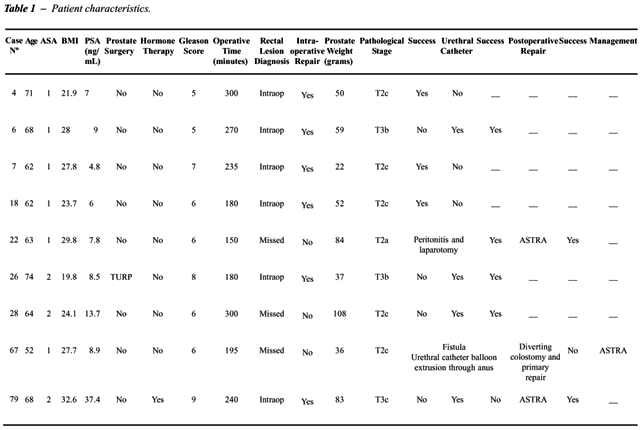
was administered in one patient. Patient characteristics are summarized
on Table-1.
The patients were given one dose of a second-generation
cephalosporin preoperatively and a fosfosoda enema was administered. Six
hours after surgery a 40 mg subcutaneous dose of enoxaparin was administered
and continued on daily basis until the patient was discharged. Mean operative
time was 228 minutes (range 150 to 300).
Digital
rectal examination is routinely performed after the prostate has been
removed and before the beginning of the anastomosis (at the beginning
of the series digital rectal examination was only done if a rectal lesion
was suspected, this practice was abandoned due to the fact that two rectal
lesions were intraoperatively missed). If a lesion on the rectal wall
is identified, repair of the defect in 2 layers is performed. The mucosa
and seromuscular layers are closed with a 2-zero monocryl running suture
with particular attention to the edges of the defect. A second layer including
the tissue over the neurovascular bundles is sutured with interrupted
2-zero monocryl sutures. The integrity of the repair is controlled by
abundantly washing the operative field with saline and introducing a 30
Fr multi-perforated rubber catheter through the rectum; then air is insufflated
while checking for bubbles in the saline filled pelvic cavity. The vesicourethral
anastomosis is performed with interrupted sutures of 2-zero monocryl.
The watertightness of the anastomosis is confirmed after placing a urethral
catheter and filling the bladder with 200cc of saline. If necessary additional
stitches are made until a watertight anastomosis is obtained. Digital
anal dilation is performed and a suction tube is left in the Retzius space.
Broad-spectrum intravenous antibiotics (1.5
g/day of metronidazole and 2 g/day of a third-generation cephalosporin)
are administered until postoperative day 5. A clear liquid diet is started
on postoperative day 1 and a regular diet is started on day 3. Average
urethral catheter removal was done on day 11.4 (range 5 to 15).
Inadvertent intraoperative rectal injuries
diagnosed in the postoperative follow up were initially managed conservatively
with urethral catheterization. Recto-urethral fistula was corrected with
the anterior transphincteric, transanal surgical approach (ASTRA).
With this transphincteric approach the patient
is placed prone in a jackknife position with the buttocks strapped apart.
A perineal incision is made extending from the scrotum to the anal verge,
deepened by incising all structures until excision of the fistula is performed.
Layers are developed on the urinary and rectal sides of the fistula, closure
of bladder is done with interrupted sutures of 2-zero polyglactin, rectal
submucosa is also closed with interrupted 2-zero polyglactin sutures,
and finally rectal mucosa is closed with a running 2-zero polyglactin
suture. The sphincter is closed with interrupted sutures; the perineal
incision is then closed. No tissue grafts are used and no suction tubes
are left. Oral liquids are started six hours after surgery and urethral
catheter is withdrawn between postoperative day 7 and 10.
RESULTS
Nine
(8%) patients were complicated by rectal injury. Six (66.6%) out of 9
injuries were diagnosed by digital rectal examination after the prostate
had been removed and the lesion was repaired intraoperatively. Three cases
(33.3%) were diagnosed postoperatively after a recto-urethral fistula
was evidenced. On these 3 cases rectal digital examination had not been
performed during surgery since no rectal injury was suspected and at the
time routine digital rectal examination was not our practice. In all of
the patients that underwent intraoperative diagnosis and repair of the
rectal defect, the integrity of the repair was controlled by rectal insufflation
of air in the saline filled pelvic cavity. In 4 patients injury occurred
during nerve sparing radical prostatectomy. Also in 4 patients surgical
preservation of bladder neck was performed. Six out of 9 injuries occurred
during dissection of the posterior surface of the prostatic apex and 3
during a wide posterolateral excision.
Three (50%) of the 6 patients with intraoperative
diagnosis and repair, healed primarily without the need of colostomy.
Recto-urinary fistula was evidenced by pneumaturia in the remaining 3
(50%). These 3 patients were managed conservatively during 30 days with
an indwelling urethral catheter. One of the patients failed conservatory
management requiring secondary repair with posterior transphincteric transrectal
sagital approach (ASTRA).
One of the 3 patients of postoperative diagnosis
was evidenced by the extrusion of the urethral catheter through the anus
on postoperative day 7. In this patient the section of the recto-urethralis
muscle was done with the LigasureTM device. A colostomy with attempt of
primary closure was done but the fistula appeared soon after. Successful
definite repair using the ASTRA technique took place a month later.
On one of the other two patients, peritonitis
was diagnosed on day 4 requiring laparotomy with abundant abdominal cavity
saline irrigation. No fistula was evident at that moment. After 2 weeks
the patient was discharged, but 15 days later he started complaining of
pneumaturia. Rectal urine leakage and a 1.5 cm recto-urinary fistula were
evident at examination. The patient underwent anterior transphincteric,
transanal fistula repair without the need of a diverting colostomy. On
the last patient urinary fistula was diagnosed postoperatively after pneumaturia
was observed. The patient was managed conservatively with 30 days of an
indwelling urethral catheter. All fistulas repaired with ASTRA evolved
uneventfully. There was no perioperative mortality.
Histology showed a median postoperative
Gleason score of 7 (range 5 to 9) and pathological stage was pT2a, pT2c,
pT3b, pT3c in 1, 5, 2 and 1 patient respectively. Mean prostate weight
was 59 g (range 22 to 108). There were 3 patients with positive surgical
margins, 2 were apical and 1 was posterolateral.
DISCUSSION
Because
radical prostatectomy is a difficult procedure, rectal laceration is always
a possible complication. In the largest series of laparoscopic radical
prostatectomy this injury has been reported to range from 1% to 2.4% (10-13).
The incidence of rectal lesion found in our series is the highest reported
(8%) in laparoscopic radical prostatectomy, still it is within the range
reported for open surgery. We believe this is because our series is a
single self-taught surgeon experience with a non-standardized technique.
Most of the lesions occurred during the first few surgeries while the
technique was under development (cases # 4, 6, 7, 18, 22, 26, 28).
Hoznek et al. reported 2 rectal injuries
among 200 procedures (1%) while Rassweiler et al. reported 3 rectal injuries
(1.6 %) and 2 delayed recto-urethral fistulas (1.1%) in 180 consecutive
laparoscopic radical prostatectomies (10). To our knowledge our series
of 110 laparoscopic extraperitoneal radical prostatectomies performed
by a single surgeon in a three year period is one of the largest published
in Latin-American literature. It is noteworthy to mention that the majority
of injuries were observed in the first fifty patients (77.8%). We believe
that routine colostomy is not needed in the absence of a septic complication.
Morbidity and costs of colostomy are well recognized.
Recent reports suggest that limited preparation
of the bowel before radical prostatectomy might allow the safe closure
of an associated rectal injury without colostomy (5,14).
No routine preoperative bowel preparation
is done and broad spectrum antibiotics are regularly administered at our
institution. We believe that if a rectal lesion is to be avoided, special
attention must be taken during key steps of laparoscopic radical prostatectomy.
In 6 patients the rectal injury occurred when the recto-urethral muscle
was sectioned from above using monopolar coagulation scissors. This is
the site where rectal lesions usually occur. In the other 3 patients the
rectal lesion occurred after dividing the most distal portion of the prostatic
pedicles with the LigasureTM device. In one of these patients the division
of the recto-urethralis muscle was also done with the LigasureTM device.
We believe that the rectal defect may have been temporarily sealed by
the device making it undetectable and allowing the protrusion of the catheter’s
balloon on postoperative day 7. To prevent rectal lesions, the apex of
the prostate should be meticulously dissected by dividing the recto-urethral
muscle from the posterolateral angle with cold scissors. Also, we consider
paramount the adequate incision of the posterior layer of Denovillier’s
fascia after the dissection of both seminal vesicles has taken place.
It is essential for the success of this procedure that the vesicourethral
anastomosis be preformed in a watertight fashion. If a rectal laceration
is done and the surgical closure is adequate, the urethral catheter must
be kept in place for no less than 10 days. Primary repair can be safely
done with no need for colostomy. Intraoperative identification of rectal
laceration must be made in order to perform primary repair and avoid diverting
colostomy. We concur with recent reports in that early postoperative care
such as antibiotic therapy, low fiber diet and anal dilation may help
the healing of a rectal injury (15-17).
However, primary repair can fail and a recto-urinary
fistula may develop. Minimally invasive perineal approaches can be used
such as ASTRA, which allows fistula resection and adequate closure (18,19).
This approach was first described by Gecelter (18) in 1973 and reproduced
at our institution only changing the forced lithotomy position for a jack-knife
position (20).
However, like many authors we believe that
the best treatment of fistula is injury prevention with careful dissection
of the posterior prostatic planes.
In our current experience of over 300 extraperitoneal
laparoscopic radical prostatectomies, no rectal lesion has occurred in
the last 150 cases. This can be explained by the systematization of the
technique and the acquired expertise of the surgeons who performed it.
CONCLUSIONS
Rectal injury during laparoscopic extraperitoneal radical prostatectomy is a dreaded complication. It can be managed intraoperatively or by a minimally invasive procedure without the need of colostomy. Early diagnose and rectal wall closure in two layers is essential for successful repair. The best treatment of fistula is injury prevention with careful dissection of the posterior prostatic planes. Because laparoscopic radical prostatectomy is a challenging procedure and is associated with a very flat learning curve, the incidence of rectal injuries is prone to diminish with experience.
CONFLICT OF INTEREST
None declared.
REFERENCES
- Schuessler WW, Kavoussi LR, Clayman RV, Vancaille T: Laparoscopic radical prostatectomy: initial case report. J Urol. 1992; 147: 246A.
- Schuessler WW, Schulam PG, Clayman RV, Kavoussi LR: Laparoscopic radical prostatectomy: initial short-term experience. Urology. 1997; 50: 854-7.
- Bollens R, Vanden Bossche M, Roumeguere T, Damoun A, Ekane S, et al.: Extraperitoneal laparoscopic radical prostatectomy. Results after 50 cases. Eur Urol. 2001; 40: 65-9.
- Harpster LE, Rommel FM, Sieber PR, Breslin JA, Agusta VE, Huffnagle HW, et al.: The incidence and management of rectal injury associated with radical prostatectomy in a community based urology practice. J Urol. 1995; 154: 1435-8.
- Katz R, Borkowski T, Hoznek A, Salomon L, de la Taille A, Abbou CC: Operative management of rectal injuries during laparoscopic radical prostatectomy. Urology. 2003; 62: 310-3.
- McLaren RH, Barrett DM, Zincke H: Rectal injury occurring at radical retropubic prostatectomy for prostate cancer: etiology and treatment. Urology. 1993; 42: 401-5.
- Leandri P, Rossignol G, Gautier JR, Ramon J: Radical retropubic prostatectomy: morbidity and quality of life. Experience with 620 consecutive cases. J Urol. 1992; 147: 883-7.
- Igel TC, Barrett DM, Segura JW, Benson RC Jr, Rife CC: Perioperative and postoperative complications from bilateral pelvic lymphadenectomy and radical retropubic prostatectomy. J Urol. 1987; 137: 1189-91.
- Borland RN, Walsh PC: The management of rectal injury during radical retropubic prostatectomy. J Urol. 1992; 147: 905-7.
- Hoznek A, Salomon L, Olsson LE, Antiphon P, Saint F, Cicco A, et al.: Laparoscopic radical prostatectomy. The Creteil experience. Eur Urol. 2001; 40: 38-45.
- Rassweiler J, Sentker L, Seemann O, Hatzinger M, Stock C, Frede T: Heilbronn laparoscopic radical prostatectomy. Technique and results after 100 cases. Eur Urol. 2001; 40: 54-64.
- Turk I, Deger S, Winkelmann B, Schonberger B, Loening SA: Laparoscopic radical prostatectomy. Technical aspects and experience with 125 cases. Eur Urol. 2001; 40: 46-52; discussion 53.
- Elder JS, Gibbons RP, Correa RJ Jr, Brannen GE: Morbidity of radical perineal prostatectomy following transurethral resection of the prostate. J Urol. 1984; 132: 55-7.
- Guillonneau B, Gupta R, El Fettouh H, Cathelineau X, Baumert H, Vallancien G: Laparoscopic [correction of laproscopic] management of rectal injury during laparoscopic [correction of laproscopic] radical prostatectomy. J Urol. 2003; 169: 1694-6.
- Renschler TD, Middleton RG: 30 years of experience with York-Mason repair of recto-urinary fistulas. J Urol. 2003; 170: 1222-5; discussion 1225.
- Venable DD: Modification of the anterior perineal transanorectal approach for complicated prostatic urethrorectal fistula repair. J Urol. 1989; 142: 381-4.
- Noldus J, Fernandez S, Huland H: Rectourinary fistula repair using the Latzko technique. J Urol. 1999; 161: 1518-20.
- Gecelter L: Anterior transanorectal approach for posterior urethral strictures. S Afr J Surg. 1972; 10: 189-93.
- Culkin DJ, Ramsey CE: Urethrorectal fistula: transanal, transsphincteric approach with locally based pedicle interposition flaps. J Urol. 2003; 169: 2181-3.
- Castillo, O., Bodden, M., Vitagliano, G., Gomez, R.: Anterior transanal, transsphincteric sagital approach for fistula repair secondary to laparoscopic radical prostatectomy: a simple and effective technique (Submitted).
____________________
Accepted after revision:
April 10, 2006
_______________________
Correspondence address:
Dr. Octavio Castillo
Av. Santa Maria 500
Providencia, Santiago, Chile
E-mail: octaviocastillo@vtr.net