ECONOMICAL
IMPACT OF ORCHIECTOMY FOR ADVANCED PROSTATE CANCER
(
Download pdf )
ADRIANO A. P. DE PAULA, HILTON R. S. PICCELLI, NILSON P. PINTO, ANTONIO G. TELES, ANTONIO G. FRANQUEIRO, ADRIANO R. L. MALTEZ, JOSE H. SILVA
Section of Oncological Urology, Araujo Jorge Hospital, Association Against Cancer of Goias (ACCG), Goiania, Góias, Brazil
ABSTRACT
Purpose:
To demonstrate the economical impact of surgical castration in comparison
to the medical castration for patients with advanced prostate cancer.
Material and Methods: Between January 2001
and December 2001, 32 patients with advanced prostate cancer underwent
bilateral sub-capsular orchiectomy at our Hospital. The costs of this
procedure were compared to the costs of medical castration with LH-RH
analogues.
Results: The costs of the surgical procedure
were extremely reduced when compared to published data on the medical
treatment. Surgical castration did not have any stronger negative impact
on the evolution of these patients when compared to medical castration.
Conclusion: Surgical castration is an efficient
and low cost treatment for advanced prostate cancer.
Key
words: prostate; prostatic neoplasms; castration; therapy; costs
and cost analysis; androgen antagonists
Int Braz J Urol. 2003; 29: 127-32
INTRODUCTION
Most
prostate cancers are hormone-dependent; this means that they need testosterone
for disease progression. Ninety percent of testosterone is produced by
Leydig cells of the testis, whereas adrenal glands account for 5% of this
production. Survival after treatment can reach 10 to 15 years as shown
by Johansson & Ljunggren (1981).
The simplest way to get a hormonal blockade
is bilateral orchiectomy, a procedure described by Huggins & Hodges
(1). Riba (1942) modified the original technique to avoid an empty scrotum
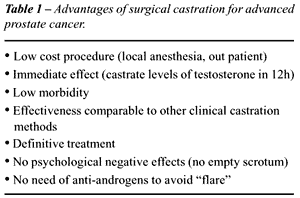
and described the subcapsular bilateral orchiectomy. The advantages of
this technique are shown in Table-1.
The most popular treatment to reach hormonal
blockade is the use of LH-RH analogues. The greatest problem of this modality
of treatment is its high cost, especially if there is an expectation of
extended survival, as is currently observed in the literature. Other disadvantages
are shown in Table 2 (2).

Hormonal blockade can also be achieved by
using estrogens, steroidal anti-androgens and non-steroidal anti-androgens,
but none of these methods is more effective or has fewer side effects
than surgical castration (3,4). Not even maximal blockade has shown better
results when compared to orchiectomy alone or to the single use of LH-RH
analogues (only 3 out of 27 randomized trials showed the benefits of maximal
blockade) (5,6).
Great savings can be achieved when LH-RH
analogues are replaced by bilateral orchiectomy, even when the latter
is adopted after hormone refractory disease.
MATERIALS AND METHODS
Thirty-two
patients with advanced prostate cancer underwent bilateral orchiectomy
at our Hospital during the year of 2001, and their clinical and biochemical
evolution, as well as the costs of the treatment, were analyzed.
All patients had T3, T4 or any T adenocarcinoma
of the prostate with bone metastasis.
Bilateral orchiectomy was indicated to these
patients, in view of the need for continuous treatment. It was adopted
as primary procedure or as replacement of another hormonal blockade. All
patients were informed on the details of the surgical procedure, its risks
and its possible complications.
The operation was performed under local
anesthesia and sedation, and there were no in-patients. The mean time
of the procedure was 17 minutes, and 100 mg i.v. of cetoprofen and 1g
i.v. cefazolin were routinely administrated.
Data on patients and their biochemical evolution
are shown in Table-3. The mean age of the patients was 73.81, ranging
from 59 to 93. Eighteen patients had a Gleason score of up to 6, and 5
presented figures above 7.
The “Unified Health System”, which comprises public health-care
in Brazil, covered the costs of all patients.

RESULTS
None
of the patients stayed in hospital for more than 12 hours on the day of
surgery.
The median follow up was of 11.43 months.
Eight patients had taken anti-androgens
before the procedure. In this work only 4 patients required anti-androgens
after surgery to control rising PSA, whereas the PSA levels of 27 of them
decreased after the intervention. The lowest nadir obtained was 0.08 ng/mL.
Four patients showed no PSA decrease 30
days after orchiectomy, but 3 of them had already been diagnosed for hormone
refractory disease.
Two patients died of prostate cancer, respectively
5 and 9 months after surgery (at their first presentation, the former
patient had a PSA level of 890 ng/mL and the latter had already been restricted
to bed due to bone metastasis at lumbar spine).
No patient required any medication other
than cetoprofen and paracetamol to control surgical pain.
Three patients presented scrotal hematoma
and were treated with antibiotics and local care.
No psychological complaints were referred
to the surgery.
DISCUSSION
The
amount paid by the Brazilian public health care for each bilateral orchiectomy
was US$ 43. The cost of surgical castration varies depending on the country
where it is performed and considering different kinds of social security
systems.
In the present context, a single dose of
LH-RH analogue costs 1.6 times more when compared to the surgical procedure.
Considering the median follow up of 11.41 months and the fact that those
30 patients remained alive at the end of this work, we can estimate a
total cost of US$ 33,387.63 with LH-RH analogues.
The subcapsular technique bypasses the need
for prosthesis thus contributing to a lower cost when compared to total
orchiectomy. Chapman reported no difference on testosterone and LH values
when comparing subcapsular to total orchiectomy (7). Hering et al. also
showed no statistical difference between total and subcapsular orchiectomy,
nevertheless, related 43% of psychological side effects in the subcapsular
group (8).
Side effects like mastalgy, gastric symptoms
and higher risk of deep vein thrombosis were not seen in our work, but
they are reported when estrogens or anti-androgens are used (3,4).
Public health entities can reap significant
savings when castration is taken as a treatment for advanced prostate
cancer. Depending on the country, a single dose of LH-RH analogue can
be more expensive than bilateral orchiectomy.
This paper clearly shows that surgical castration,
at our institution, is an efficient, inexpensive, simple and low psychological
effect modality of treatment for advanced prostate cancer. In addition,
the quality of life of patients submitted to orchiectomy was good, as
has already been shown by several papers (11). This work shows that, if
well informed, patients with advanced prostate cancer accept bilateral
orchiectomy well.
Better results in relation to nadir could
have been achieved with a longer follow up, but this is not the aim of
the present work (10).
There will always be indication for other
hormone blockade modalities (mainly LH-RH analogues) in situations such
as intermittent treatment, radiotherapy adjuvant or concomitant treatment
or even in cases in which the patient does not accept surgical castration
(9).
Mariani & Glover suggested that the
savings brought about by the substitution of LH-RH analogues for surgical
castration should be channeled to research of new prostate cancer treatment
modalities (12).
CONCLUSIONS
This
work shows that bilateral subcapsular orchiectomy is a low cost, efficient
modality of treatment for advanced prostate cancer at our institution.
Its acceptance is quite good and its psychological effects are almost
inexistent.
We suggest the urologist who deals with
prostate cancer to consider the economical impact when offering the different
ways to treat advanced prostate cancer, or, at least, to propose surgical
castration when the diagnosis of hormone refractory disease is made.
REFERENCES
- Huggins C, Hodges CV: Studies on prostatic cancer: the effect of castration of estrogen and of androgen injection on serum phosphatases in metastatic carcinoma of the prostate. Cancer Res. 1941; 1: 293-7.
- Stricker HJ: Luteinizing hormone-releasing hormone antagonists in prostate cancer. Urology 2001; 58: 24-7.
- Kolvenbag GJ, Iversen P: Anti-androgen monotherapy: a new form of treatment for patients with prostate cancer. Urology 2001; 58: 16-23.
- Malkowics SB: The role of Diethylstilbestrol in the treatment of prostate cancer. Urology 2001; 58: 108-13.
- Collette L, Studer UE: Why phase III trials of maximal androgen blockade versus castration in M1 prostate cancer rarely shows statistically significant differences. Prostate 2001; 48: 29-39.
- Schmitt B, Witt TJ: Combined androgen blockade with non-steroidal Anti-androgens for advanced prostate cancer: a systematic review. Urology 2001; 57: 727-32.
- Chapman JP: Comparison of testosterone and LH values in subcapsular vs total orchiectomy patients. Urology 1987; 30: 27-8.
- Hering FL, Dall’oglio MF, Caponero R, Rodrigues PR, Nesrallah LJ, Srougi M: Total versus subcapsular orchiectomy for treatment of advanced prostatic carcinoma: Comparison of serum testosterone and PSA levels. J Bras Urol. 1999; 25: 221-4 [in Portuguese].
- Bolla M, Gonzalez D, Warde P, Dubois JB, Mirimanoff RO, Storme G, et al.: Improved survival in patients with locally advanced prostate cancer treated with radiotherapy and goserelein. N Engl J Med. 1997; 337: 295-300.
- Benaim EA, Pace CM: Nadir prostate-specific antigen as a predictor to progression to androgen-independent prostate cancer. Urology 2002; 59: 73-8.
- Nygard R, Norum J: Goserelin (Zoladex) or orchiectomy in metastatic Prostate cancer? A quality of life and cost-effectiveness analysis. Anticancer Res. 2001; 21: 781-8.
- Mariani AJ, Glover M: Medical versus surgical androgen suppression therapy for prostate cancer: a 10-year longitudinal cost study. J Urol. 2001; 165: 104-7.
________________________
Received:
November 8, 2002
Accepted after revision: February 17, 2003
______________________
Correspondence address:
Dr. Adriano A. Peclat de Paula
Hospital Araújo Jorge - Urologia
Rua 239, 181
Goiânia, GO, 74605-070, Brazil
Fax: + 55 62 202-4040
E-mail: adrianopaula@hotmail.com
The
authors should be congratulated for the choice of their theme. They have
the merit and the courage to discuss an infrequent issue in the literature
due to obvious reactions it may induce. Although the study deals superficially
with the aspect of the effectiveness of the treatment and does not allow
us to draw conclusions about it, it is direct to the point about its central
issue: orchiectomy is much cheaper than medical castration. In fact, the
“Economical impact of orchiectomy for advanced prostate cancer”
still needs more detailed studies on the types of treatment and more reflection
on the part of urologists. If we consider how limited the resources of
our Public Health System are, it is very important to discuss and review
the amount of money that is spent on LH-RH analogues that offer the same
results and benefits as an orchiectomy.
I
reinforce the authors’ opinion, which is certainly also shared by
other urologists. Mariani, who has already been mentioned (1), explores
the topic very well. Based upon his reflections and his data, the amounts
we would spend on LH-RH analogues for just one patient of non hormone-refractory
advanced disease (in an average of 30 months) would be the following:
US$ 43 x 1.6 x 30 months. This means that each medical castration costs
4700% more than the US$ 43 that are spent on an orchiectomy. Moreover,
the medical procedure does not offer any logical benefit and shows the
same results in terms of the patient’s survival. These resources
could benefit 48 patients with the definitive surgery, without taking
into consideration those approximately 15% of the patients who possibly
would end up migrating into the surgical treatment. In other words, for
each patient treated with LH-RH analogue, we could perform an orchiectomy
in one patient and still offer the access to 47 other patients to surgeries
of the same type. In terms of public health, our leaders should consider
these issues.
A
survey held among medical doctors in the USA has indicated that 68-81%
of the American urologists recommend medical anti-androgenic therapy (2).
Another study has further demonstrated that when the patient is invited
to choose his own treatment freely after being informed of his possibilities,
70% also prefer the medical treatment. However, when 20% of the costs
of the treatment are asked for as a counterpart on the part of the patient,
only 24% choose medication (1). These figures, in addition to the fact
that both treatments offer the same results, cast some doubt over the
premise. They suggest the need for us to undertake studies about these
types of treatment and their consequences on the patient’s self-esteem,
on his physical appearance and especially on his quality of life considering
our socio-cultural and economical situation. An inadequate and unreal
resource policy is not fair and may limit the benefit to many other patients.
References
1. Mariani AJ, Glover M: Medical versus surgical androgen suppression
therapy for prostate cancer: a 10-year longitudinal cost study. J Urol.
2001; 165: 104-7.
2. Wasson JH, Fowler Jr FJ, Barry MJ: Androgen deprivation therapy for
asymptomatic advanced prostate cancer in the prostate specific antigen
era: a national survey of urologist beliefs and practices. J Urol. 1998;
159: 1993-7.
3. Iversen P, Tyrrel CJ, Kaisary AV, Anderson JB, Baert L: Casodex (bicalutamide)
150-mg monotherapy compared with castration in patients with previously
untreated nonmetastatic prostate cancer: Results from two multicenter
randomized trials at a median follow-up of 4 years. Urology 1998; 51:
389-92.
Dr. Homero Arruda
Division of Urology
Federal University of São Paulo
São Paulo, SP, Brazil
EDITORIAL COMMENT
Orchiectomy was the first efficient treatment for advanced prostate cancer since the work of Huggins & Hodges, cited in the article. It is still used, which proves its value.Many drugs have been developed to treat this disease. Each of them acts differently, but all have the same aim. However, these drugs are difficult to dose and especially their price render them inaccessible to a great part of our population, which leads our patients to abandon treatment quickly and to suffer the consequences of the disease.
Among institutional patients, we notice that even with free distribution of the drug, the rate of adherence to the treatment is not as high as desired, which usually occurs due to the socio-economical and cultural level of these patients. Another important factor to be considered are the side-effects of many of these drugs, as well as the absolute contraindication of some drugs for patients with deep vein thrombosis.
Sub-capsular orchiectomy is an excellent option for these patients, since it is a definitive treatment, has minimal side-effects and no contraindication, and it avoids psychological trauma due to an empty scrotum.
It has been questioned whether sub-capsular orchiectomy would be as efficient as total orchiectomy. However, recent studies show that beyond being equally effective, the former is more economical, since it bypasses the need for a testicular prosthesis and disagreeable psychological side-effects (1).
This article thus demonstrates that in terms of effectiveness and costs, sub-capsular orchiectomy is extremely efficient for the treatment of advanced prostate cancer, being more economical, avoiding difficulties with doses and side-effects and keeping the esthetics of the scrotum.
Reference
1. Hering FL, Dall’oglio MF, Caponero R, Rodrigues PR, Nesrallah
LJ, Srougi M: Total versus subcapsular orchiectomy for treatment of advanced
prostatic carcinoma: Comparison of serum testosterone and PSA levels.
J Bras Urol. 1999; 25: 221-4 [in Portuguese].
Dr. Flávio Hering
Division of Urology
Federal University of São Paulo
São Paulo, SP, Brazil