MODULATION
OF URETHRAL ALPHA-SYMPATHETIC BY PARASYMPATHETIC BEFORE AND FOLLOWING
BETHANECHOL CHLORIDE INJECTION
(
Download pdf )
HAYLTON J. SUAID, JEOVÁ N. ROCHA, ANTONIO C.P. MARTINS, ADAUTO J. COLOGNA, SILVIO TUCCI JUNIOR
Section of Urodynamics, Division of Urology, Department of Surgery and Anatomy, HCFMRP-USP, São Paulo, SP, Brazil
ABSTRACT
Introduction
and Objectives: Chagas’ disease causes specific parasympathetic
denervation and in its digestive clinic form promotes also functional
alterations in bladder. Thus, the aim was to investigate the existence
of balance between sympathetic and parasympathetic systems in lower urinary
tract, as occurs in other organs. We verified the urethral closing pressure
before and following parasympathetic stimulus.
Patients and Methods: For that, the urethral
closure pressure was studied before and after the injection of 5 mg of
bethanechol chloride subcutaneously in 28 voluntary female patients, divided
into 4 groups. The constitution of theses groups was: A) normal control
= 6 patients; B) Chagas’ disease with positive serology only = 5
patients; C) Chagas’ disease with cardiac disease = 6 patients,
and D) Chagas’ disease with digestive disease and vesical hyporeflexia
= 11 patients. Urethral profilometry was performed through perfusion urethral
catheter with a 6.5 ml/minute flow and a traction rate of 5 mm/minute.
Results: Means and standard deviations for
urethral closure pressure before bethanechol chloride were respectively:
group A = 67.3 ± 7.1; group B = 69.2 ± 7.4; group C = 95.8
± 5.1; group D = 82.1 ± 8.4. After bethanechol chloride
they were: group A = 66.0 ± 6.6; group B = 77.0 ± 7.6; group
C = 98.3 ± 8.8; group D = 45.9 ± 6.2. The Kruskal Wallis
statistical test did not show statistically significance difference between
groups A, B, C. However, it was statistically significant between groups
C and D with p = 0.003. Wilcoxon test showed p = 0.001, only for values
in group D before and following bethanechol chloride.
Conclusions: Chagas’ disease in its
intestinal form seems to alter urethral function as well. Parasympathetic
stimulation decreased urethral pressure, indicating potential modulation
by the parasympathetic system over the sympathetic system.
Key
words: urethra; sympathetic nervous system; parasympathetic nervous
system; bethanechol; Chagas disease
Int Braz J Urol. 2003; 29: 162-5
INTRODUCTION
Chagas’
disease, an endemic problem in Brazil, was largely studied concerning
impairment of autonomic nervous system. The symptoms are a consequence
of lesions produced in peripheral parasympathetic vegetative innervation
(1), which involves mainly heart and large bowel, and the studies are
focused on theses organs and on central nervous system.
There are few reports in literature concerning
the impairment of genitourinary system. Thus, in 250 autopsies of patients
with Chagas’ disease, 2 cases of megabladder were found (2). The
impairment of parasympathetic system neurons in inferior hypogastric ganglion
was experimentally verified in rats (3). One of the major factors of these
hypogastric ganglia is the presence of nitric oxide synthase (NOS) in
postganglionic nerves. Nitric oxide (NO) promotes the relaxation of the
smooth muscle fiber (4). Stimulation of lumbar afferent nerve roots promotes
vesical contraction and urethral relaxation. The blockage of NOS produces
inhibition of urethral relaxation (5). In relation to the bladder, anatomic
study of vesical wall in animals with megabladder did not identify structural
alterations (6). Functional study of bladder in patients with Chagas’
disease was performed recently, where a drop in detrusor’s pressure
was found with increase of abdominal pressure during voiding and increase
in voiding time (vesical contraction) (7). The association of these facts
with lesion of juxtavesical ganglion could reflect in modulation of muscles
contractions in bladder and urethra.
Justification
Considering the findings described
above that patients with Chagas’ disease, in its intestinal form,
have impairment of vesical function and present also alterations in urethral
closure pressure, it was questioned if there was or not a functional modulation
between sympathetic and parasympathetic systems in lower urinary tract.
Objective
To verify the influence of lower urinary
tract’s parasympathetic system during modulation of urethral muscles’
contraction.
PATIENTS AND METHODS
Twenty-two
female volunteers were selected, with positive serology or with Chagas’
disease in its cardiac form, or digestive form with hyporeflexive vesical
dysfunction, and other 6 volunteers considered normal, whose ages ranged
from 37 to 48.5 years. They were assigned in 6 normal women who constituted
group A (control); 5 in group B (patients with positive serology without
disease); 6 in group C (patients with Chagas’ disease and cardiopathy)
and 11 in group D (patients previously studied, with disease involving
the digestive tract and vesical hyporeflexia), all of them were asymptomatic
concerning the urinary tract.
Urethral Profile
The study was performed with a Life Tech
Inc 1154 device, where urethral profile tracings were obtained. The methodology
employed was perfusion with a continuous infusion pump and flow of 6.5
ml/minute, and catheter mechanical traction with a speed of 5 mm/minute
(8,9). With this methodology, static profiles were done for determining
closure pressures. Following, it was injected, subcutaneously in forearm,
5 mg of bethanechol chloride. After a waiting period of 30 minutes, the
static urethral profiles were repeated.
Statistical
Analysis
It was performed through Kruskal-Wallis
test for comparison between the 4 studied groups and through Wilcoxon
nonparametric test for evaluating data within the same group.
RESULTS
Results
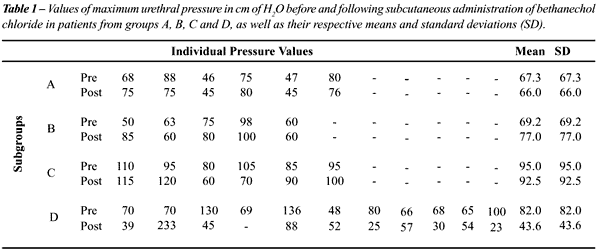
are expressed in Table-1. Before administration of bethanechol chloride
it can be observed that means and standard deviations of urethral closing
pressure values were, respectively, for group A (normal control), 67.3
± 7.1 cm of water, for group B (positive serology) were 69.2 ±
7.4 cm of water, for group C (cardiac form) were 95.8 ± 5.1 cm
of water, and for group D (digestive form) were 82.0 ± 8,4 cm of
water. Means and standard deviations of urethral closing pressure following
parassympathomimetic injection were respectively: for group A = 66.0 ±
6.6 cm of water, for group B = 77.0 ± 7.6 cm of water, for group
C = 98.3 ± 8.8 cm of water, and for group D = 45.9 ± 6.2
cm of water. Kruskal-Wallis test comparing the averages and standard deviations
of urethral closing pressure before bethanechol chloride for groups A,
B, C and D revealed p > 0.05, whose interpretation shows that there
is not a significance level. The same test after bethanechol chloride,
comparing the averages and standard deviations through Wilcoxon test between
groups A, B and C also showed p > 0.05 and, thus, was not significant.
Comparison of data of group D through Wilcoxon test showed a value of
p = 0.003, considered very significant.
DISCUSSION
Maximum
urethral closure pressure in patients with Chagas’ disease in its
cardiac and digestive forms showed to be higher than in control patients,
though a significance level on Kruskal-Wallis statistical test did not
occur. This fact conforms to previous descriptions that the urethral closure
pressure in patients with Chagas’ disease with digestive and vesical
impairment was significantly increased (5). The fact that it was not significant
in this study may be related to the lower number of patients. However,
it is difficult to state that this fact is due uniquely to one factor,
including here factors inherent to the methodology employed. Maximum urethral
closure pressure following bethanechol chloride did not present significant
alterations between groups A, B and C, being in accordance to the drug’s
action which is parasympathomimetic, when in the urethra there is a predominance
of alpha-sympathetic receptors. In the other hand, after bethanechol chloride
injection the maximum urethral closure pressure in group D showed a significant
drop, when a comparison with pressure values in this group before drug
injection is made by the Wilcoxon test. The urethral contraction depends
on adrenergic stimulation of alpha-1 receptors. Its relaxation is related
to muscarinic receptors. Intrathecal or intraventricular injection of
atropine sulfate or atropine methonitrate inhibit relaxation of urethral
muscle during the voiding phase through stimulation of pelvic nerve. This
fact suggests that stimulation of central muscarinic receptors promotes
urethral relaxation during voiding (10). Muscarinic receptors in urethra
also present inhibition of muscular contraction. Parasympathetic stimulation
causes release of nitric oxide, produced by NO synthase (NOS) in cholinergic
nerves, which promotes muscular relaxation in urethra (11). NOS blockage
produces inhibition of urethral relaxation (6). Thus, destruction of parasympathetic
system neurons, related to the lower urinary tract (3), caused by Chagas’
disease, may lead to decreased release of NO, through reduction of cholinergic
stimulus of muscarinic receptors at the urethral level, facilitating contraction.
Bethanechol chloride produces cholinergic stimulus when injected subcutaneously.
In patients with Chagas’ disease with vesical hyporeflexia, a decrease
in vesical capacity and in detrusor’s contraction time was verified
following injection of 5 mg, indicating parasympathomimetic activity.
In the same way, the stimulation of muscarinic receptors in the urethra
could promote release of NO and consequently cause relaxation of the sphincter.
This finding may suggest that the reduction
of the neuropharmacological agent by parasympathetic denervation, which
occurs in this disease, can exacerbate the action of the other neuromediator
(alpha-sympathetic), as occurs in other organs, consequently raising the
maximum urethral closure pressure. Thus, the bethanechol chloride injection,
by stimulating muscarinic receptors, has promoted a decrease in maximum
urethral closure pressure.
In this way, normally there would be a balance
between sympathetic and parasympathetic functions in lower urinary tract
and the specific parasympathetic lesion has caused an imbalance. This
hypothesis formulated like this in relation to human beings cannot be
found in literature, perhaps because there was not an experimental model
which promoted a parasympathetic denervation as selective as that which
occurs in Chagas’ disease.
CONCLUSIONS
Chagas’ disease in its intestinal form seems to alter urethral function as well. Parasympathetic stimulation acted so to decreased urethral pressure, indicating potential modulation by parasympathetic system over sympathetic system.
REFERENCES
- Koberle F: Pathogenesis of Chagas disease. VER. Goiânia Méd. 1957; 3: 155 [in Portuguese].
- Koberle F: Pathogenesis of Brazilian and European Megaesophagus. Thesis. Medical School of Ribeirão Preto, State University of São Paulo (USP), 1962 [in Poruguese].
- Ciconelli AJ: Quantitative Analysis of the Neurons from the Lower Hipogastric Plexus in Normal and Experimental Infected Rats. Thesis. Medical School of Ribeirão Preto, State University of São Paulo (USP), 1963 [in Poruguese].
- Vizzard MA, Erdman SL, Forsterman U, de Groat WC: Differential distribution of nitric oxide syntase in neural pathways to the urogenital organs (urethra, pênis, urinary bladder) of the rat. Brain Res. 1994; 646: 279-91.
- Fraser MO, Flood HD, de Groat WC: Urethral smooth muscle relaxation is mediated by nitric oxide (NO) released from parasympathetic postglanglionic neurons. J Urol. 1995; 153: 461A.
- Okomura M, Correa Neto A: Pathogenesis of Chagas disease. VER. Goiânia Méd. 1982; 28: 77 [in Portuguese].
- Rocha JN, Suaid HJ, Martins ACP, Cologna AJ, Tucci Jr S: Urodynamic evaluation of patients with Chagas disease. Acta Cir Bras. 2001; 16 (Sup 1): 7-8 [in Portuguese].
- Brown M, Wickham JEA: The urethral pressure profile. Br J Urol. 1969; 41: 211.
- Lowe PJ, Saunders GBA, Downie JW, Awad SA: Catheter withdrawing apparatus for clinical urethral pressure profile studies. J Urol. 1976; 116: 626.
- Masuda H, TsujiiT, Azuma H, Oshima H: Role of a central muscarinic cholinergic pathway for relaxation of the proximal urethra during the voiding phase in rats. J Urol. 2001; 165: 999-1003.
- Anderson KE: Neurotransmission and drug effects in urethral smooth muscle. Scand J Urol Nephrol. (Suppl) 2001; 207: 26-34.
_______________________
Received: October 18, 2002
Accepted after revision: February 17, 2003
_______________________
Correspondence
address:
Dr. Haylton Jorge Suaid
Hospital das Clínicas, FMRP
Departamento de Cirurgia e Anatomia
Sala 934, 9o andar
Ribeirão Preto, SP, 14048-900, Brasil
Fax: + 55 15 633-0836