EFFECT
OF SHOCK WAVE REAPPLICATION ON URINARY N-ACETYL-BETA-GLUCOSAMINIDASE IN
CANINE KIDNEY
(
Download pdf )
MARCO A.Q.R. FORTES, ADAGMAR ANDRIOLO, VALDEMAR ORTIZ, MIGUEL SROUGI
Division of Urology, Paulista School of Medicine, Federal University of São Paulo, UNIFESP, São Paulo, SP, Brazil
ABSTRACT
Objective:
Renal tubular damage can be assessed with the aid of urinary dosing of
N-acetyl-beta-glucosaminidase (NAG) and it is possible to demonstrate
a significant correlation between shock wave and damage to renal parenchyma.
The objective of this study was to assess the effect of shock wave reapplication
over urinary NAG in canine kidney.
Materials and Methods: The authors submitted
10 crossbred dogs to 2 applications of 2000 shock waves in a 24-hour interval
in order to assess urinary NAG values after 12, 24, 36 and 48 hours.
Results: Twelve hours following the first
shockwave application there was an increase in NAG of 6.47 ± 5.44
u/g creatinine (p < 0.05). Twelve hours and 24 h following the second
application there was no increase in the urinary enzyme, - 2.56 ±
- 7.36 u/g creatinine and 2.89 ± - 7.27 u/g creatinine, respectively
(p > 0.05).
Conclusion: Shock wave reapplication with
a 24-hour interval did not cause any increase in urinary NAG.
Key
words: kidney; lithotripsy; high-energy shock waves; acetylglucosaminidase;
dogs
Int Braz J Urol. 2004; 30: 148-154
INTRODUCTION
The
first non-invasive method for treating patients with urinary tract lithiasis
was introduced by Chaussy in 1980 at the Department of Urology of Munich
University (1). Using electrically generated shock waves to fragment stones
inside the kidney without any incision, puncture or endoscopic invasion,
this first experiment started the extracorporeal shock wave lithotripsy
(ESWL) era. Due to its efficacy and safety, ESWL became the method of
choice for treating renal stone either as monotherapy or combined with
other forms of lithotripsy.
Whatever the generating source is, shock
waves can be released in a gradual intensity scale that usually ranges
from 14 to 20 KV reaching the target in an area known as focal point,
whose diameter varies according to the equipment’s specificity.
The safest equipments are those capable
of fragmenting the stone using low power in the smallest focal area possible
in order to avoid damage to the adjacent renal parenchyma. Though the
shock wave is focused on the stone, renal tissue is subjected to trauma
as well and, therefore, morphologic and functional changes can occur in
this area (2).
The effects of shock waves on the renal
parenchyma were studied through imaging scans, histopathological tests
and dosage of plasmatic and urinary renal function markers (3-5). Studies
using urinary enzymes such as N-acetyl-beta-glucosaminidase (NAG), beta-galactosidase,
gamma-glutamyl-transferase and high molecular weight proteins such as
macroglobulins and calbidin d28K assessed renal trauma resulting from
shock waves because they are proteins that, under normal conditions, are
not filtered by the glomerulus. Following local trauma, they reach the
collecting system and can be dosed in urine (6,7). On the other hand,
after 2 to 3 days, these markers return to their normal levels indicating
that the produced alterations could be transitory and the renal tissue
would rapidly recover (8-11).
Thus, due to the prompt recovery from the
initial renal trauma, a new lithotripsy session could be performed within
a short period interval if the patient required retreatment. However,
there is no consensus about which would be the time interval required
for retreatment following the first lithotripsy session, with some centers
waiting for 3 days, others for one week and others up to one month to
repeat lithotripsy (6,12,13).
The intense use of ESWL currently, the lack
of knowledge about acute lesions caused by re-treatment within a short
time interval and the empirical way by which treatment is conducted, stimulated
the development of an experimental model aimed to clarify important doubts
in this field of medical knowledge as well as to generate subsidies for
new research.
This objective of this work was to assess
the effect of shock waves reapplication on urinary N-acetyl-beta-glucosaminidase
(NAG) in canine kidney.
MATERIALS AND METHODS
We used 10 animals that underwent 2 applications of shock waves on the right kidney, with a 24-hour interval between them, and 5 urine collections for determining NAG, according to the study design.
Study Design

All animals were kept isolated and free
from food during 12 hours previously to the session of shock wave application,
however they had free access to water.
General anesthesia was induced with intravenous
thionembutal (25 mg/Kg) and maintained with inhalatory pentrane 2% though
endotracheal tube until the end of the session.
A Siemens lithotriptor, model Lithostar
Plus Multiline® was used in the experiment. Shock waves are generated
by electromagnetic discharges, when the tension peak is induced by fast
movements of a membrane under liquid medium. The generator produces a
tension ranging from 200 to 300 bar. The tension used is chosen according
to the variation of the employed voltage, from 13 to 20 KV in intensity.
The tension waves propagate through interfaces result in an elliptical-shaped
focus, measuring about 11 x 9 millimeters. The focus system to be used
is obtained by means of acoustic lens and the contact with the animal’s
skin through a bag containing water and gel.
Previously to the shock wave application,
but with the animal already anesthetized, an urine sample was collected
in order to perform sedimentoscopy and dosages of creatinine and NAG.
Such collection was performed by aseptic supra-pubic puncture. Similarly,
urine samples were collected 12 hours after each session and 24 hours
after the second session, in the kennel, with the animal under restraint,
but without anesthesia.
Thus, during the experiment, 5 urine samples
were collected from each animal: 1) The first sample immediately before
the first shockwave application (T0); 2) The second sample,
in the kennel, 12 hours after the first application (T12);
3) The third sample 24 hours after the first application and immediately
before the second one (T24); 4) The fourth sample 36 hours
after the first application and 12 hours after the second one (T36);
5) The fifth sample 48 hours after the first application and 24 hours
after the second one (T48).
After the first urine collection, tricotomy
was performed at the abdominal and lumbar regions, in the contact area
between the animal and the water and gel bubble of the shock wave-generating
apparatus. The animals were placed over the bubble, in right lateral decubitus,
and under fluoroscopic guidance, positioned in such a way they would receive
the impact of shock waves always on the lower pole of the right kidney.
Then, the animals had their paws fixed to the apparatus’ table with
gauze and 2 crepe tapes were passed, one over the thorax and the other
over the lower abdomen in order to prevent its displacement during the
procedure.
For fluoroscopic guidance, an intravenous
injection of iodinated contrast medium (sodium and meglumine amidotrizoate)
was performed at a dosage of 1 mg/Kg of weight. The injection of contrast
medium, in addition to allowing the assessment of the animal’s entire
urinary tract, guided the focusing of the lower pole of the right kidney,
site where the shock wave applications were made.
Every 10 minutes, during the procedure,
another dose of contrast medium was injected in order to confirm that
there was no change in the focal point due to the animal’s movement.
On each application, the animals received
2000 shock wave impulses of 18 KV, at a frequency of 100 impulses per
minute, during approximately 20 minutes. Upon completing the applications,
the animal was taken for the kennel’s isolation area, receiving
water and proper ration once it was completely recovered from anesthesia.
A part of each collected urine sample was
immediately submitted to the laboratory for performing sedimentoscopy.
Another part of the urine was stored at - 4ºC until submission, after
a maximum of 30 days, for the laboratory as well, for dosing NAG and creatinine.
In this test, the Na-3-cresolsulphonphthaleinyl-N-acetyl-B-D-glucosaminide
is hydrolyzed by NAG, releasing 3-cresolsulphonphthalein and sodium salt
(3-cresol red), which are photometrically measured at 580 nm. The result
for NAG is expressed in u/l. Urinary creatinine is dosed and the result
is expressed in g/l.
The statistical analysis was performed using
the Wilcoxon test due to the paired structure of data in order to compare
the variation of NAG values (u/g), which corresponds to the dosage of
NAG per gram of creatinine. The significance level was fixed at 0.05 or
5%.
RESULTS
No
change was found in the urine examinations collected before the first
shock wave application. All other urine samples collected after the applications
presented numberless red cells on sedimentoscopy.
The results from NAG dosages in relation
to creatinine and expressed in NAG u/g are listed in Table-1.

There was a significant increase in NAG
(u/g of creatinine) 12 hours after the first shock wave application (p
< 0.05) (Table-2). After 24 hours such increase was still observed,
but it was not regarded as significant (p > 0.05) (Table-2).
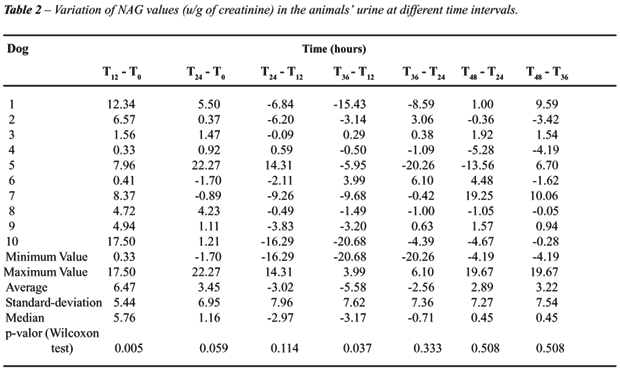
The third assessment performed 12 hours
after the second shock wave application and 36 hours after the first one
did not evidence a significant increase in this enzyme (p > 0.05) (Table-2),
similarly to the assessment performed 24 hours after the second application
and 48 hours after the first one (> 0.05) (Table-2).
DISCUSSION
The
choice of the animal was based in objections made by several authors regarding
the discrepancy between the size of the shock wave focus and the kidney
size (5,6,14). Studies conducted in small animals such as rats, for example,
would have a proportionally larger area of the renal parenchyma that is
affected by the shock wave when compared to humans. The area affected
by the shock wave in the kidney, referred as focal point, was 11 x 9 mm
with the lithotriptor employed, corresponding to approximately 10% of
the renal tissue exposed in human kidneys, approximately 25% in dogs and
almost the entire parenchyma in rats. The choice of the number of impulses
to be applied was based in previous studies, which concluded that the
use of a high number of shock waves is not necessary in order to assess
their effects over several tissues (4).
Urine samples were collected by direct supra-pubic
puncture in order to avoid contamination of the samples. The option of
dosing urinary NAG for assessment of damages caused to the renal parenchyma
was because this enzyme is a specific marker for any aggression to the
renal parenchyma (5,8,15). Urinary enzymes are considered sensitive markers
of renal damage and therefore are more reliable than conventional methods
used for investigating renal function. The increase in urinary levels
of this enzyme immediately following an aggression to the kidney, in this
case by ESWL, and its return to normal levels in a short period makes
this enzyme the ideal marker for acute experiments in kidney (16).
The hematuria found in all post-ESWL urine
samples reflects the occurrence of renal lesion in an acute form. In this
study, hematuria can be explained only by direct tissular action of shock
waves, since it was not present previously. It was not possible to conclude
if the hematuria was more intense following the first or the second lithotripsy
session.
Some clinical assessments did not evidence
a significant increase in NAG in patients submitted to lithotripsy (17,18).
The majority of clinical studies, however, confirmed such increase (6,8,9,19-22).
Experimental studies in rabbits, dogs and rats confirmed such increase
as well (13,23,24).
Some factors can produce these contradictory
results including the sample size, different equipments with different
energy principles, number of impulses and focus size, patients’
clinical condition (hydration, urinary obstruction and infection), age
and gender, location and number of stones, in addition to conditions of
urine storage, moment of collection, sensitivity of the dosing method,
expression of results and statistical analysis.
Some experimental studies and clinical assessments
confirmed the increase in NAG immediately following the shockwave application;
most often this increase was detected after 12 hours. However, in some
studies, the levels of this enzyme returned to their normal values after
24 hours (20,21).
For this reason we conducted our study performing
the first dosage 12 hours after each lithotripsy session, with a significant
increase in this enzyme being observed following this period. On the other
hand, 24 hours after the first session there was a marked decrease in
the release of NAG in the urine enough to make this difference statistically
non-significant.
The loss of this lysosomal enzyme immediately
following ESWL suggests the presence of corresponding morphologic alterations
in the renal tubular system, and the intensity of urinary elimination
of the enzyme reflects the severity of the tubular damage (5). Since NAG
is an enzyme with high molecular weight (> 70,000) it is not filtered
by the glomerulus under normal conditions, but when any acute renal damage
occurs it reaches the renal tubule’s lumen and finally the urine.
The normalization of urinary NAG dosage
would mean then the end of acute destruction of tubular cells, but it
does not enable us to tell anything about the extension or the disappearance
of residual damage to the renal parenchyma.
The behavior of NAG, increasing immediately
after the lithotripsy session and decreasing within 1 week was observed
in clinical studies and in one experimental study in rats, suggesting
that shock waves can cause some acute renal damage that resolves quickly
(7,21,23).
In our study only the dosage performed 12
hours after the first shockwave application evidenced a significant increase
in NAG. We could expect, also, a new increase in this enzyme 12 hours
after the second session, but it did not happen. Not even after 24 hours
there was a significant increase in NAG.
Since the release of this enzyme occurs
due to the tubular rupture caused by the shock waves and to compression
by intra-renal hematomas, it is possible that this phenomenon does not
occur with the same intensity following the second lithotripsy session.
Since the application area is the same, a second application would not
cause, according to our view, increased edema or increased vascular rupture,
which would be reflected through an increase in this enzyme.
Confirming this reasoning, other studies
did not find also major histological changes, after 2 weeks, in animals
undergoing 2 shock wave applications in a 48-hour interval compared with
those undergoing only 1 session (25). Thus in another study using high
molecular weight markers, among them NAG, considered the shockwave application
safe after a 5-day interval (22). In one experimental study with rats
it was concluded that shock wave reapplication after 14 days does not
increase the alterations in renal morphology caused by the first application
(26).
We know that the tubular damage can be quantified.
With the aid of urinary NAG dosing it is possible to demonstrate a significant
correlation between shock waves and damage to the renal parenchyma. In
our study this tubular damage occurred following the first application
and remained stable after the second one, performed just 24 hours later.
It is true that many patients submitted
to ESWL require a second treatment, but which must be the time period
until this reapplication? Our study, though performed in dogs, suggests
that any damage produced to the renal parenchyma could be resolved, from
a functional point of view, within 24 hours, and the second treatment
could occur, thus, only one day later.
Some lithotripsy centers do not perform
the second shockwave application shortly after the first one based on
the justification that it is necessary to wait for the fragments elimination
in order to subsequently decide for another session. If we consider potential
complications such as obstruction by stones (steinstrasse), infection
and pain, the best option would be to perform the second session as soon
as possible so that lower sized fragments would have better chances of
being eliminated.
CONCLUSION
We concluded that, under the conditions in the present study, high-energy shock waves, when applied to canine kidney produced an increase in urinary NAG 12 hours later, with normalization after 24 hours and when reapplied after 24 hours they did not cause a rise in urinary NAG after 36 and 48 hours.
REFERENCES
- Chaussy CG, Brendel W, Schmiedt E: Extracorporeal induced destruction of kidney stones by shock waves. Lancet.1980; 13: 1265-8.
- Claro JFA: Shock Wave Efects on Renal Growth and Function – Experimental Studies in Rats. Doctoral Thesis, State University of Campinas, 1994.
- Delius M, Enders G, Xuan Z, Liebich H, Brendel W: Biological effects of shock waves: kidney damage by shock waves in dogs - dose dependence. Ultr Med Biol. 1988; 14: 117-22.
- Lottmann HB, Archambaud F, Hellal B, Pageyral M, Cendron M: Technetium-dimercapto-succinic acid renal scan in the evaluation of potential long-term renal parenchymal damage associated with extracorporeal shock wave lithotripsy in children. J Urol. 1998; 159: 521-4.
- Weichert-Jacobsen K, Stockle M, Loch T, Bruske T: Urinary Leakage of tubular enzymes after shock wave lithotripsy. Eur Urol. 1998; 33:104-10.
- Recker F, Hofmann W, Bex A, Tscholl R: Quantitative determination of urinary marker proteins: a model to detect intrarenal bioeffects after extracorporeal lithotripsy. J Urol. 1992; 148: 1000-6.
- Erkizan O, Ayder AR, Minareci S, Lekili M, Dincel C: NAG, GGT, creatinine, urea and creatinine clearance before and after ESWL. Int Urol Neprol. 1994; 26: 259-62.
- Assimos DG, Boyce HW, Furr EG, Espeland MA, Holmes RP, Harrison LH, et al.: Selective elevation of urinary enzyme levels after extracorporeal shock wave lithotripsy. J Urol. 1989; 142: 687-90.
- Karlsen SJ, Berg J: Acute changes in kidney function following extracorporeal shock wave lithotripsy for renal stones. Br J Urol. 1991; 67: 241-5.
- Karlin GS, Schulsinger D, Urivetsky M, Smith AD: Absence of persisting parenchymal damage after extracorporeal shock wave lithotripsy as judged by excretion of renal tubular enzymes. J Urol. 1990; 144: 13-4.
- Kirkali Z, Kirkali G, Tahiri Y: The effect of extracorporeal electromagnetic shock waves on renal proximal tubular function. Int Urol Nephrol. 1994; 26: 255-7.
- Drach GW, Dretler S, Fair W, Finlayson B, Gillenwater J, Griffith D, et al.: Report of the United States cooperative study of extracorporeal shock wave lithotripsy. J Urol. 1986; 135: 1127-33.
- Morris JS, Husmann W, Wilson T, Preminger GM: Temporal effects of shock wave lithotripsy. J Urol. 1991; 145: 881-3.
- Neisius D, Seitz G, Gebhardt T, Ziegler M: Dose-dependent influence on canine renal morphology after application of extracorporeal shock waves with Wolf Piezolith. J Endourol. 1989; 3: 337-45.
- Raab WP: Diagnostic value of urinary enzyme determinations. Clin Chem. 1972; 18: 5-25.
- Sakkas G, Becopoulos T, Karayannis A, Drossos G, Giannopoulou K: Enzymatic evaluation of renal damage caused by different therapeutic procedures for kidney stone disease. Int Urol Nephrol. 1995; 27: 669-77.
- Krongrad A, Saltzman B, Tannenbaum M: Enzymuria after extracorporeal shock wave lithotripsy. J Endourol. 1991; 5: 209-11.
- Kitada S, Kuramoto H, Kumazawa J, Yamaguchi A, Nakasu H, Hara S: Effects of extracorporeal shock wave lithotripsy on urinary excretion of N-acetyl-beta-glucosaminidase. Urol Int. 1989; 44: 35-7.
- Trinchieri A, Zanetti G, Tombolini P, Mandressi A, Ruoppolo M, Tura M, et al.: Urinary NAG excretion after anesthesia-free extracorporeal lithotripsy of renal Stones: a marker of early tubular damage. Urol Res. 1990; 18: 259-62.
- Strohmaier WL, Koch J, Balk N, Wilbert DM, Bichler KH: Limitation of shock-wave-induced renal tubular dysfunction by nifedipine. Eur Urol. 1994; 25: 99-104.
- Uozomi J, Ueda T, Naito S, Ogata N, Yasumatsu T, Koikawa Y, et al.: Clinical significance of urinary enzymes and â2-microglobulin following ESWL. Int Urol Nephrol. 1994; 26: 605-9.
- Recker F, Bex A, Hofmann W, Uhlschmid G, Tscholl R: Pathogenesis and shock wave rate dependence of intrarenal injury from extracorporeal lithotripsy. J Endourol. 1992; 6: 199-203.
- Weichert-Jacobsen K, Scheidt M, Kulkens C, Loch T: Morphological correlates of urinary enzyme loss after extracorporeal lithotripsy. Urol Res. 1997; 25: 257-62.
- Karlsen SJ, Smevik B, Stenstrom J, Berg KJ: Acute physiological changes in canine kidneys following exposure to extracorporeal shock waves. J Urol. 1990; 143: 1280-3.
- Fuchs AM, Couson W, Fuchs GJ: Effect of extracorporeally induced high-energy shock waves on the rabbit kidney and ureter: a morphologic and functional study. J. Endourol. 1988; 2: 341-4.
- Kira V, Kaufmann OG, Ortiz V, Srougi M: Morphological alterations following of retreatment eletrohiraulic shock waves in rat kidney. J Endourol. 2000; 14 (suppl 1): A6 (BS2-2).
_________________________
Received: November 24, 2003
Accepted after revision: April 4, 2004
_______________________
Correspondence
address:
Dr. Marco Antônio Fortes
Rua André Grabois, 465
Rio de Janeiro, RJ, 22785-480, Brazil
Fax: + 55 21 3411 1321
E-mail: fortesmarco@hotmail.com