FIBROEPITHELIAL
POLYP OF THE URETHRA
(
Download pdf )
GIULIANO A. AITA, HELIO BEGLIOMINI, DEMERVAL MATTOS JR
Hospital do Servidor Publico Estadual de Sao Paulo, Sao Paulo, SP, Brazil
ABSTRACT
The fibroepithelial polyp of the urethra is rare in adults. Hematuria and obstructive urinary symptoms are the most common findings. The treatment of choice is endoscopic resection and the prognosis for these lesions is excellent. There is no previous report on recurrence. We describe 2 new cases, with 1 of them presenting recurrence following surgical resection.
Key
words: urethra; neoplasms, fibroepithelial; polyp
Int Braz J Urol. 2005; 31: 155-6
INTRODUCTION
Fibroepithelial polyps of the urethra are rare lesions in adults and are most frequently seen in males during the first decade of life. Few cases have been described in the literature so far. As well as physical examination, the investigation for these polyps usually includes imaging exams (voiding cystourethrography and ultrasonography) and urinary endoscopy. However, the diagnosis is primarily established by pathology. There is no association with malignant degeneration.
CASE REPORTS
Case
1
A 62-year old male patient reported painless
total hematuria for 5 days. He had a previous history of smoking and arterial
hypertension. Physical examination and ultrasonography of the urinary
tract did not reveal any significant changes. The cystourethroscopy showed
a vegetating pediculate lesion measuring approximately 0.5 cm in diameter
located distally from the verumontanum. A transurethral resection was
performed and the pathological diagnosis was of a fibroepithelial polyp
of the urethra. The patient is asymptomatic after a 1-year follow-up.
Case
2
A 49-year old female patient presented a
history of dysuria and urethral tumor for approximately 4 months. The
physical examination showed a polypoid lesion measuring approximately
4 cm at its longer length originating from the distal third of the urethra
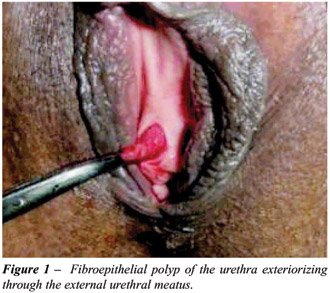
and exteriorizing through the external urethral meatus (Figure-1). A cystoscopy
was performed, which showed no alteration. The patient underwent exeresis
of the lesion using an open approach with a good outcome. The histopathological
analysis showed it to be a fibroepithelial polyp of the urethra. The postoperative
outcome was good, but 1 year after surgery a new lesion was observed in
the same urethral topography with very similar characteristics to the
first one. A new exeresis was performed following an analysis of the potential
for polypoid reactions, such as inflammatory process and urethral caruncle,
because of the patient’s age and gender. Potential for these reactions
was excluded.
COMMENTS
Fibroepithelial
polyps of the urethra are usually diagnosed during the first decade of
life. They are constituted by connective tissue and smooth muscle cells
covered by a normal transitional epithelium or by areas of squamous metaplasia
(1).
The most frequent clinical manifestation
in adults is hematuria, while obstructive symptoms are predominant in
children. A voiding cystourethrography can aid in the diagnosis as it
can identify a filling defect at the level of the prostatic urethra in
males. Ultrasonography is another additional resource for revealing polypoid
lesions that can extend to the bladder neck, and cystourethroscopy allows
the direct visualization of the lesion (2). However, diagnosis is primarily
confirmed by the lesion’s histological analysis. Differential diagnosis
includes formations resulting from urothelial reactions, such as inflammatory
processes and, in post-menopausal women, urethral caruncles. All these
conditions reveal the development of “polypoid” lesions without
the characteristics of connective stroma with smooth muscle fibers, which
are present in fibroepithelial polyps.
The treatment of choice for urethral polyps
is endoscopic resection. The open approach was chosen for this female
patient due to the proximity of the lesion to the external urethral meatus.
There was also a recurrence of the lesion, something that had not previously
been described for fibroepithelial polyps of the urethra. The prognosis
of such lesions is excellent and there is no malignant degeneration (3).
REFERENCES
- Foster RS, Garret RA: Congenital posterior urethral polyps. J Urol. 1986; 136: 670-2.
- Lanzas Prieto JM, Menendez Fernandez CL, Perez Garcia FJ, Gutierrez Garcia R, Gonzalez Tuero J, Guate Ortiz JL: Fibroepithelial polyp of the urethra in an adult. Actas Urol Esp. 2003; 27: 654-6.
- Miroglu C, Ilhan A, Ozdiler E: Congenital urethral polyp in an adult. Br J Urol. 1988; 61: 531-2.
_______________________
Received: October 10, 2004
Accepted after revision: December 14, 2004
_______________________
Correspondence address:
Dr. Giuliano Amorim Aita
Av. Bem-te-vi, 362 / 91 A
Sao Paulo, SP, 045234-030, Brazil
E-mail: giulianoaita@hotmail.com