SURGICAL
COMPLICATIONS AFTER RENAL TRANSPLANTATION IN GRAFTS WITH MULTIPLE ARTERIES
(
Download pdf )
EDUARDO MAZZUCCHI, AURO A. SOUZA, WILLIAN C. NAHAS, IOANNIS M. ANTONOPOULOS, AFFONSO C. PIOVESAN, SAMI ARAP
Renal Transplantation Unit, Division of Urology, University of Sao Paulo Medical School, Sao Paulo, SP, Brazil
ABSTRACT
Introduction:
Renal transplantation with multiple arteries appears, in literature, associated
to a major index of surgical complications. This study compared the surgical
complications and short-term outcome renal transplants with multiple arteries
and single artery grafts.
Materials and Methods: The data of 64 renal
transplants with multiple arteries performed between January 1995 and
December 1999 were compared to the ones of 292 transplants with single
renal artery. The aspects analyzed were number of arteries of the graft,
donor type, vascular reconstruction technique, the occurrence of surgical
complications, the incidence of delayed graft function, graft function
1 month after transplantation, graft loss and the patients’ deaths.
Results: The incidence of surgical complications
in grafts with multiple arteries and single renal artery was respectively:
vascular – 3.1% and 3.1%; urological – 6.3% and 2.7% and other
surgical complications – 15.6% and 10.6%, respectively. The incidence
of lymphoceles was 3.1% in grafts with a single artery and 12.5% in grafts
with more than 1 artery (p = 0.0015). The incidence of delayed graft function
in grafts with multiple arteries and with a single renal artery was respectively
35.1 and 29.1% (p = 0.295). Mean serum creatinine at the 30th postoperative
day was 2.46 and 1.81 in grafts with multiple and with 1 artery, respectively
(p=0.271).
Conclusions: Kidney transplantation using
grafts with single and multiple arteries present similar indexes of surgical
complications and short-term outcome; lymphoceles were more frequent among
grafts with multiple arteries.
Key
words: kidney transplantation; renal arteries; abnormalities;
intraoperative complications
Int Braz J Urol. 2005; 31: 125-30
INTRODUCTION
Despite
being a consolidated procedure, renal transplantation is liable to complications
due to technical problems and peculiarities inherent to patients with
chronic renal failure.
Some difficulties arise from anatomical
anomalies like multiple arteries and ureters, pediatric donors and horseshoe
kidneys, among others (1). Multiple renal arteries are unilaterally found
in 25% of the population and bilaterally in 10%, and may represent a challenge
to the surgeon (1,2). As an auxiliary procedure for renal transplantation
with multiple arteries, the out-of-body vascular reconstruction (bench
technique) aims at generating a unique arterial ostium to facilitate the
vascular anastomosis and to decrease the incidence of complications (3,4).
On the other hand, in situ reconstruction of multiple artery grafts can
be used, like the inferior epigastric artery applying to small caliber
polar arteries revascularization (5,6).
Vascular complications in renal grafts with
a single artery, including thrombosis and arterial stenosis, range from
1 to 16% (7,8). Urologic complications occur in 2% to 10% of transplanted
patients (9-11). Renal transplantations with multiple arteries are reported
as having a major index of vascular and urologic complications (12).
The aim of this study was to compare the
incidence of surgical complications in grafts with multiple arteries and
those with a single artery.
MATERIALS AND METHODS
The
charts of 356 renal transplantations performed in 351 patients between
January 1995 and December 1999 were reviewed. The patients were divided
into 2 groups. Group 1 - grafts with a single artery (292 grafts –
288 patients) and group 2 - grafts with multiple arteries (64 grafts –
64 patients). Five patients were submitted to 2 transplants during the
study period. One of them had the first graft with 2 renal arteries and
the second one with 1 renal artery. The other 4 patients had both transplants
with one artery.
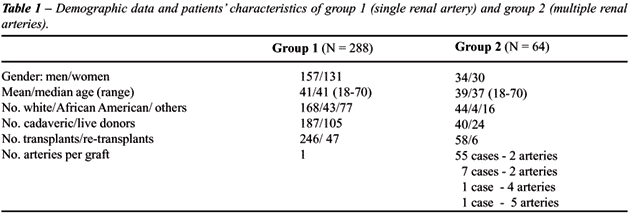
Demographic data are in Table-1.
Open live donor nephrectomy was performed
through an extraperitoneal flank incision in all cases. Vascular anastomoses
were performed to the external iliac vein and external iliac artery. Urinary
tract reconstruction was accomplished by the Gregoir technique. Ureteral
stents were exceptionally used either when ureteral re-implant to the
bladder was not adequate, or when the ureter was ischemic or when the
bladder wall was thickened due to neurological disorders. The techniques
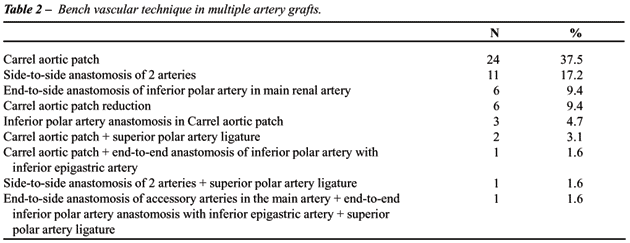
applied for arterial reconstructions in graft with multiple arteries are
presented in Tables-2 and 3.

Doppler ultrasonography was routinely performed
in the second or third day after transplant in order to evaluate vascular
flow as well as the urinary system. Renal arteriography was performed
for the diagnosis of arterial stenosis. Significant arterial stenosis
was considered when an obstruction greater than 50% on the artery diameter
was found. The diagnosis of urinary complications was achieved by ultrasonography
and cystography. Cystography was performed every time there was a suspicion
of a urinary fistula.
Delayed graft function was defined as the
need of at least one dialysis section after transplant. The mean follow
up of patients was 2.2 years (1 - 1,822 days). Patients were followed
at the outpatient unit, initially once a week during the first month after
transplant, then once a month for the following 3 months and then each
6 months for the entire life.
Statistical analysis was done using the
chi square test, corrected for continuity according to Yates, Fisher exact
test and the non-parametric Kruskal Wallis test. P < 0.05 was considered
statistically significant.
RESULTS
Eleven
vascular complications occurred (3.1%). Overall, renal artery stenosis
occurred in 6 patients (1.7%), renal vein thrombosis in 4 patients (1.1%)
and renal artery thrombosis in 1 patient (0.3%).
In group 1, 6 patients (2.1%) developed
renal artery stenosis, 2 (0.7%) vein thrombosis and 1 patient (0.3%) arterial
thrombosis. Among patients with renal artery stenosis, 4 patients had
grafts from living donors and 2 from cadaveric donors. Two patients required
surgical repair. Two patients with renal vein thrombosis and 1 patient
with renal artery thrombosis received cadaveric donors grafts (graft nephrectomy
was performed). In group 2, 2 patients (5%) developed vein thrombosis.
Graft nephrectomy was performed in both cases (Table-4).

In group 1, 8 (2.7%) urinary fistulae occurred
(6 patients had grafts from living donors and 2 from cadaveric donors.
Six patients required surgical repair and two patients were treated by
bladder drainage).
In group 2, 3 (4.7%) urinary fistulae and
1 (1.6%) ureteral stenosis occurred (all patients had grafts from cadaveric
donors). Urinary fistulae were treated surgically in 2 patients and by
bladder drainage in one. The obstruction at the ureterovesical anastomosis
required surgical repair. The incidence of fistulae was higher among multiple
arteries grafts, but no statistically significant difference was found
(Table-5).

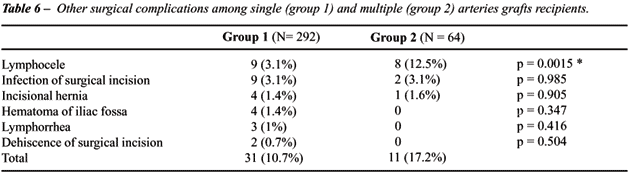
Regarding the other surgical complications,
we found in group 1, 9 lymphoceles (3.1%), 9 infections of the surgical
incision (3.1%), 4 incisional hernias and 4 hematomas of the iliac fossa
(1.4%). In group 2, 8 lymphoceles (12.5%), 2 infections in surgical site
(3.1%) and 1 incisional hernia (1.6%) occurred (Table-6).
Delayed graft function occurred in 85 patients
in group 1 (29.1%) and in 23 patients in group 2 (35.1%) (p = 0.295).
Mean serum creatinine at 30th postoperative day was 1.81 mg/dL in group
1 and 2.46 mg/dL in group 2 (p = 0.271).
Renal graft losses were due to arterial
or venous thrombosis and occurred in 3 (1.0 %) grafts with single artery,
and in 2 (3.0%) grafts with multiple arteries. No patient died due to
surgical complications in the single artery group. In the multiple arteries
group, 2 patients died (3%) due to urinary fistulas followed by septicemia.
COMMENTS
Theoretically,
a higher risk of surgical complications to the living donor and to the
recipient is associated to the renal graft with multiple arteries. At
the beginning of the renal transplantation era, this fact was considered
as a contraindication to the procedure. Nowadays, multiple vessels are
not considered a problem anymore neither to open nor to laparoscopic nephrectomies.
We did not have any laparoscopic donor nephrectomy during the period studied.
Recent studies have demonstrated that laparoscopic donor nephrectomy of
kidneys with multiple renal vessels is safe and effective, providing kidney
donor and allograft outcomes comparable to those of open surgery (13,14).
Several mechanisms causing vascular complications
have been postulated such as faulty suture technique producing incomplete
intimal reapproximation with secondary intraluminal fibrosis, postoperative
hypotension, hypercoagulable state, atherosclerosis of the donor or recipient
vessels, trauma to the donor artery during perfusion, wide disparity in
vessel size, torsion of the graft during performance of the anastomosis,
kinking of artery and angulation of the vein owing to improper location
of the graft or to the anastomosis (15,16).
Multiple renal arteries have been associated
with a higher rate of vascular complications, including arterial thrombosis
and renal artery stenosis (14). Several techniques for bench or in situ
reconstruction of multiple renal arteries have been described in order
to reduce the incidence of these vascular complications (10). In grafts
from cadaver donors, the Carrel aortic patch is the standard technique
of vascular reconstruction in renal transplants with a single and multiple
arteries (17).
In this study, we reviewed the incidence
of surgical complications in transplants with multiple arteries and compared
them with transplants with 1 artery performed in the same period. As the
number of transplants with multiple arteries is small, the occurrence
of complications is low and the statistical analysis may be impaired.
Arterial stenoses occur in a range of 0.8
to 12.4% of all renal transplants (10,17). In our casuistic, there were
6 cases (1.7%) of renal arterial stenosis, all of them in grafts with
single artery. All cases were diagnosed through Doppler ultrasonography
and confirmed by arteriography. Revascularization is recommended in those
cases in which arterial stenosis is considered the cause of intractable
hypertension and/or declining renal function and when the obstruction
is greater than 50% (6). A variety of surgical procedures have been performed
including resection of the stricture segment, bypass grafting methods,
lysis of adhesions, patch angioplasty, and dilatations (18). In 2 cases,
the stenotic portion was resected and re-anastomoses performed. The remaining
4 cases were treated clinically as the hypertension could be treated with
anti-hypertensive drugs satisfactorily and renal function remained stable.
Renal vascular thrombosis caused graft loss
in 5 patients, all of them with a single artery. In our series, we did
not find any arterial thrombosis in kidney graft with multiple arteries.
According to the literature, the incidence
of urological complications range from 3% to 34% with an associated mortality
ranging from 0% to 60% (10,11). In our casuistic, the incidence of urinary
complications in grafts with a single artery was lower than that in grafts
with multiple arteries, but without statistically significant difference.
Urinary fistulae in grafts with multiple arteries occur at an incidence
of 2.2% to 4.8% (17). In this study, three cases (4.7%) of urinary fistula
occurred with a mortality index of 3.1% due to this complication.
Lymphoceles occur in 1% to 12% of all kidney
transplants (19). We found a significant higher incidence of lymphocele
in grafts with multiple arteries (12.5%) compared to grafts with a single
artery (3.1%), p = 0.0015). The lymphocele occurs due to deficient ligature
of lymphatic vessels during dissection of iliac vessels of recipient and/or
during dissection of graft vessels, acute rejection, or drugs used after
surgery, such as steroids, diuretics, heparin, mophetil mycophenolate
and others (20). In grafts from cadaveric donors, the visualization of
the lymphatic vessels is almost impossible after perfusion and ligature
is commonly not performed. Usually the lymphatic vessels are more abundant
in grafts with multiple arteries and so they are vulnerable to insufficient
ligature, therefore, speculate that this fact can explain the higher occurrence
of lymphocele among grafts with multiple arteries.
Wound infection ranges between 2% and 43%
and is associated mainly to diabetes, urinary fistulas, hematomas and
after graft nephrectomies (21). In our study, we had an incidence of 3.1%,
and no difference occurred between grafts with single and multiple arteries.
Delayed graft function was more frequent
among grafts with multiple arteries, but without statistically significant
difference, and this fact can be explained by the manipulation necessary
for vascular reconstruction in these grafts, causing an increase in warm
ischemia period. Although we did not analyze this aspect in this article,
it is clear that warm ischemia time is longer in transplants with multiple
arteries and this may influence the immediate function of the graft. Consequently,
serum creatinine on the 30th postoperative day was higher in this group
but, again, no statistically significant difference was found.
The losses of grafts due to surgical complications
were, in the whole, due to vascular complications. In our series, 2 deaths
occurred among patients with multiple arteries that presented with urinary
fistula associated to sepsis. Again, this mortality alerts to the great
potential danger of these surgical complications.
CONCLUSION
In this study, there was no significant difference in the occurrence of vascular and urologic complications, as well as delayed graft function when we compared grafts with single and multiple arteries. The incidence of lymphoceles was significant higher among grafts with more than 1 artery.
REFERENCES
- Sampaio FJ, Passos MA: Renal arteries. Anatomic study for surgical and radiological practice. Surg Radiol Anat. 1992: 14: 113-7.
- Novick AC: Surgery of Renal Transplantation and Complications. In: Novick AC, Straffon RA (eds.), Vascular Problems in Urologic Surgery. Philadelphia, W.B. Saunders. 1982; pp. 233-44.
- Novick, AC; Magnusson M, Braun WE: Multiple-artery renal transplantation: emphasis on extracorporeal methods of donor arterial reconstruction. J Urol. 1979; 122: 731-5.
- Nghiem, DD: Donor aortoplasty for transplantation of kidney with multiple arteries. J Urol. 1994; 152: 2055-6.
- Benoit G, Moukarzel M, Hiesse C, Verdelli G, Charpentier B, Fries, D: Transplant renal artery stenosis: experience and comparative results between surgery and angioplasty. Transpl Int. 1990; 3: 137-40.
- Grenier N, Douws C, Morel D, Ferriere JM, Le Guillou M, Potaux L, et al.: Detection of vascular complications in renal allografts with color Doppler flow imaging. Radiology. 1991; 178: 217-23.
- Laasonen L, Edgren J, Forslund T, Eklund B: Renal transplant artery stenosis and percutaneous transluminal angioplasty. Acta Radiol Diagn (Stockh). 1985; 26: 609-13.
- Kuo PC, Bartlett ST, Schweitzer EJ, Johnson LB, Lim JW, Dafoe DC: A technique for management of multiple renal arteries after laparoscopic donor nephrectomy. Transplantation. 1997; 64: 779-80.
- Mundy AR, Podesta ML, Bewick M, Rudge CJ, Ellis FG: The urological complications of 1000 renal transplants. Br J Urol. 1981; 53: 397-402.
- Hashimoto Y, Nagano S, Ohsima S, Takahara S, Fujita T, Ono Y, et al.: Surgical complications in kidney transplantation: experience from 1200 transplants performed over 20 years at six hospitals in central Japan. Transplant Proc. 1996; 28: 1465-7.
- van Roijen JH, Kirkels WJ, Zietse R, Roodnat JI, Weimar W, Ijzermans JN: Long-term graft survival after urological complications of 695 kidney transplantations. J Urol. 2001; 165: 1884-7.
- Roza AM, Perloff LJ; Naji A, Grossman RA, Barker CF: Living-related donors with bilateral multiple renal arteries. A twenty-year experience. Transplantation 1989; 47: 397-9.
- Wilson CH, Bhatti AA, Rix DA, Soomro NA.: Comparison of laparoscopic and open donor nephrectomy: UK experience. BJU Int. 2005; 95: 131-5.
- Hsu TH, Su LM, Ratner LE, Trock BJ, Kavoussi LR: Impact of renal artery multiplicity on outcomes of renal donors and recipients in laparoscopic donor nephrectomy. Urology. 2003; 61: 323-7.
- Rijksen JF, Koolen MI, Walaszewski JE, Terpstra JL, Vink M: Vascular complications in 400 consecutive renal allotransplants. J Cardiovasc Surg (Torino). 1982; 23: 91-8.
- Nghiem DD: Donor aortoplasty for transplantation of kidney with multiple arteries. J.Urol. 1994; 152: 2055-6.
- Kocak T, Nane I, Ander H, Ziylan O, Oktar T, Ozsoy C. Urological and surgical complications in 362 consecutive living related donor kidney transplantations. Urol Int. 2004; 72: 252-6.
- Morris PJ, Yadav RV, Kincaid-Smith P, Anderton J, Hare WS, Johnson N, Johnson W, Marshall VC: Renal artery stenosis in renal transplantation. Med. J. Aust. 1971; 1: 1255-7.
- Braun WE, Banowsky LH, Straffon RA, Nakamoto S, Kiser WS, Popowniak KL, et al.: Lymphocytes associated with renal transplantation. Report of 15 cases and review of the literature. Am J Med. 1974; 57: 714-29.
- Burleson R, Marberger PD: Prevention of lymphocele formation following renal allotransplantation. J Urol. 1982; 127: 18-9.
- Kyriakides GK, Simmons RL, Najarian JS: Wound infections in renal transplant wounds: pathogenetic and prognostic factors. Ann Surg. 1975;182: 770-5.
__________________________
Received: September 27, 2004
Accepted after revision: January 17, 2005
_______________________
Correspondence address:
Dr. Eduardo Mazzucchi
Rua Apiacas, 621 / 121
São Paulo, SP, 05017-020, Brasil
E mail: mazuchi@terra.com.br