CYSTIC
RENAL CELL CARCINOMA ARISING FROM MULTILOCULAR CYSTIC NEPHROMA OF THE
SAME KIDNEY
(
Download pdf )
AHMAD M. OMAR, ALTAF Q. KHATTAK, JOHN A. LEE
Departments of Urology and Histopathology, Rotherham General Hospital United Kingdom, and Hull York Medical School, United Kingdom
ABSTRACT
Multilocular cystic nephroma is an uncommon benign entity grouped among the cystic non-genetic diseases. It is characterized by variable-sized, non-communicating cysts separated by irregular thin walled septa. Though multilocular cystic nephroma is usually considered a benign lesion, malignant changes in the cysts should not be overlooked.
Key
words: kidney; cyst; renal cell carcinoma
Int Braz J Urol. 2006; 32: 187-9
INTRODUCTION
The kidneys are prone to a variety of cystic disorders that includes developmental, acquired, and neoplastic lesions. However, the synchronous occurrence of two different renal tumors in the same kidney is a rare event. Here we report a case of cystic renal cell carcinoma arising in a multilocular cystic nephroma in a 65-year-old woman.
CASE REPORT
A
65-year-old white woman presented with a 10-month history of weight loss
and malaise. There was no history of urinary or bowel symptoms. A mass
was palpated in the right loin. Urine analysis was normal and urine cytology
was negative for malignancy. Full blood count, liver function tests and
renal function tests were all normal. An ultrasound scan showed a large
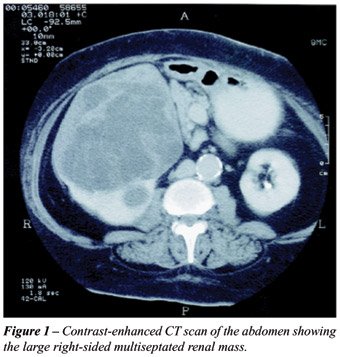
complex mass arising from the lower pole of the right kidney. CT scanning
displayed a huge multilocular heterogeneous mass in the lower pole of
the right kidney (Figure-1). The differential diagnosis of a malignant
versus a benign lesion was not possible with imaging, and a right radical
nephrectomy was performed.
On pathology, a large multi-loculated cyst
with occasional more solid areas replaced the kidney. The lesion had an
intact fibrous capsule with no involvement of the peri-renal tissues.
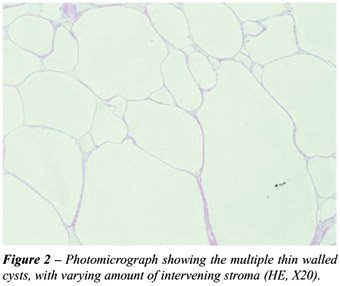
Microscopically, the cysts were thin walled and epithelial lined, with
varying amounts of intervening cellular stroma containing numerous small
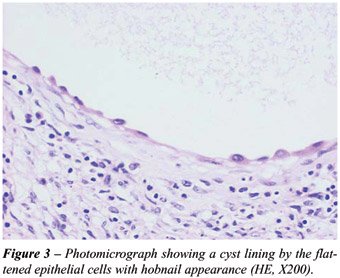
tubular cysts and focal smooth muscle (Figure-2). The appearances were
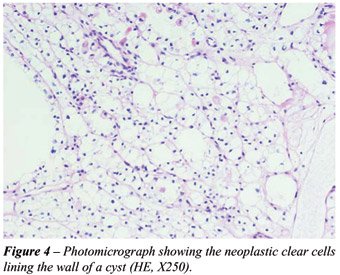
those of a multilocular cystic nephroma (Figure-3). However, in some of
the variegated and thickened areas noted macroscopically, the typical
clear cells of cystic renal cell carcinoma were found (Figure-4). The
renal cell carcinoma did not breach the capsule or invade adjacent renal
tissues.
COMMENTS
The
etiology of multilocular cystic nephroma (MCN) has been the subject of
controversy for a long period of time. However, many currently believe
that MCN is a benign neoplasm and lies at the benign end of a continuum
that includes the cystic partially differentiated nephroblastoma (CPDN)
variants of Wilms’ tumor (1,2).
There is a bimodal age distribution. Under
the age of 5 years, MCN occurs most frequently in males, whereas the adult
group has a female predominance between the ages of 40 and 60. The most
common presenting symptoms are a painless abdominal mass, abdominal or
flank pain, and occasionally hematuria (2).
Several authors have reported on the difficulty
of differentiating between MCN and multilocular cystic renal cell carcinoma
(MLCC). However, definitive diagnosis is always histological.
Renal cell carcinoma may occasionally arise
in a variety of longstanding cystic diseases of the kidney, including
the cysts of multilocular cystic nephroma. However, most of the reported
malignancies in multilocular renal cysts have been clear cell carcinomas.
The prognosis for CRCC is excellent. A recent
study of 21 patients from Japan reported that after surgery, 5-year and
10-year disease free specific survival for these patients were both 100%
(3). Our patient remains free of recurrence with 4 years follow-up.
In summary, a multilocular renal cyst is
usually considered a benign lesion, but malignant changes in the cyst
can occur, indicating that thorough sampling should be undertaken for
histology. However, the prognosis is excellent and most patients are likely
to achieve long-term survival.
CONFLICT OF INTEREST
None declared.
REFERENCES
- Joshi VV, Beckwith JB: Multilocular cyst of the kidney (cystic nephroma) and cystic, partially differentiated nephroblastoma. Terminology and criteria for diagnosis. Cancer. 1989; 64: 466-79.
- Madewell JE, Goldman SM, Davis CJ Jr, Hartman DS, Feigin DS, Lichtenstein JE: Multilocular cystic nephroma: a radiographic-pathologic correlation of 58 patients. Radiology. 1983; 146: 309-21
- Koga S, Nishikido M, Hayashi T, Matsuya F, Saito Y, Kanetake H: Outcome of surgery in cystic renal cell carcinoma. Urology. 2000; 56: 67-70.
____________________
Accepted after revision:
September 30, 2005
________________________
Correspondence address:
Dr. Ahmad M. Omar
Department of Urology
Rotherham General Hospital
Rotherham, S60 2UD, South Yorkshire
United Kingdom
E-mail: amomar70@hotmail.com
EDITORIAL COMMENT
Epithelial hyperplasia evolving to neoplasia is common to several forms of human renal cystic disease, both congenital and acquired. Most frequently occurs in von Hippel-Lindau disease, a dominantly inherited syndrome of cerebellar and retinal hemangioblastomas, pancreatic, epididimal and renal cysts and tumors. Tumors also occur in acquired renal cystic disease in end-stage kidneys especially those of patients on long-term hemodialysis, in the dominantly inherited disorder tuberous sclerosis complex and, less frequently, in the adult polycystic renal disease. The arising of cystic renal cell carcinoma from multilocular cystic nephroma is a very controversial condition. The present case is worth reporting because the multilocular cystic nephroma is well documented. Thin septa of either fibrous tissue or resembling ovarian stroma are present and covered by flattened or low cuboidal epithelium with small amounts of cytoplasm occasionally with hobnail appearance. However, this cystic lesion may be coincidental to the renal cell carcinoma. Many other cases should be reported in order to consider cystic multilocular nephroma a predisposing lesion to kidney neoplasias.
_________________
Dr.
Athanase Billis
Full-Professor of Pathology
State University of Campinas, Unicamp
Campinas, São Paulo, Brazil
E-mail: athanase@fcm.unicamp.br