UNILATERAL
RENAL AGENESIA ASSOCIATED WITH PARTIAL EPIDIDYMIS AND VAS DEFERENS AGENESIA
IN A PATIENT WITH ABDOMINAL TESTICLE
(
Download pdf )
JOAO L. PIPPI SALLE, JACOB LANGER, LUCIANO A. FAVORITO
Department of Urology, Hospital for Sick Children, University of Toronto, Toronto, Canada
ABSTRACT
This study considers a unilateral renal agenesia associated with agenesia of the epididymis body and tail and the vas deferens and non-palpable left testicle in a 20-month-year-old patient. During laparoscopic procedure, the testicle was positioned at approximately 5 cm above the inguinal ring. The size was appropriate for the age and the head of the epididymis was situated in its normal position. The decision was made to perform the first step of the Fowler-Stephens’ surgery and the patient presented a good evolution. The association of male duct system agenesia with unilateral renal agenesia in a patient with cryptorchidism diagnosed by laparoscopy is an extremely rare event, however generally in these cases the testicle is of normal size, presents unaltered hormonal function, and must be preserved.
Key
words: testis; cryptorchidism; kidney; urogenital anomalies
Int Braz J Urol. 2006; 32: 208-10
INTRODUCTION
Urinary
and genital systems originate in the intermediary mesoderm located along
the posterior wall of the abdominal cavity between the fourth and the
tenth week post-conception (1). Alterations in this development before
the fourth week can lead to unilateral agenesia of the genitourinary structures
(1).
The occurrence of duct anomalies (epididymis,
vas deferens, ejaculatory ducts and seminal vesicles) is very frequent
in infertile patients and in cryptorchidism (1,2). However, reports of
partial agenesia of the epididymis associated with vas deferens and renal
agenesia in patients with abdominal testicle is extremely rare. The objective
of the present article is to discuss the occurrence of unilateral renal
and genital duct agenesia in a patient with an abdominal testicle located
during a laparoscopic diagnosis procedure.
CASE REPORT
We
discuss the case of a twenty-month-old patient with a non-palpable left
testicle and topic right testicle of normal size for his age who presented
no other significant alterations during the physical exam. An abdominal
ultrasound showed the left testicle in an intra-abdominal position. The
patient was submitted to laparoscopic orchidopexy, which revealed the
left testicle situated around 5 cm above the internal inguinal ring.
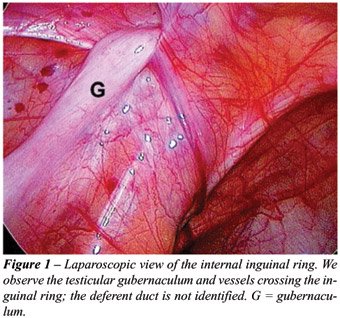
During the procedure, we noticed the absence
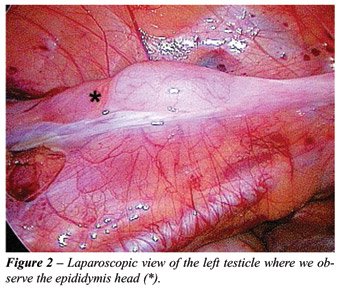
of the left vas deferens (Figure-1) and agenesia of the epididymis body
and tail (Figures-2 and 3) and also of the left kidney. The epididymis
head was in its normal situation (Figure-2). As the testicle was of a
normal size, we decided to perform the Fowler-Stephens surgery in 2 steps
– clamping of the spermatic vessels first with the second step (orchidopexy)
after 6 months. The patient evolved well and was discharged the day after
the procedure.

COMMENTS
Anomalies
of the epididymis and the vas deferens can be divided into 2 groups: (a)
anomalies associated with cryptorchidism and (b) anomalies observed during
infertility investigations. Anomalies of the epididymis are associated
with cryptorchidism in 36 to 72% of cases (2); however, the existence
of epididymis agenesia is one of the rarest epididymis anomalies (2).
Partial agenesia of the epididymis with
its head in the habitual position can be explained by alterations in vascularization
during the period of mesonefric tubules development before its fusion
with the testicular tubules (3).
Renal anomalies in cryptorchidism present
an incidence rate similar to the general population, with renal agenesia
being one of the most common (1). Of patients with unilateral renal agenesia,
10 to 15% present genital anomalies, and of these patients with genital
anomalies, the testicle is generally normal with an occurrence of partial
agenesia of the epididymis and of the deferent in 50% of cases (1). In
rare cases of cryptorchidism where there is a renal and epididymis agenesia,
the testicle generally is normally sized and presents unaltered hormone
function, therefore, must be preserved, even though the reproductive function
is compromised.
CONFLICT OF INTEREST
None declared.
REFERENCES
- Favorito LA, Cardinot TM, Morais AR, Sampaio FJ: Urogenital anomalies in human male fetuses. Early Hum Dev. 2004; 79: 41-7.
- Barthold JS, Redman JF: Association of epididymal anomalies with patent processus vaginalis in hernia, hydrocele and cryptorchidism. J Urol. 1996; 156: 2054-6.
- Gill B, Kogan S, Starr S, Reda E, Levitt S: Significance of epididymal and ductal anomalies associated with testicular maldescent. J Urol. 1989; 142: 556-8; discussion 572.
________
Accepted:
July 25, 2005
_______________________
Correspondence address:
Dr. Luciano Alves Favorito
Rua Professor Gabizo, 104/201
Rio de Janeiro, RJ, 20271-320, Brazil
Fax: + 55 21 3872-8802
E-mail: favorito@uerj.br