COMPARISON
BETWEEN PSA DENSITY, FREE PSA PERCENTAGE AND PSA DENSITY IN THE TRANSITION
ZONE IN THE DETECTION OF PROSTATE CANCER IN PATIENTS WITH SERUM PSA BETWEEN
4 AND 10 NG/ML
(
Download pdf )
EMERSON P. GREGORIO, JOAO P. GRANDO, EUFANIO E. SAQUETI, SILVIO H. ALMEIDA, HORACIO A. MOREIRA, MARCO A. RODRIGUES
Section of Urology, Department of Surgery, Health Sciences Center, State University of Londrina, UEL, Londrina, Parana, Brazil
ABSTRACT
Objective:
Compare the capacity of the PSA density (PSAD), Free PSA percentage (%FPSA)
and PSA transition zone density (PSATZ) in improving the sensitivity and
specificity of the PSA to detect prostate cancer (PCa) in men with a PSA
between 4 and 10 ng/mL.
Materials and Methods: One hundred and forty
five men with PSA between 4 and 10 ng/mL were prospectively studied. Blood
collection for the total PSA and free PSA was performed as well as transrectal
ultra-sound with prostate biopsy and measurement of the total prostate
volume (TPV) and transition zone volume (TZV). Patients with initial negative
biopsy were followed and the prostate biopsy was repeated in those that
presented PSA increase. The capacity of the PSAD, %FPSA and PSADTZ in
improving the sensitivity and specificity pf the PSA test to the detection
of the PCa was assessed by univariate and multivariate analyses and through
the ROC curve.
Results: Of the 145 patients, 38 (26.2%)
had PCa and in 107 (73.8%) a benign prostate disease was diagnosed. No
difference among the PSAD, %FPSA and PSADTZ was found. The multivariate
analysis showed that the PSADTZ, %FPSA, TZV and age were those more powerful
and highly significant PCa predictors.
Conclusion: The determination of %FPSA and
PSAD can allow a better discrimination between PCa and benign disease
that the isolated use of PSA. The combination of PSADTZ, %FPSA, TZV and
age promote a high accuracy for PCa detection.
Key
words: prostate; prostate-specific antigen; prostatic neoplasms;
prostatic hyperplasia; biopsy; diagnosis
Int Braz J Urol. 2007; 33: 151-60
INTRODUCTION
The
prostate cancer (PCa) is the second most frequent tumor in Brazilian men
(1). For the PCa diagnosis a prostate biopsy is needed, however it is
an invasive method that should be avoided in men with low probability
of carrying a PCa (2). The Prostate-specific antigen (PSA), together with
the digital rectal examination, is today the main tool to identify men
with a higher probability of having PCa and, thus, with indication of
a prostate biopsy (3). However, sensitivity and specificity of the PSA
are not yet enough to make it an ideal marker for PCa, since, high PSA
values can also be observed in benign diseases such as benign prostate
hyperplasia (BPH) and prostatitis (4).
More than 80% of men that present high PSA
are in the range between 4.0 and 10.0 ng/mL (5). From those, approximately
2/3 when investigated for prostate biopsy present benign conditions. Recently,
various strategies were introduced to improve the sensitivity and specificity
of the PSA. Among those, we can highlight PSA density, speed of PSA increase,
distribution of serum PSA levels according to age and the determination
of molecular forms of PSA (6).
The free to total PSA ratio (R FPSA / TPSA)
have emerged as the most useful clinical method to improve specificity
and sensitivity to detect the PCa (2). The value of the other concepts
derived from the above-mentioned PSA is still controversial and subject
to considerable debate (2).
Kalish et al. (7) introduced the concept
of transition zone PSA (PSA divided by the transition zone volume); however,
this concept brings discussions (8).
In this way, we have aimed, in this study,
the comparison of the capacity of PSA density, percentage of free PSA
and PSA density in the transition zone in improving the PSA sensitivity
and specificity to detect the PCa in men with PSA between 4 and 10 ng/mL.
MATERIALS AND METHODS
We
have included in this study patients attended consecutively at the urology
outpatient clinic from our university that presented with serum PSA between
4 and 10 ng/mL. We have excluded patients with urinary tract infection,
bearing a vesical catheter, in urinary retention, with clinical signals
of acute prostatitis, with a PCa history, previous prostate surgery of
any nature, hormonal manipulation or using finasteride.
Between February 2000 and April 2004, the
population of the study consisted of 145 men with a mean age of 68.04
± 8.81 years. After obtaining the informed consent all patients
were submitted to blood collection, digital rectal examination and transrectal
ultrasonography of the prostate with biopsy.
The blood samples were collected before
any manipulation of the prostate, and free and total PSA serum concentrations
were dosed in the same samples using “AxSYM Total PSA and Free PSA
Assay”, by the MEIA method (microparticle enzyme immunoassays) according
to the orientations of the lab (Abbot Laboratories, Abbott Park, IL 60064).
Digital rectal examination was performed
and classified as suspect or non-suspect for neoplasia.
Transrectal ultrasonography of the prostate
was performed using an endocavitary convex probe with a 6.5 MHz transducer
(Hitachi - model EVP-V33). Measures of the tri-axial distances of the
prostate and its transitional zones were taken in its larger diameter
and the volumes, both total and of the prostate transitional zone, were
calculated by the following formula: volume = 0.52 x transverse diameter
x anteroposterior diameter x longitudinal diameter. The sextant prostate
biopsy was performed added to two biopsies of the transition zone and
of possible suspicious area during transrectal ultrasonography. A 22 mm
(Manan pro-mag 2.2) automatic pistol was used and a 25 cm x 18 gauche
(Manan ACN 1825 MF) biopsy needle. The product of the biopsy was submitted
to pathological exam through the hematoxylin-eosin exam and the findings
were classified as positives for PCa, nodular hyperplasia (NH), NH associated
with a focus of chronic prostatitis, NH with atrophy, presence of atypical
glands (ASAP) or prostatic intraepithelial neoplasia (PIN).
Patients with evidence of PCa in the initial
biopsy were followed (mean follow-up time of 24.2 ± 15.2 months)
and those that presented a PSA increase (19 patients), ASAP (10 patients)
and/or PIN (2 patients) were submitted to a new biopsy, being that, in
some patients we have performed up to four biopsies of the prostate and
the mean number of fragments obtained in the biopsy per patient, at the
end of the study was of 9.7 ± 3.82 fragments.
In the patients submitted to a new biopsy
it was used for statistical analysis the values of the total PSA, free
PSA, TPV, TZV and the result of the pathological exam assessed in the
last biopsy.
The %FPSA was obtained multiplying by 100
the product of the division of the free PSA value by the total PSA. The
PSAD and the PSADTZ were expressed in ng/mL/cc and calculated dividing
the total PSA by TPV and TZV, respectively.
For statistical analysis, the SPSS program
(SPSS for Windows release 10.0.1. 1999. Chicago: SPSS Inc.) was used.
Since all continuous variables did not present a normal distribution by
the Shapiro-Wilk test, it was applied, to compare the groups’ median
the Mann-Whitney U test (to compare 2 groups) and the Kruskal-Wallis test
(to compare 3 or more groups) and to establish correlations the Spearman
coefficient. A multivariate logistics regression model (MLRM) analysis
was employed to assess the capacity of the different variables (age, digital
rectal examination with suspicion of neoplasia, presence of hypoechogenic
lesions to transrectal ultrasonography, TPV, TZV, total PSA, free PSA,
%FPSA, PSAD and PSADTZ) in predicting PCa. As a selection method for the
variables the stepwise regression was applied, considering as significant
p < 0.05 and removal of the variable of the model when p > 0.10.
The MLRM allowed the calculation of a predictive PCa probability for each
patient individually.
The statistical program Medcalc for Windows
version 8.1.0.0 (Medcalc Software, Mariakerke, Belgium) was used to demonstrate
the best cut-off point for each diagnosis test (PSA, PSAD, PSADTZ, %FPSA
and MLRM) as well as to calculate its respective positive predictive values
(PPV), negative predictive values (NPV), sensitivities and specificities
to predict PCa. The sensitivity of each diagnosis test was calculated
for each cut-off point, dividing the number of patients without PCa and
which test was negative by the total of patients without PCa. The ROC
(Receiver Operating Characteristics) curve was employed to graphically
demonstrate the sensitivities and specificities of the different diagnostic
tests. The areas bellow the ROC curve (global accuracy) of the 5 diagnostic
tests were also calculated and compared, in pairs, through the software
Medcalc as described by Hanley & McNeil (9). To calculate the PPV,
NPV, sensitivity, specificity and global accuracy of the MLRM the PCa
preventive probability supplied by MLRM was used. All statistical analysis
was performed considering p < 0.05 statistically significant and with
a 95% trust interval.
RESULTS
In
the first prostate biopsy, performed in the 145 patients, the adenocarcinoma
was diagnosed in 29 patients (20%). In the repetition of prostate biopsy,
the adenocarcinoma was diagnosed in 6 of the 19 patients (32%) that, during
the follow-up period, presented an increase of the PSA, in 1 of the 2
patients (50%) with PIN and in 2 of the 10 patients (20%) that presented
ASAP at the initial biopsy. At the end of the study, after repeat prostate
biopsy in 31 of the 145 patients, the adenocarcinoma of the prostate was
diagnosed in 38 patients (26%), nodular hyperplasia (NH) in 38 patients
(26%), NH with prostate atrophy in 27 patients (19%) and NH with non-specific
chronic prostatitis focuses in 42 patients (29%).
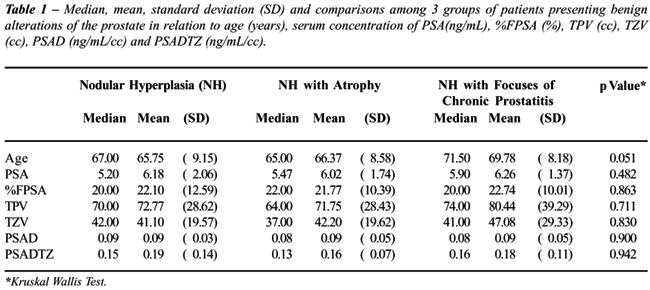
Considering the three groups of patients
without PCa (NH, NH with chronic prostatitis focuses, NH with atrophy),
there was no statistically significant difference among them in relation
to the median age, PSA, %FPSA, TPV, TZV, PSAD and PSADTZ (Table-1), allowing,
grouping those patients in a sole group named “Benign Prostatic
Hyperplasia” (BPH) group for the purpose of statistical analysis.
Thus, at the end of the study it was observed that the PCa was diagnosed
in 38 patients (26%) and the BPH was diagnosed in 107 patients (74%).
The characteristics of those patients and the comparison between both
groups (PCa and BPH) are presented on Figure-1 and Table-2.


The results of the digital rectal examination
and the presence of peripheral zone hypoechogenic lesions to transrectal
ultrasonography are presented respectively on Tables -3 and 4. The TZV
was compared to the TPV showing a linear positive relation between both
volumes with a Spearman correlation coefficient of 0.919 (Trust interval
0.889 - 0.942) (Figure-2).


The multivariate logistics regression model
(MLRM) analysis to predict PCa demonstrated that only variables such as
age, TZV, %FPSA and PSADTZ were statistically significant predictors of
PCa. The other variables were excluded from the model due to their low
predictive values. In this multivariate analysis the PSADTZ presented
a better result that the other variables to predict the PCa (Table-5).

The Figure-3 represent the ROC curves produced
by the PCa predictive probability of the MLRM and by variables PSAD, %FPSA,
PSADTZ and PSA as well as the area bellow the ROC curve (global accuracy),
their respective trust intervals and the comparison of the different areas.
Table-6 represent the area bellow the different ROC curves obtained with
their respective standard errors and trust intervals, as well as the value
of the cut-off point localized above and to the right of each curve (the
best cut-off point) and their respective PPV, NPV, sensitivity and specificity.

For a 95% sensitivity to detect PCa, specificities
for PSA, PSADTZ, %FPSA, PSAD and MLRM were respectively: 12.8%, 21.3%,
26.6%, 27.7% and 28.7%.

Figure-4 represent the ROC curves produced
by MLRM, PSAD, %FPSA, PSADTZ and PSA as well as the area bellow the ROC
(global accuracy), their respective trust intervals and the comparison
of the different areas in the 95 patients that presented a digital rectal
examination without a suspicion of neoplasia.

COMMENTS
This
study is different form most of the other ones developed for the detection
of the PCa, for involving a segment of the patients with subsequent biopsies,
minimizing, thus, the risks of false negative results of the initial prostate
biopsy. The literature regarding the relation between alterations of the
PSA serum concentration and the presence of atrophy and/or prostate inflammation
is very limited and controversial (10-12), thus, the concern in analyzing
if the patients with focuses of chronic prostatitis or atrophy were distinct
from the patients without such alterations, and it was also a differential
of this study as Table-1 makes it evident.
Among articles recently published about
the detection of PCa, few (6,8,13-19) are the ones that analyze and compare,
through the ROC curve, the accuracies of the PSA, PSAD, %FPSA and PSADTZ,
at the same time, in the range of PSA between 4 and 10 ng/mL.
Considering global accuracy, such as in
this study, the majority of the investigators (6,13-15) has demonstrated
advantage in the use of the concept of %FPSA in relation to the isolated
use of PSA for the detection of PCa. Only Kikuchi et al. (16) did not
confirm this superiority. As in this study the majority of the authors
(8,13,15-17) agrees that the accuracy of PSAD is superior to PSA for the
detection of the PCa, even though these results could not be reproduced
by other authors (6,14,18).
Even though some advantage of the %FPSA
has been demonstrated in relation to the PSAD (6,14). In this study, as
well as in others (13,15,16), the concepts of PSAD and %FPSA did not present
statistically significant difference when the accuracies for the detection
of PCa. However, the use of the %FPSA in relation to PSAD presents advantages,
because it can eliminate the costs and the invisibility of the transrectal
ultrasonography procedure, that is required to measure the prostate volume
(6). On the other hand, the numeric volume of the best %FPSA rate remains
unknown and these volumes can be influenced by the type of essay used,
the prostate size, age and variations in PSA measurement (3,13).
In 1994, Kalish et al. (7) introduced the
concept of PSADTZ to improve the PSA accuracy in predicting the results
of a positive prostate biopsy for PCa. Further on Djavan and collaborators
(6,13) demonstrated that the PSADTZ would be more efficient than all the
other concepts derived from the PSA. However, this supposed advantage
has been questioned, since these results could not be reproduced. In the
present study In the present study, as in others (8,14,15,17), the concept
of PSADTZ did not present global accuracy superior to the concepts of
PSAD and %FPSA. Kikuchi et al. (16) found a superiority of the concept
of PSADTZ in relation to %FPSA, however the PSADTZ was not better than
the PSAD. On the other hand, Ferreira and collaborators (19) found a superiority
of the PSADTZ in relation to the PSAD, however the PSADTZ was not better
than the %FPSA.
There are many reasons to explain the discrepancies
of results of different investigators in relation to the accuracy of various
concepts deriving from the PSA. They include variations in the measurements
of the total PSA, free PSA and prostate volume by transrectal ultrasonography,
the use of inadequate methodologies and statistics and errors of sampling
in the fragment of prostate biopsy. The errors in the biopsy regard the
fact that in smaller prostates the possibility of obtaining positive fragments
for PCa is higher than in larger prostates (8). This is reinforced by
the observation of Lin et al. (8) that revising various works on the PSAD
and PSADTZ they observed that, in almost all of them as well as in the
present study (Table-2), the volumes of the prostates that presented malignancy
were significantly smaller than the volume of the benign glands. Some
authors suggest increasing the number of fragments in larger prostates
in 50 cc, to correct those sampling errors (20).
As in the article of Djavan et al. (13)
in this study, in the multivariate analysis the PSADTZ and the %FPSA,
were the two variables most strongly predictors of PCa, being that the
PSADTZ was the variable that presented the largest predicting power, concurring
with the result of the others (2,4,6,7,13,16,19).
It is important highlight that, in the present
study, in the univariate analysis, even though the PSADTZ, does not offer
additional information in relation to the isolated use of the PSA the
TZV measure and the PSADTZ calculation can collaborate to increase the
accuracy of the diagnostic tests to detect the PCa, since in the multivariate
analysis the PSADTZ was a strongly PCa predictive variable and the MLRM
produced a high global accuracy (84%) to predict PCa, being that superior
to the concepts of %FPSA, PSADTZ and PSA, when used isolatedly.
CONCLUSIONS
The determination of %FPSA and PSAD can allow a better discrimination between PCa and BPH than the isolated use of the PSA in patients with PSA levels between 4 and 10 ng/mL. The various concepts deriving from the PSA (%FPSA, PSAD and PSADTZ) present a similar accuracy to detect the PCa. The combination of PSADTZ, %FPSA, TZV and age, promote an increase in the prediction of PCa.
CONFLICT OF INTEREST
None declared.
REFERENCES
- Brasil. Ministério da Saúde. Secretaria de Atenção à Saúde. Instituto Nacional de Câncer. Coordenação de Prevenção e Vigilância: Estimativa 2006: Incidência de câncer no Brasil. Rio de Janeiro. INCA, 2005; p. 34.
- Djavan B, Remzi M, Zlotta A, Seitz C, Snow P, Marberger M: Novel artificial neural network for early detection of prostate cancer. J Clin Oncol. 2002; 20: 921-9.
- Catalona WJ, Partin AW, Slawin KM, Brawer MK, Flanigan RC, Patel A, et al.: Use of the percentage of free prostate-specific antigen to enhance differentiation of prostate cancer from benign prostate disease: a prospective multicenter clinical trial. JAMA. 1998; 279: 1542-7.
- Zlotta AR, Djavan B, Marberger M, Schulman CC: Prostate specific antigen density of the transition zone: a new effective parameter for prostate cancer prediction. J Urol. 1997; 157: 1315-21.
- Catalona WJ, Richie JP, Ahmann FR, Hudson MA, Scardino PT, Flanigan RC, et al.: Comparison of digital rectal examination and serum prostate specific antigen in the early detection of prostate cancer: results of a multicenter clinical trial of 6,630 men. J Urol. 1994; 151: 1283-90.
- Djavan B, Zlotta A, Remzi M, Ghawidel K, Basharkhah A, Schulman CC, et al.: Optimal predictors of prostate cancer on repeat prostate biopsy: a prospective study of 1,051 men. J Urol. 2000; 163: 1144-8; discussion 1148-9.
- Kalish J, Cooner WH, Graham SD Jr: Serum PSA adjusted for volume of transition zone (PSAT) is more accurate than PSA adjusted for total gland volume (PSAD) in detecting adenocarcinoma of the prostate. Urology. 1994; 43: 601-6.
- Hanley JA, McNeil BJ: A method of comparing the areas under receiver operating characteristic curves derived from the same cases. Radiology. 1983; 148: 839-43.
- Schatteman PH, Hoekx L, Wyndaele JJ, Jeuris W, Van Marck E: Inflammation in prostate biopsies of men without prostatic malignancy or clinical prostatitis: correlation with total serum PSA and PSA density. Eur Urol. 2000; 37: 404-12.
- Kwak C, Ku JH, Kim T, Park DW, Choi KY, Lee E: Effect of subclinical prostatic inflammation on serum PSA levels in men with clinically undetectable prostate cancer. Urology. 2003; 62: 854-9.
- Di Silverio F, Gentile V, De Matteis A, Mariotti G, Giuseppe V, Luigi PA, et al.: Distribution of inflammation, pre-malignant lesions, incidental carcinoma in histologically confirmed benign prostatic hyperplasia: a retrospective analysis. Eur Urol. 2003; 43: 164-75.
- Djavan B, Zlotta AR, Byttebier G, Shariat S, Omar M, Schulman CC: Prostate specific antigen density of the transition zone for early detection of prostate cancer. J Urol. 1998; 160: 411-8; discussion 418-9.
- Okegawa T, Noda H, Nutahara K, Higashihara E: Comparison of two investigative assays for the complexed prostate-specific antigen in total prostate-specific antigen between 4.1 and 10.0 ng/mL. Urology. 2000; 55: 700-4.
- Egawa S, Suyama K, Matsumoto K, Kuwao S, Baba S: Prospective evaluation of prostate cancer detection by prostate specific antigen related parameters: comparison in serum and plasma samples. J Urol. 2002; 167: 97-102.
- Kikuchi E, Nakashima J, Ishibashi M, Ohigashi T, Asakura H, Tachibana M, et al.: Prostate specific antigen adjusted for transition zone volume: the most powerful method for detecting prostate carcinoma. Cancer. 2000; 89: 842-9.
- Maeda H, Arai Y, Ishitoya S, Okubo K, Aoki Y, Okada T: Prostate specific antigen adjusted for the transition zone volume as an indicator of prostate cancer. J Urol. 1997; 158: 2193-6.
- Lin DW, Gold MH, Ransom S, Ellis WJ, Brawer MK: Transition zone prostate specific antigen density: lack of use in prediction of prostatic carcinoma. J Urol. 1998; 160: 77-81; discussion 81-2.
- Kurita Y, Terada H, Masuda H, Suzuki K, Fujita K: Prostate specific antigen (PSA) value adjusted for transition zone volume and free PSA (gamma-seminoprotein)/PSA ratio in the diagnosis of prostate cancer in patients with intermediate PSA levels. Br J Urol. 1998; 82: 224-30.
- Ferreira MD, Koff WJ: Assessment of serum level of prostate-specific antigen adjusted for the transition zone volume in early detection of prostate cancer. Int Braz J Urol. 2005; 31: 137-45; discussion 146.
- Presti JC Jr, Hovey R, Carroll PR, Shinohara K: Prospective evaluation of prostate specific antigen and prostate specific antigen density in the detection of nonpalpable and stage T1C carcinoma of the prostate. J Urol. 1996; 156: 1685-90.
____________________
Accepted after revision:
October 31, 2006
_______________________
Correspondence address:
Dr. Emerson Pereira Gregório
Rua Mato Grosso 1794
Londrina, Paraná, 86010-180, Brazil
Fax: + 55 43 3323-5823
E-mail: emerson.gregorio@sbu.org.br