BOTULINUM
TOXIN INJECTION: A REVIEW OF INJECTION PRINCIPLES AND PROTOCOLS
(
Download pdf )
DAVID E. RAPP, ALVARO LUCIONI, GREGORY T. BALES
Section of Urology, Department of Surgery, University of Chicago Hospitals, Chicago, Illinois, USA
ABSTRACT
Despite the favorable outcomes seen using botulinum toxin (BTX) for voiding dysfunction using BTX, a standardized technique and protocol for toxin injection is not defined. We reviewed the current literature on intravesical BTX injection for DO (detrusor overactivity). Specific attention was placed on defining optimal injection protocol, including dose, volume, and injection sites. In addition, we sought to describe a standard technique to BTX injection.
Key
words: botulinum toxin; detrusor overactive; techniques
Int Braz J Urol. 2007; 33: 132-41
INTRODUCTION
The
introduction of botulinum toxin (BTX) within the field of urology offers
an exciting new modality for the treatment of urologic disorders. The
first reported urologic application of BTX injection was in the treatment
of detrusor-sphincter dyssynergia (DSD) (1). In the subsequent years,
the successful application of BTX has been reported in an increasing number
of urologic disorders, including detrusor hypocontractility, sensory disorders,
interstitial cystitis (IC), and benign prostatic hyperplasia (BPH) (2-5).
To date, the most widespread urologic application of BTX has been in the
treatment of urinary urgency and incontinence due to detrusor overactivity
(DO). Accordingly, improved subjective and objective outcomes are demonstrated
in numerous investigations using BTX injection in the treatment of both
neurogenic and idiopathic detrusor overactivity populations (6-17).
Despite the initial success achieved via
BTX injection in the treatment of voiding dysfunction, further improvement
is necessary. Arguably, the most important immediate obstacle to the more
successful widespread urologic utilization of BTX is the lack of a standardized
technique for intravesical BTX administration. Published investigations
to date have utilized varying doses, volumes, and injection sites/numbers.
Foremost, this variation makes systematic assessment of the safety and
efficacy of BTX difficult. Further, it remains difficult to provide urologists
seeking to incorporate BTX into their treatment armamentarium with a standardized
protocol for administration. This article reviews the common protocols
reported in the literature with specific focus on injection dose, distribution,
and volume. Further, data is presented to help define related clinical
issues, including duration of action, treatment onset, and benefit of
repeat injection. Finally, we describe a standard technique for intravesical
BTX injection. Due to the expanding number of urologic BTX applications
(e.g. IC and BPH), this review will center on the most widespread application
of BTX injection for DO.
PROTOCOL FOR BOTULINUM TOXIN INJECTION
Injection
Dose, Efficacy Outcomes
A
total injection dose of 100 to 400 U (Botox®) and 500 to 1000 SU (Dysport®)
has been reported in published study to date. The vast majority of reported
literature has used the Botox® preparation and, for this reason, the
following discussion will focus on this preparation. Data using the Dysport®
preparation is presented as available. Clinical experience suggests a
toxin equivalency of 1 U Botox® to 3.5-5 SU Dysport® (18).
The majority of published study has utilized
a 300 U dose (6-17). Several studies are reported using a 200 U dose and
isolated study is described using both 100 and 400 U doses (7,8,11,16).
In comparing the efficacy results of these studies, similar improvement
is seen with respect to both subjective and objective outcomes. Outcome
measures include incontinence episodes, quality of life indices, mean
cystometric capacity, compliance, and decreased mean voiding pressures.
Despite similar outcomes, definitive conclusions regarding the optimal
dose remain difficult in the absence of study directly focused on dose-response
outcomes.
Few individual studies have utilized variable
dosing. In one of the first published investigations of BTX injection,
Schurch and colleagues reported the use of 200 and 300 U in the treatment
of NDO (7). The authors reported that the administration dose was based
on previous titration study demonstrating that this range was most likely
to result in a complete blockade of acetylcholine at the detrusor level.
Although a dose-response analysis was not formally conducted, the two
patients failing to respond to treatment both received 200 U. As a result,
the authors concluded that 300 U might be the optimal dose for NDO.
The same group subsequently reported the
first direct comparison of 200 versus 300 U (8). In this prospective investigation,
59 patients with NDO were randomized to receive injection of 200 or 300
U of BTX-A. Significant subjective and objective improvement was seen
in the two study arms, including improved continence, bladder capacity,
and maximum detrusor pressure. No difference in primary outcomes was demonstrated
when comparing study arms. However, the authors caution that this outcome
may have been affected by the small study sample size.
Kuo et al. recently reported a randomized
comparison of 100, 150, and 200 U in the treatment of refractory DO (19).
Clinical and urodynamic outcomes were similar between the 150 and 200
U groups, with those patients receiving 100 U experiencing less favorable
therapeutic results. Based on these data, the authors conclude that a
150 U dose provides a satisfactory outcome with decreased adverse effects
compared to the 200 U dose (discussed below). As 300 U is the most utilized
dose to date, the failure to include this dose in the study comparison
is a notable limitation.
Recently, Ruffion et al. investigated the
benefit of 500 versus 1000 SU of Dysport® in the treatment of NDO
(20). Following toxin injection, 76% of patients were found to be completely
dry using both doses. Non-responders to 500 SU also failed to achieve
a response using a 1000 SU dose, suggesting that the overall efficacy
rates are similar when using both doses. Of note, this report also describes
an earlier experience using 300 SU, which had no clinical effect.
Injection
Dose, Duration Outcomes
Histological
evidence suggests that toxin injection is followed by a chemical dennervation,
which is followed by re-sprouting of axons (21,22). The timing of axonal
re-sprouting is variable and is observed over a period of weeks to months.
However, Haferkamp et al. found that only 3/7 biopsy specimens demonstrated
axonal sprouting at 9 months following injection (22). As symptom benefit
has been generally shown to subside by this time point, this data suggests
that duration of effect may not relate primarily to axonal sprouting.
Alternative data suggests that the local
action of intra-detrusor BTX injection may effect a functional motor inhibition
not associated with neuronal death. Further, BTX has recently been demonstrated
to have inhibitory effects on additional neuronal populations (e.g. sensory,
autonomic) and non-neuronal tissue (e.g. urothelium) (23-25). Apostolidis
and associates demonstrated through immunohistochemistry study that overall
neuronal density within bladder biopsy specimens was not significantly
reduced at 4 and 16 weeks following toxin injection (26). However, a reduced
expression of the sensory neuron receptors TRPV1 and P2X3 was observed
and corresponded with the clinical benefit seen in the patients. Recently,
Khera et al. reported that BTX injection inhibited urothelial ATP release,
suggesting that toxin injection may suppress purinergic sensory signaling
through this action (27). Finally, while the muscular integrity is not
altered following intra-detrusor injection, decreased bladder wall fibrosis
is seen in patients following toxin injection when compared to those patients
without toxin injection (22,28). While a complete description of related
research is beyond the scope of this review, this data is particularly
important as the specific mechanism of toxin action may relate to the
durability of clinical effect.
Irrespective of these factors, the clinical
benefit of intradetrusor BTX injection appears to last at least six months.
Shurch and colleagues reported a duration of at least nine months in their
initial experience enrolling patients with NDO (7). Subsequent to this
study, nearly all studies have concluded that the duration of action ranges
from 6 to 10 months (6-17). Importantly, this duration has been found
irrespective of treatment population (i.e. NDO vs. IDO) and Botox®
dose used. The previously described dose comparison study by Shurch and
associates demonstrated similar therapeutic benefit when comparing 200
and 300 U, which lasted through the study termination (8). However, the
study duration of 24 weeks limits the conclusions that may be made with
respect to injection duration. In contrast, Ruffion et al. concluded that
1000 SU Dysport® was associated with a significantly longer duration
of action (10.4 vs. 4.8 months) when compared to 500 SU (20). In those
patients initially receiving 500 SU who went on to receive repeat injections
using 1000 SU, the duration increased consistent with those patients initially
receiving 1000 SU. Certainly, further study is needed to better define
the relation of injection dose and outcome duration. However, we believe
that it is appropriate to counsel patients that the treatment effect may
last at least six months.
Injection
Dose, Side Effects
Certainly, a significant concern related
to dose escalation lies in the potential side effects. To date, only one
report evaluated overall adverse events utilizing a direct comparison
of two Botox® doses. No difference was seen in overall adverse events
between 200 versus 300 U (8). Again, further large scale, direct comparison
investigation is needed to better assess the side effect profile associated
with varying doses. Nonetheless, some general conclusions may be drawn
from the reported experiences using varying doses.
Foremost, significant side effects associated
with BTX injection are uncommon. Hematuria and post-operative pain are
the most common symptoms observed following toxin injection, however,
no data exists to suggest a dose dependent nature to these effects. Given
the paralytic nature of BTX, systemic effects are of significant theoretical
concern. To date, no severe systemic complication (e.g. respiratory muscle
weakness/paralysis) has been reported. Less severe systemic side effects,
such as extremity weakness, are not reported in the vast majority of series
reported to date. Del Popolo reported hypostenia with reduced supralesional
muscle force in 5/61 patients undergoing 300 U toxin injection for DO
(29). These symptoms disappeared by four weeks following injection. Grosse
et al. reported transient trunk and/or extremity weakness in four patients
(total six injections) following Dysport® injection using both a 750
SU and 1000 SU dosing (18). In these cases, the duration of muscle weakness
ranged from two weeks to two months. Finally, Wyndaele et al. reported
upper extremity weakness in 2 patients following intravesical injection
of BTX (300 U Botox®, 1000 SU Dysport®), persisting in these cases
for 90 days (30). While these reports represent isolated cases, it is
important to note that no such events are seen using lower doses of both
preparations (200 U Botox®, 500 SU Dysport®).
Certainly, urinary retention is a significant
concern following toxin injection and may also be directly related to
injection dose. Following intravesical BTX injection (300 U), Rajkumar
et al. report an increased PVR in an IDO cohort (12). However, no incidence
of urinary retention requiring catheterization was reported. Using a 300
U dose, Kessler et al. reported de novo CIC in 9 patients (4 IDO, 5 NDO)
due to a PVR greater than 150 mL (14). Popat and colleagues report de
novo CIC in 69% of NDO patients (300 U) as compared to 19% of those with
IDO (200 U) (15). Finally, in the previously described comparison of 150,
200 and 250 U, Kuo et al. found that a dose-dependent increase in difficulty
voiding and acute urinary retention (100 U: 0%, 150 U: 10%, 200 U: 20%)
was seen over all doses (19). A separate investigation of NDO patients
by the same author found that 30% of study participants required CIC (31).
Of note, the majority of those patients requiring CIC were men. Despite
these reports, no incidence of urinary retention is reported in the majority
of investigation, making it difficult to reach definitive conclusions
regarding the true incidence of urinary retention and its relation to
dose escalation.
Despite the absence of conclusive data suggesting
a higher incidence of adverse effects associated with 300 U, dose modification
based on specific patient parameters has been reported in an attempt to
reduce the risk of clinically significant PVR and/or urinary retention.
Rackley et al. report the use of a 100 U trial dose in patients with detrusor
overactivity combined with urodynamic evidence of borderline contractility
(17). These authors also use this trial dose in patients of advanced age,
given evidence demonstrating advanced age to predict for hypocontractile
bladder conditions. Smith and colleagues report the use of a greater number
of injections in patients with NDO as compared to those with IDO or IC
(16). This approach may be particularly effective in this subset of patients,
who perform CIC but remain incontinent as a result of detrusor overactivity.
Accordingly, detrusor hypocontractility may actually be a desired effect
in these patients.
Injection
Volume
Published investigation to date has generally
used an injection volume ranging from 0.1 mL to 0.5 mL/injection site.
More recently, injection techniques using a larger injection volumes have
been discussed (32). Larger dilution volumes have been shown to result
in increased gastrocnemius muscle relaxation in an animal model (33).
Theoretically, it is possible that larger dilution volumes will result
in greater suburothelial diffusion, thereby allowing for toxin action
on a larger surface area of muscle. However, no evidence has been presented
to suggest that increased dilution volume used during intravesical injection
BTX will result in superior clinical outcomes. In contrast, larger volumes
may have the deleterious effect of increasing the potential for serosal
extravasation. Further, as BTX administration is more frequently performed
in the outpatient clinical setting, larger volumes may also result in
increased patient discomfort.
Injection
Distribution
In general, toxin injection is performed
using 20-40 evenly distributed intramural injection sites. These sites
include the bladder base and posterolateral walls of the bladder. As the
wall of the bladder dome is the thinnest bladder region and lies in an
intraperitoneal position, this area is avoided to prevent inadvertent
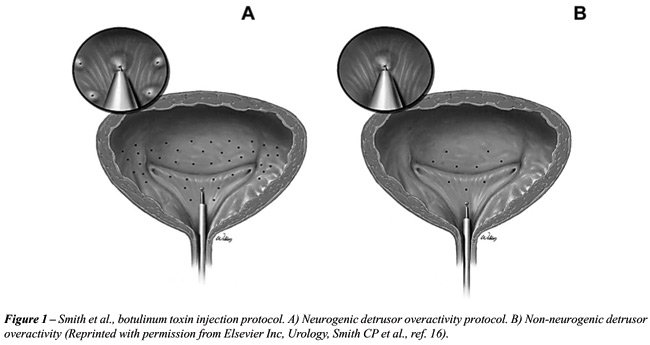
bowel injury. Figure-1 illustrates the injection template used by Smith
et al. In contrast to this uniform distribution pattern, other authors
use an injection template concentrated over the posterior bladder wall
only (34).
Perhaps the greatest question related to
optimal injection template involves the decision to include or spare the
trigone. The initial report of intravesical toxin injection described
a trigone-sparing injection distribution (7). This decision to avoid the
trigone was multifactorial, including a desire to avoid inducing reflux
to the upper tracts. In addition, it was believed that injection of the
dense trigonal innervation from both sensory, adrenergic, and non-cholinergic
pathways might complicate the efficacy analysis of a cholinergic blockade.
Subsequent investigations have predominantly utilized trigone-sparing
injections. Whether these protocols were adapted based on similar concerns,
simply a lack of other protocols to define trigonal inclusion, or for
other reasons is unclear.
Given the concerns raised by Schurch et
al., it was indeed reasonable for early investigators to spare the trigone
in the absence of persuasive evidence to support trigonal inclusion. However,
a significant amount of subsequent basic and clinical research has suggested
that sensory neuron dysfunction may actually contribute to the pathophysiology
of detrusor overactivity, sensory urgency, and IC (35-37). In addition,
increasing evidence suggests that botulinum toxin inhibits both sensory
neuron actions and the release of sensory neuropeptides from adjacent
cell types (e.g. urothelium) that may contribute to sensory signaling
(23,24,27). Finally, BTX has also been show to decrease gene expression
associated with bladder inflammation, suggesting a possible role in an
even wider spectrum of pain-predominant disorders (e.g. IC) (38). Combined,
these data would suggest a possible benefit to including the trigone in
the injection distribution.
Two recent studies report successful outcomes
utilizing a BTX injection with trigonal inclusion (16,17). However, no
direct comparison was made with patients receiving trigone-sparing injections.
Although routine post-operative voiding cystourethrogram (VCUG) was not
performed to rule out the possibility of iatrogenic reflux, neither study
reported postoperative urinary tract infection based on urinalysis and
symptom presentation.
At the University of Chicago, we conducted
a pilot study to assess the subjective benefit of trigonal-inclusion during
BTX injection (39). A total of 40 patients with OAB refractory to anticholinergic
treatment underwent trigone or trigone-sparing injection of BTX-A (300
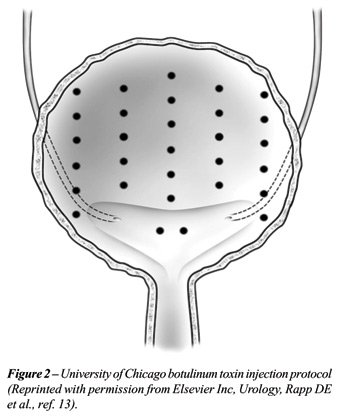
U). Our trigonal-inclusion protocol comprised 30 evenly distributed injections
(10 U/injection site), with two injections being placed in the trigonal
region (Figure-2). A statistically significant improvement in UDI and
IIQ symptom scores was seen at 3-week and 6-month follow-up in both groups.
However, no difference between the treatment arms was found. Notably,
the trigonal injection number was arbitrary and it is possible that a
greater number of injections within the trigonal region would have improved
patient outcome. Despite these findings, further investigation is needed
to determine whether trigonal injection is associated with improved urodynamic
outcomes or may be more appropriately used in patients with isolated sensory
and/or pain complaints. Further, in patients with pain- or sensory-predominant
symptomatology, it may be possible that a trigone-only injection template
may be sufficient to provide clinical benefit.
CLINICAL ISSUES RELATED TO BTX INJECTION
Treatment
Onset
Few investigations define the exact onset
of treatment response given the available literature. When reported, most
investigations define treatment onset based on subjective response, introducing
significant interpatient variation and recall bias. In contrast, objective
outcomes, as demonstrated by urodynamic evaluation, are often not performed
until 4 to 6 weeks following therapy. For these reasons, it is often difficult
to define precise treatment onset.
Smith et al. reported that maximal efficacy
was seen between 7 and 30 days following intradetrusor injection of BTX
(16). Time to maximal efficacy was defined using patient interview conducted
via telephone consultation or during clinic visit. In our investigation
of 35 patients undergoing bladder injection of BTX for treatment of OAB,
patient questionnaires were used to evaluate time to first and time to
maximal symptom improvement (13). Responders reported first noting an
improvement to their symptoms at a range of 1 to 14 days (mean 5.3) postoperatively
and described reaching the maximal symptom improvement at 2 to 20 days
(mean 8.3) postoperatively.
Repeat
Injection
Two investigations have specifically evaluated
the efficacy of BTX in patients undergoing repeat injection. Grosse and
colleagues reported 66 patients undergoing repeat BTX injection (Botox®,
300 U, Dysport®, 750 SU) in the treatment of neurogenic urinary tract
dysfunction (40). All patients underwent one repeat injection, with a
portion undergoing as many as six repeat injections. No difference was
seen when comparing the difference between injection intervals. Major
improvement in subjective satisfaction was seen in 71% of patients undergoing
repeat injection and was comparable to the 74% rate observed following
the initial injection. Urodynamic improvement in cystometric capacity
and reflex volume were seen through the measured endpoint of injection
3.
Repeat injection is also reported in other
studies. Smith et al. report 27 patients undergoing repeat injection at
intervals of 6 months or longer (16). The authors comment that repeat
injections usually lasted longer than the initial injection, with some
patients having a durable response greater than 1 year. However, no specific
data regarding repeat injection is provided in this report. Ruffion et
al. report repeat Dysport® injection (500 versus 1000 SU) in 36 patients
(20). In those patients receiving an initial dose of 1000 SU, there have
been no treatment failures. All patients receiving a second injection
revealed improved symptoms.
Based on these data, it appears that the
efficacy of BTX injection continues in the majority of patients undergoing
repeat injection. Undoubtedly, however, a small percentage of patients
will fail repeat injection. Multiple toxin injection may cause resistance
and associated treatment failure, with the development of anti-toxin antibodies
being proposed as one potential etiology of resistance (41). This data
served as one rationale for the investigation of BTX-B in the treatment
of urologic disorders. The use of BTX-B for DO has been reported in de
novo patients, those with documented BTX-A resistance, and in a cross-over
investigation protocol (42-46). Subjective and objective improvement was
seen in all studies. However, the short duration of effect (ranged six
weeks to six months) suggests that the use of BTX-B may be most appropriate
for patients initially failing BTX-A injection. Currently it is unclear
which patients are likely to respond to repeat injection, which criteria
should be used to time reinjection, and the role that BTX-B will play
in this treatment algorithm.
TECHNIQUE FOR INTRAVESICAL BOTULINUM TOXIN INJECTION
Bladder
Injection Technique
BTX injection is performed at our center
using intravenous sedation. Toxin injection using local anesthesia is
also reported and is associated with minimal discomfort. Rackley et al.
report The Cleveland Clinic Foundation injection protocol, in which 100
mL of 2% lidocaine solution is instilled into the bladder with a 15 to
20 minute dwell time (17). More experience using BTX under local anesthesia
may allow for cost reduction, avoidance of anesthetic risks, and injection
in the clinic setting. All patients receive perioperative antibiotics.
Intravesical injection of BTX is performed
by first diluting the toxin to the desired concentration. Botox is preserved
in a vacuum-dried formulation, with each vile containing 100 units. At
our institution, each vile of Botox® is diluted using 1 mL of preservative-free
saline, yielding 10 units per 0.1 mL for injection at each site. The entire
dilution is then drawn into a 1mL syringe. A total of two or three vials
are used, dependent on desired total dose. As excessive movement can decrease
the potency of the toxin through disruption of its disulfide bonds, care
is taken to avoid shaking during toxin preparation (47).
A variety of cystoscopic equipment has been
used to perform BTX injection. At our institution, we use a rigid 21F
cystoscope and a collagen injection needle inserted through the endoscopic
working port. Alternatively, a flexible cystoscope can be used and may
be better suited for injection in the clinic setting, especially with
the male patient. In this setting, a longer injection needle may be required
and can be combined with the use of a sheath to stabilize the needle for
ease during injection. Finally, both reusable and disposable injection
needles may be used, however, the long-term cost associated with disposable
needles must be considered.
BTX injection is initiated with standard
cystoscopy in the dorsal lithotomy position. Following entry into the
bladder with the cystocope, the needle tip is observed under direct vision.
As the needle sheath volume approximates 0.5 mL, priming is required.
Accordingly, 0.5 mL of BTX is injected into the needle prior to insertion
into the detrusor muscle. Visual confirmation of a sufficient priming
dose is provided by observing for cessation of air bubble flow from the
needle tip.
The bladder wall is then injected with BTX,
divided among evenly distributed intramural injection sites. In male patients,
a longer injection needle may be used when necessary. Twenty to 30 evenly
distributed intra-detrusor injections are generally administered based
on the specific protocol used (see previous discussion). Our injection
technique involves the creation of a submucosal bleb, allowing for action
on the underlying detrusor muscle. This technique allows for visual confirmation
of the insertion depth and diffusion along the suburothelial space. Other
authors attempt direct needle insertion and toxin injection within the
detrusor muscle itself. When using this technique, care must be taken
to avoid the risk of inserting the needle through the bladder serosa,
with resultant toxin extravasation and risk to neighboring pelvic structures.
Finally, BTX mixed with methylene blue is described to aid in identifying
injection sites and to ensure a uniform distribution (34). However, this
technique is not advocated by the manufacturers of Botox® due to the
unknown interactions between these two agents. As a result of sheath priming,
the final 0.5 mL of toxin are injected by flushing the sheath with a fourth
1 mL syringe containing 0.5 mL of saline.
CONCLUSION
The
introduction of BTX injection offers a promising treatment for a variety
of urologic disorders. Toxin injection may be easily performed using standard
cystoscopic equipment in the outpatient or clinic setting. The greatest
clinical experience is reported using 200 and 300 U Botox®. Available
data suggest that clinical efficacy, duration, and the side effect profile
is similar at these doses. While more data is needed, in the absence of
conclusive evidence suggesting improved clinical outcomes using 300 U,
the expense of BTX would support the use of a 200 U dose. Much less data
is available regarding clinical outcomes using the Dysport® preparation.
Isolated reports support that efficacy is similar when using a dosing
range of 500 to 1000 SU. However, these same reports suggest that 1000
SU may be associated with a longer duration of action, but increased risk
of systemic side effects. While this data may suggest that 750 SU is the
optimal dose, no definitive data is present to support this conclusion.
A variety of injection volumes have been
used, demonstrating similar efficacy and tolerability. However, no investigation
has specifically compared variable volumes in the setting of one injection
dose. Injection duration extends six to ten months in the majority of
study. Data suggests that repeat injection is successful in the vast majority
of initial responders, irrespective of preparation used (Botox® or
Dysport®). More experience is needed to precisely define the optimal
protocol for BTX with respect to therapeutic outcomes and adverse effects.
CONFLICT OF INTEREST
None declared.
REFERENCES
- Dykstra DD, Sidi AA, Scott AB, Pagel JM, Goldish GD: Effects of botulinum A toxin on detrusor-sphincter dyssynergia in spinal cord injury patients. J Urol. 1988; 139: 919-22.
- Kuo HC: Effect of botulinum a toxin in the treatment of voiding dysfunction due to detrusor underactivity. Urology. 2003; 61: 550-4.
- Zermann DH, Ishigooka M, Schubert J, Schmidt RA: Trigonum and bladder base injection of botulinum toxin A (BTX) in patients with severe urgency-frequency-syndrome refractory to conservative medical treatment and electrical stimulation. Neurourol Urodyn. 2001; 20: 412-3, Abstract.
- Smith CP, Radziszewski P, Borkowski A, Somogyi GT, Boone TB, Chancellor MB: Botulinum toxin a has antinociceptive effects in treating interstitial cystitis. Urology. 2004; 64: 871-5.
- Kuo HC: Prostate botulinum A toxin injection—an alternative treatment for benign prostatic obstruction in poor surgical candidates. Urology. 2005; 65: 670-4.
- Bagi P, Biering-Sorensen F: Botulinum toxin A for treatment of neurogenic detrusor overactivity and incontinence in patients with spinal cord lesions. Scand J Urol Nephrol. 2004; 38: 495-8.
- Schurch B, Stohrer M, Kramer G, Schmid DM, Gaul G, Hauri D: Botulinum-A toxin for treating detrusor hyperreflexia in spinal cord injured patients: a new alternative to anticholinergic drugs? Preliminary results. J Urol. 2000; 164: 692-7.
- Schurch B, de Seze M, Denys P, Chartier-Kastler E, Haab F, Everaert K, et al.: Botulinum toxin type a is a safe and effective treatment for neurogenic urinary incontinence: results of a single treatment, randomized, placebo controlled 6-month study. J Urol. 2005; 174: 196-200.
- Reitz A, Stohrer M, Kramer G, Del Popolo G, Chartier-Kastler E, Pannek J, et al.: European experience of 200 cases treated with botulinum-A toxin injections into the detrusor muscle for urinary incontinence due to neurogenic detrusor overactivity. Eur Urol. 2004; 45: 510-5.
- Schulte-Baukloh H, Michael T, Sturzebecher B, Knispel HH: Botulinum-a toxin detrusor injection as a novel approach in the treatment of bladder spasticity in children with neurogenic bladder. Eur Urol. 2003; 44: 139-43.
- Hajebrahimi S, Altaweel W, Cadoret J, Cohen E, Corcos J: Efficacy of botulinum-A toxin in adults with neurogenic overactive bladder: initial results. Can J Urol. 2005; 12: 2543-6.
- Rajkumar GN, Small DR, Mustafa AW, Conn G: A prospective study to evaluate the safety, tolerability, efficacy and durability of response of intravesical injection of botulinum toxin type A into detrusor muscle in patients with refractory idiopathic detrusor overactivity. BJU Int. 2005; 96: 848-52.
- Rapp DE, Lucioni A, Katz EE, O’Connor RC, Gerber GS, Bales GT: Use of botulinum-A toxin for the treatment of refractory overactive bladder symptoms: an initial experience. Urology. 2004; 63: 1071-5.
- Kessler TM, Danuser H, Schumacher M, Studer UE, Burkhard FC: Botulinum A toxin injections into the detrusor: an effective treatment in idiopathic and neurogenic detrusor overactivity? Neurourol Urodyn. 2005; 24: 231-6.
- Popat R, Apostolidis A, Kalsi V, Gonzales G, Fowler CJ, Dasgupta P: A comparison between the response of patients with idiopathic detrusor overactivity and neurogenic detrusor overactivity to the first intradetrusor injection of botulinum-A toxin. J Urol. 2005; 174: 984-9.
- Smith CP, Nishiguchi J, O’Leary M, Yoshimura N, Chancellor MB: Single-institution experience in 110 patients with botulinum toxin A injection into bladder or urethra. Urology. 2005; 65: 37-41.
- Rackley RR, Frenkl TL, Abdelmalak JB: Botulinum toxin: the promise of therapy for complex voiding dysfunction. Cont Urol. 2005; 38-52.
- Grosse J, Kramer G, Tong TQT, Stoher M, Jakse G: Efficacy, dosage, and safety of Dysport English botulinum toxin A in sever neurogenic detrusor overactivity. Eur Urol. 2005; suppl. 4: Abst #405.
- Kuo HC: Comparison of the therapeutic effects of suburothelial injection of botulinum A toxin at different doses for refractory detrusor overactivity. J Urol. 2006; 175: 113 (A347).
- Ruffion A, Capelle O, Paparel P, Leriche B, Leriche A, Grise P: What is the optimum dose of type A botulinum toxin for treating neurogenic bladder overactivity? BJU Int. 2006; 97: 1030-4.
- de Paiva A, Meunier FA, Molgo J, Aoki KR, Dolly JO: Functional repair of motor endplates after botulinum neurotoxin type A poisoning: biphasic switch of synaptic activity between nerve sprouts and their parent terminals. Proc Natl Acad Sci U S A. 1999; 96: 3200-5.
- Haferkamp A, Krengel U, Reitz A, Grosse J, Kramer G, Schumacher S, et al.: Are botulinum-A toxin injections into the detrusor of patients with neurogenic detrusor overactivity safe? Ultrastructural data of detrusor biopsies. Neurourol Urodyn. 2003; 22: 499-500.
- Rapp DE, Turk KW, Bales GT, Cook SP: Botulinum toxin type a inhibits calcitonin gene-related peptide release from isolated rat bladder. J Urol. 2006; 175: 1138-42.
- Chuang YC, Yoshimura N, Huang CC, Chiang PH, Chancellor MB: Intravesical botulinum toxin a administration produces analgesia against acetic acid induced bladder pain responses in rats. J Urol. 2004; 172: 1529-1532.
- Sampaio FJ: Effect of botulinum toxin A on the autonomic nervous system of the rat lower urinary tract. Int Braz J Urol. 2003; 29: 176-8.
- Apostolidis A, Popat R, Yiangou Y, Cockayne D, Ford AP, Davis JB, et al.: Decreased sensory receptors P2X3 and TRPV1 in suburothelial nerve fibers following intradetrusor injections of botulinum toxin for human detrusor overactivity. J Urol. 2005; 174: 977-82; discussion 982-3.
- Khera M, Somogyi GT, Kiss S, Boone TB, Smith CP: Botulinum toxin A inhibits ATP release from bladder urothelium after chronic spinal cord injury. Neurochem Int. 2004; 45: 987-93.
- Comperat E, Reitz A, Delcourt A, Capron F, Denys P, Chartier-Kastler E: Histologic Features in the Urinary Bladder Wall Affected from Neurogenic Overactivity-A Comparison of Inflammation, Oedema and Fibrosis With and Without Injection of Botulinum Toxin Type A. Eur Urol. 2006; 50: 1058-64.
- Del popolo G: Botulinum-A toxin in the treatment of detrusor hyperreflexia. Neururol Urodyn. 2001; 20: 522.
- Wyndaele JJ, Van Dromme SA: Muscular weakness as side effect of botulinum toxin injection for neurogenic detrusor overactivity. Spinal Cord. 2002; 40: 599-600.
- Kuo HC: Clinical effects of suburothelial injection of botulinum A toxin on patients with nonneurogenic detrusor overactivity refractory to anticholinergics. Urology. 2005; 66: 94-8.
- Smith CP, Chancellor MB: Emerging role of botulinum toxin in the management of voiding dysfunction. J Urol. 2004; 171: 2128-37.
- Kim HS, Hwang JH, Jeong ST, Lee YT, Lee PK, Suh YL, et al.: Effect of muscle activity and botulinum toxin dilution volume on muscle paralysis. Dev Med Child Neurol. 2003; 45: 200-6.
- Mahajan ST, Kenton K, Brubaker L: Cystoscopic intra-detrusor botulinum A toxin injection for the treatment of detrusor overactivity incontinence. J Urol. 2006; 175: 539, Abst #1672.
- Ray FR, Moore KH, Hansen MA, Barden JA: Loss of purinergic P2X receptor innervation in human detrusor and subepithelium from adults with sensory urgency. Cell Tissue Res. 2003; 314: 351-9.
- Chuang YC, Fraser MO, Yu Y, Chancellor MB, de Groat WC, Yoshimura N: The role of bladder afferent pathways in bladder hyperactivity induced by the intravesical administration of nerve growth factor. J Urol. 2001; 165: 975-9.
- Szallasi A, Fowler CJ: After a decade of intravesical vanilloid therapy: still more questions than answers. Lancet Neurol. 2002l;1: 167-72.
- Vemulakonda VM, Somogyi GT, Kiss S, Salas NA, Boone TB, Smith CP: Inhibitory effect of intravesically applied botulinum toxin A in chronic bladder inflammation. J Urol. 2005; 173: 621-4.
- Lucioni A, Rapp DE, Gong EM, Fedunok P, Bales GT: Botulinum toxin type A injection for overactive bladder: trigone versus trigone-sparing injection. (In Press).
- Grosse J, Kramer G, Stohrer M: Success of repeat detrusor injections of botulinum a toxin in patients with severe neurogenic detrusor overactivity and incontinence. Eur Urol. 2005; 47: 653-9.
- Doellgast GJ, Brown JE, Koufman JA, Hatheway CL: Sensitive assay for measurement of antibodies to Clostridium botulinum neurotoxins A, B, and E: use of hapten-labeled-antibody elution to isolate specific complexes. J Clin Microbiol. 1997; 35: 578-83.
- Dykstra DD, Pryor J, Goldish G: Use of botulinum toxin type B for the treatment of detrusor hyperreflexia in a patient with multiple sclerosis: a case report. Arch Phys Med Rehabil. 2003; 84: 1399-400.
- Dykstra D, Enriquez A, Valley M: Treatment of overactive bladder with botulinum toxin type B: a pilot study. Int Urogynecol J Pelvic Floor Dysfunct. 2003; 14: 424-6.
- Reitz A, Schurch B: Botulinum toxin type B injection for management of type A resistant neurogenic detrusor overactivity. J Urol. 2004; 171: 804; discussion 804-5.
- Pistolesi D, Selli C, Rossi B, Stampacchia G: Botulinum toxin type B for type A resistant bladder spasticity. J Urol. 2004; 171: 802-3.
- Ghei M, Maraj BH, Miller R, Nathan S, O’Sullivan C, Fowler CJ, et al.: Effects of botulinum toxin B on refractory detrusor overactivity: a randomized, double-blind, placebo controlled, crossover trial. J Urol. 2005; 174: 1873-7.
- Smaldone MC, Chancellor MB: Bladder or urethra injection of botulinum toxin type A: one institution’s experience. Am J Urol Rev. 2005; 3: 422-426.
________
Accepted:
September 20, 2006
_______________________
Correspondence address:
Dr. David E. Rapp
Department of Surgery, Section of Urology
University of Chicago Pritzker School of Medicine
5841 S. Maryland Avenue, MC 6038
Chicago, Illinois, 60637, USA
Fax: + 1 773 702-1001
E-mail: derapp@yahoo.com