SERUM LEVELS OF
TOTAL ACID PHOSPHATASE, PROSTATIC ACID
PHOSPHATASE, TOTAL AND FREE PROSTATE-SPECIFIC
ANTIGEN IN PATIENTS WITHIN CHRONIC HEMODIALYSIS PROGRAM

Department of Urology, School of Medicine, Celal Bayar University, Manisa, Turkey
ABSTRACT
Objective:
To investigate the effect of terminal renal failure with chronic hemodialysis
on prostatic disease markers [total acid phosphatase (TAP), prostatic
acid phosphatase (PAP), prostate-specific antigen (PSA) and free prostate-specific
antigen (fPSA)].
Patients and Method: Total acid phosphatase
(TAP), prostatic acid phosphatase (PAP), prostate-specific antigen (PSA)
and free prostate-specific antigen (fPSA) were measured in 28 patients
over 40 years of age on terminal renal failure with chronic hemodialysis.
Correlation was calculated between the dialysis duration and prostatic
disease marker levels.
Results: There was no evidence of artefactual
elevation of prostatic disease markers. TAP, PAP, PSA and fPSA levels
were in the normal range in all of the patients. However, PSA and fPSA
levels decreased as the dialysis duration increased.
Conclusion: Prostatic disease markers were
useful in the routine screening of men receiving long-term dialysis, but
the clinicians should be on alert when the dialysis duration increases.
Key Words:
prostate; cancer; prostatic markers; hemodialysis
Braz J Urol, 27: 133-135, 2001
INTRODUCTION
Serum
concentrations of total acid phosphatase (TAP), prostatic acid phosphatase
(PAP), prostate-specific antigen (PSA) and free prostate-specific antigene
(fPSA) are commonly used as a marker of prostatic disease. PSA is a 33000-dalton
glycoprotein and as many other glycoproteins are know to accumulate in
end-stage renal failure this might possibly cause on artefactual increase
in prostatic disease markers, with a high incidence of false positive
results in patients with renal insufficiency.
Kidney and liver may play a role in the
elimination of free PSA (f-PSA) from blood stream. Kiliç et al.
also demonstrated that a limited liver reserve is sufficient to maintain
serum f-PSA and total PSA (t-PSA) levels within normal ranges (1).
Previous studies have shown that PSA is
not eliminated by hemodialysis and others note that PSA levels increased
after dialysis (2,3). The purpose of this study was to evaluate hemodialysis
have any effect on prostatic disease markers such as PSA, fPSA, TAP, PAP
and to determine the effect of dialysis duration upon those markers which
has never been discussed in the literature.
We have therefore, addressed this question
by measuring prostatic markers in patients receiving long-term dialysis.
MATERIAL AND METHODS
Twenty-eight
patients on chronic hemodialysis were included in the study. Patients
were all men over 40 years of age (mean 55, range 41-69). Lower urinary
tract symptoms were evaluated in all patients and controls. Besides, urine
analysis and digital rectal examination were performed . Transrectal ultrasound
examination was done in men with t-PSA values greater than 4 ng/ml (Toshiba,
Tosbee, 7.5 mhz transrectally probe). Men with lower urinary tract symptoms,
urinary tract infections and suspicious digital rectal examination were
excluded from the study.
Mean dialysis time for all patients 3.2
years (range 6 month -18 years). The patients daily urinary output ranged
between 100 and 700 ml. A low-flux capillary dialyzer with cellulose diacetate
membrane was used and hemodialysis was performed in 3 session per week.
Blood and dialysate flow rates were 250-300 and 500 ml/min, respectively.
According to duration of dialysis, all patients were divided in to three
group. Group I was 0-2 years, group II was 2-4 years, group III was 4
years and over.
Serum prostatic markers were measured immediately
before hemodialysis; serum PSA and free PSA levels were measured by chemiluminescent
enzyme immunoassay by using Immulite Analyzer (DPC, Diagnostic Product
Corporation, USA). Normal range total PSA 0-4 ng/ml, free PSA 0.1-0.25
ng/ml. Serum TAP and PAP levels were determined by enzymatic colorimetric
methods (p-Nitrophenylphosphate, L-Tartarate; Pointine Scientific Inc.,
USA) on a TARGA 3000 autoanalyzer (Italy). Normal range of serum TAP 2.5-
11.7 U/L, serum PAP 0.2-3.5 U/L. Data were analyzed with Spearman correlation
test.
RESULTS
TAP
[mean 3.4 U/L,(normal: 2.5-11.7 U/L)], PAP [mean 1.7 U/L (normal: 0.2-3.5
U/L)], t-PSA [mean 1.13 ng/ml (normal: 0-4 ng/ml)] and f-PSA [mean 0.17
ng/ml (normal: 0.1-0.25 ng/ml)] levels were in the normal range in all
of the patients. Table-1 summarizes the prostatic disease markers values
in age-matched groups.There was no significance difference among the age
groups in terms of prostatic disease markers.

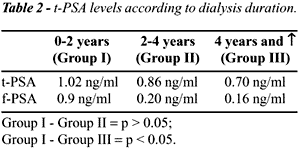
Total dialysis duration showed a negative
correlation with serum PSA and fPSA levels (r: -0.49, p < 0.01 and
r: -0.40, p < 0.04).
PSA and fPSA levels decreased as the dialysis
duration increased in patients receiving long-term dialysis (Table-2).
DISCUSSION
Prostate-specific
antigen is a serine protease produced by both benign and malignant prostatic
epithelium and widely used as a clinical maker of prostate cancer (4,5).
PSA is more sensitive than total acid phosphatase and prostatic acid phosphatase
in the detection of prostate cancer and, therefore, will be more useful
in monitoring responses and recurrence after therapy.
It has been well recognised that serum PSA
corelated with advancing patient age. Oesterling et al. (6) and Dalkin
et al. (7) have recommended adjustment of the upper normal limit of serum
PSA for advancing age.
Tumor markers play an important role in
the assessment of patients with some types of malignant disease. The effects
of several disease on the PSA have been studied in the recent years. Several
investigators have compared pre and post dialysis serum total PSA, free
PSA and free/total PSA ratio.
Kabalin showed that there was no detectable
PSA in the urine obtained from the renal pelvis. They have assessed that
the serum level of total PSA was not changed after hemodialysis significantly
(8). Danýþman et al. in their series; observed that serum
tPSa and fPSA levels did not significantly change after hemodialysis (9).
66% of men undergoing renal transplantation were over 40 years of age
and 10% of the patients with chronic renal disease were over 60 years
of age (10). It is likely that some of these patients will develop prostatic
disease. Comparisons among age-matched patients had no significant differences
in the mean PSA levels.
In this present study, no evidence of prostatic
cancer has developed in these patients over 40 years of age with end stage
renal failure. The measurement of prostatic markers used were in the normal
range. These findings indicated that neither renal impairment nor chronic
hemodialysis cause a artefactual elevation of prostatic disease markers.
The effects of total dialysis duration on
prostatic disease markers have not been studied before in the literature,
tPSA and fPSA levels decreased as the dialysis duration increased in patients
receiving long term hemodialysis.
In our study it is speculated that this
negative correlation may cause some delay in the diagnosis of prostate
cancer. However long term follow-up and pathologically confirmed studies
are needed to clarify the duration of hemodialysis on tumor markers of
the patients with prostate cancer.
In conclusion tPSA, fPSA, TAP and PAP can
be used to screen patients on dialysis, althoug they should be used with
caution in the diagnosis of prostate cancer in long term chronic hemodialysis
patients.
REFERENCES
- Kiliç S, Güntekin E, Danisman A, Kukul E, Sevük M: Serum free and total prostate-specific antigen levels in patients with liver disease. Urology, 52: 825-828, 1998.
- Monath JR, Burkart JM, Freedman BI, Pittaway DE, Russell GB, Assimos DG: Effects of hemodialysis on prostate spesific antigen. Urology, 42: 398-400, 1993.
- Sasagawa I, Nakada T, Hashimoto T, Ishigooka M, Kubota Y, Hirona K: Serum prostatic phosphatase, gamma-seminoprotein and prostatic specific antigen in hemodialysis patients. Int Urol, 48: 181-183, 1992.
- Carter HB, Pearson DJ, Matter JE, Brant LJ, Chan DW, Andres R, Fozard JL, Walsh PC: Longitudinal evaluation of prostate-specific antigen levels in men with and without prostate disease. JAMA,267: 2215-2220, 1992.
- Wang MC, Valenzuela LA, Murph GP, Chu TM: Purification of human prostate-specific antigen. Invest Urol, 17: 159-166, 1979.
- Oesterling JE, Jacobsen SJ, Chute CG, Guess HA, Girman CJ, Panser LA, Lieber MM: Serum prostate-specific antigen in a community-based population of healthymen: Establishment of age-specific reference ranges. JAMA, 270: 860-864, 1993.
- Dalkin BL, Ahman FR, Kopp JB: Prostate-specific antigen levels in men older than 50 years without clinical evidence of prostatic carcinoma. J Urol, 150: 1837-1839, 1993.
- Kabalin JN, Hornberger JC: Prostate-specific antigen is not excreted by human kidney or eliminated by routine hemodialysis. Urology, 37: 308-310, 1991.
- Daniþman A, Kiliç S, Kukul E, Yakupoglu G, Güntekin E, Baykara M, Sevük M: Do renal failure and hemodialysis have effect on the elimination of free and total prostate-specific antigen? Eur Urol, 37: 579-581, 2000.
- Morton JJ, Howe SF, Lowell JA: Influence of end stage renal disease and renal transplantation on serum prostate-specific antigen. Br J Urol, 75: 498, 1992.
______________________
Received: October 9, 2000
Accepted after revision: March 22, 2001
_______________________
Correspondence address:
Dr. Bilal Gümüs
School of Medicine, Department of Urology
Celal Bayar University, 45010 Manisa, Turkey
Fax: + + (0) (236) 237 02 13
E-mail: bhgumus@ixir.com