NATIVE FEMORAL
ARTERY-SAPHENOUS VEIN FISTULA
FOR HEMODIALYSIS
ALTAIR J. MOCELIN,
LAURO BRANDINA, ANUAR M. MATNI,
MARCO A.F. RODRIGUES, VINICIUS D.A. DELFINO, AREUZA C.A. VIANNA
Sections of Internal Medicine and Urology, State University of Londrina, Londrina, Paraná, Brazil
ABSTRACT
Objective:
To describe the outcome of the femoral artery-saphenous vein fistula as
an alternative blood access site for maintenance hemodialysis in a prospective
cohort of patients with end-stage renal failure.
Material and Methods: Sixty patients with
vascular access failure in the arms and absence of previous saphenous
vein surgery were admitted for up to two femoral artery-saphenous vein
fistulas as a puncture site for hemodialysis. The major saphenous vein
and the superficial femoral artery were isolated in the thigh and an U-shaped
subcutaneous tunnel created where the vein was placed superficially for
future punctures; arterio-venous anastomosis was accomplished by a running
6-0 prolene suture 2 centimeters below the inguinal ligament.
Results: A failing fistula was recognized
by the absence of adequate blood flow for hemodialysis or thrombosis.
Sixty three out of 73 fistulas allowed excellent blood flow from 2 months
to 16 years; the one year failure rate was 32.9%; one patient died of
massive bleeding in the immediate post-operative period; high output cardiac
failure complicated another and 2 others had severe leg edema as indication
for fistula closure.
Conclusions: Despite allowing adequate amount
of blood for dialysis, the femoral artery-saphenous vein fistula was accompanied
by a high failure rate, similar to the PTFE graft; it is however an alternative
for the renal failure patient.
Key words:
arteriovenous fistula; hemodialysis; femoral artery; saphenous vein
Braz J Urol, 27: 136-138, 2001
INTRODUCTION
Vascular
access failure imposes considerable threat to the end stage kidney patient
and represents a situation of great concern for the nephrologists. There
is no doubt on being the arteriovenous fistula the most important appendix
for life support once kidney function is lost (1), everything else depending
on its amount of blood delivered for diffusion and ultrafiltration.
When a radiocephalic or a brachiocephalic
anastomosis is unable to mature or fails, polytetrafluoroethylene (PTFE)
or a saphenous vein loop graft is placed in one arm as a substitute (2),
but present experience shows their propensity for early venous outflow
stenosis caused by endothelial and fibromuscular hyperplasia with subsequent
failure, added cost and morbidity (3). Catheters can also be used but
their failure rate and infection are also a problem.
We are showing our experience with an alternative
vascular access, the saphenous vein to the superficial femoral artery
anastomosis establishing a fistula for the maintenance hemodialysis and
treatment of chronic uremia.
MATERIAL AND METHODS
Sixty uremic patients, 52 whites and 8 blacks, 38 female, age five to eighty one (40.5 ± 16.4; x ± SD) years, with native A-V fistulas and/or PTFE graft failure in the arms underwent 73 subsequent surgical creation of a femoral artery-saphenous loop by-pass for the purpose of blood access for hemodialysis. The patients were operated on in the supine position with the inner aspect of the thigh to be used exposed. The femoral pulsation was felt and a 4-5 cm incision was made 2 cm below (paralleling) the inguinal ligament. The subcutaneous tissue was divided and a self-retaining retractor was placed to allow better field. The major saphenous vein and the superficial femoral artery were identified, isolated and repaired. The saphenous vein was then dissected downward to the knee where its distal end was ligated. This dissection was done through 2 or 3 longitudinal incisions. A U-shaped subcutaneous tunnel was created where the saphenous vein was placed in such a way that would facilitate future venipunctures. For the anastomosis between the saphenous vein and the superficial femoral artery, 4 individual stitches were first placed at a point 90° from each other and the anastomosis was fully accomplished by a running 6-0 prolene suture between these four points. Venipunctures using 16g needles were started around 15 days from the surgical procedure and repeated three times a week for its entire life span or renal transplantation. Overall, cumulative primary potency was calculated using Kaplan-Meier survival statistics
RESULTS
Sixty-three
fistulas allowed excellent blood flow which lasted from 2 to 192 months
before failure, patient transplantation or being in use at the end of
this analysis. On average, the femoral artery-saphenous vein fistulas
permitted the patient to be dialyzed for 15.7 months, the one-year failure
rate being 32.9%.
In all, nine fistulas were lost because
of the patient death, from day 4 to 82 months after the surgical procedure,
only one being related to it (massive bleeding on the fourth day); 14
fistulas were functioning, 8 at the end of the study (13 to 192 months)
and 6 maintained flow by the time of renal transplantation (2 to 20 months);
47 access went to failure, 9 due to thrombosis in the first 30 days and
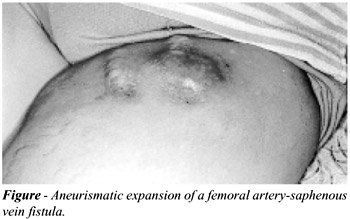
38 after allowing dialysis for a period of up to 16 years; aneurismatic
expansion was rare, and mainly at the repeated puncture sites (Figure).
In 3 others the fistula underwent planned closure, two with severe leg
edema, difficult walking and pain secondary to deep upstream vein thrombosis
in the presence of good fistula flow and one in consequence of high output
heart failure; surgical interruption of the blood flow through the fistula
led to improvement of the symptoms.
DISCUSSION
The
primary preferred arteriovenous fistulas created anastomosing a cephalic
vein to the radial artery is referred to fail at a rate of 30% from thrombosis
or insufficient caliber to permit cannulation by one year and 30 to 40%
is also the failure rate for the PTFE grafts at the same time period (4)
but by 3 years most grafts have been lost to thrombosis or infection.
In some uremic patients, upper extremity access failure even with exogenous
grafts becomes a problem in their maintenance and our attempt to solve
it using a leg vein was very successful in some patients, carrying their
dialysis up to 16 years, but failed in 32.9% of the cases in one year
and unexpectedly by 82% at 3 years, a figure referred in the literature
as happening to PTFE grafts.
We observed one patient death by massive
bleeding in the immediate postoperative period, incapacitating high output
cardiac failure in another, severe obstructive edema of the leg in two
others; the fistula high failure rate by 36 months raise concern on our
future indication of this procedure, as it shows to be no better than
a polytetrafluoroethylene graft in the arm, pointing to the need to look
for new blood vessels access for the treatment of this population.
Despite allowing adequate amount of blood
for dialysis, the femoral artery-saphenous vein fistula was accompanied
by a high failure rate, similar to the PTFE graft; it is however an alternative
for the renal failure patient.
REFERENCES
- Brescia MJ, Cimino JE, Appel K, Hurwich BJ: Chronic hemodialysis using venipuncture and a surgically created arteriovenous fistula. N Engl J Med, 275: 1089-1092, 1996.
- Harland RC: Placement of permanent vascular access devices: surgical consideration. Adv Renal Replace Ther, 1: 99-106, 1994.
- Schwab SJ, Besarab A, Beathard G Bouwer D, Etheredge E, Hartigan M: National Kidney Foundation DOQI clinical practice guidelines for hemodialysis vascular access working group. Amer J Kidney Dis, 30: 154-196, 1997.
- Hakaim AG, Scott TE: Durability of early prosthetic dialysis graft cannulation: results of a prospective, nonrandomized clinical trial. J Vasc Surg, 25: 1002-1005, 1997.
______________________
Received: August 30, 2000
Accepted after revision: February 19, 2001
_______________________
Correspondence address:
Dr. Lauro Brandina
Av. Bandeirantes, 804
Londrina, PR, 86010-010, Brazil
Fax: + + (55) (43) 321-1824
E-mail: nefro@sercomtel.com.br