CLODRONATE
FOR TREATMENT OF BONE METASTASES IN HORMONE REFRACTORY PROSTATE CANCER
(
Download pdf )
FLAVIO HERING, PAULO R.T. RODRIGUES, MARCO LIPAY
Portuguese Beneficence Hospital and Santa Helena Hospital, São Paulo, SP, Brazil
ABSTRACT
Introduction:
Approximately 85% of patients who die from prostate cancer have bone metastases.
Even though the radiological aspect of such metastases is osteoblastic,
we currently know that these lesions are mixed, with coexisting blastic
and lytic lesions, always beginning with bone lysis by osteoclast proliferation.
Treatment options are palliative and have poor response, and when there
is an improvement it is usually short-lived. This work intends to study
the effect of clodronate in the treatment of skeletal complications of
prostate cancer.
Materials and Methods: In an open prospective
study 32 patients with hormone refractory prostate cancer with metastases
to bones were assessed, in the period between November 2000 and September
2002. Mean age was 69 years (51 to 83 years). Patients were previously
assessed by a pain scale and Karnofsky index. They underwent bone scintigraphy,
X-ray, dosage of prostate specific antigen (PSA) and biochemical tests
before and following treatment (administration of intravenous clodronate
every 28 days). The Student’s t-test was used for statistical analysis.
Results: Twenty-nine patients (90.6%) showed
improvement after the first and the 2nd cycles, which persisted for at
least 4 months. Average on the pain scale improved from 7.7 to 2.1 and
Karnofsky index raised from 42 to 71. Radiological aspect of the metastases
improved in 15 patients (46.8%) and side effects were low (only 2 patients
- 6.2%).
Conclusion: Bisphosphonate was effective
in the treatment of skeletal complications of prostate cancer, presenting
an objective response in 90.6% of treated patients, with a marked improvement
in the pain scale, Karnofsky index and consequently in the quality of
life of patients, and with low side effects.
Key
words: prostatic neoplasms; neoplasm metastasis; bone; bisphosphonates;
palliative treatment
Int Braz J Urol. 2003; 29: 228-33
INTRODUCTION
The
incidence of prostate adenocarcinoma has increased greatly in the last
decade and, currently it is the most common type of non-cutaneous cancer
found in men over 50 years old. During the year of 2002, approximately
210,000 new cases were diagnosed in the USA. Currently, at the time of
diagnosis, even with all efforts for an early detection, 20% of patients
present bone metastases already. Considering that about 30% of patients
who receive treatment for localized prostate cancer presented a relapse,
the number of patients with advanced disease is high. Most of such patients
who are under hormone treatment become resistant to the hormone between
18 and 36 months after the therapy initiation and 85% to 95% of these
patients will present bone metastases and their complications (such as
pain, fractures and plegias) (1-3). The patient who presents already bone
metastases has an average survival of 2 years, which is a very long time,
considering that he will suffer with skeletal complications (2-4).
The majority of bone metastases of prostate
cancer are visualized on plain radiography as osteoblastic lesions, however
they always begin as lytic lesions with osteolysis caused by the tumorous
prostatic cells that interrupt normal bone remodeling through irregular
stimulation of osteoclasts and osteoblasts. Following the lytic lesion,
there is an excessive deposit of lamellar bone in the lacunae, forming
the osteoblastic aspect. This mechanism results in osteosclerosis, increasing
bone volume and destroying the normal bone (5-7).
Bisphosphonates have been widely employed
in bone metastases caused by breast cancer and multiple myeloma with excellent
results. It is a potent inhibitor of bone reabsorption, both normal and
pathologic, exerting a depressant effect on mature osteoclasts and inhibiting
the stimulation of osteoblasts, thus decreasing skeletal complications
(6).
The objective of the present study is to
evaluate clinically the effect of bisphosphonate clodronate in patients
with bone metastases due to hormone refractory prostate adenocarcinoma.
MATERIALS AND METHODS
Between
November 2000 and September 2002, 32 patients with bone pain due to metastasis
from hormone refractory prostate adenocarcinoma were evaluated, and treated
with clodronate in an open prospective study.
Mean age was 69 years (51 to 83). Among
those, 9 had undergone orchiectomy, 11 were using cyproterone acetate,
6 used LH-RH analogs, 2 used bicalutamide, and 4 patients were using estrogens.
Patients were considered hormone-refractory after 3 consecutive increases
of PSA during hormone therapy. In 8 patients mitoxantrone and corticoids
were administered, 5 patients received estramustine phosphate, 4 patients
used ketoconazole with corticoids and 3 patients used PC-SPES. These medications
were suspended when clinical or biochemical response ceased.
Before administration of first clodronate
dose, patients underwent a skeletal mapping for recording the quantity
and location of metastases, and every point with hypercaptation highly
suggestive of metastases was radiographed.
All patients answered to a visual pain scale
from 0 to 10 (no pain, to very strong pain), and general conditions were
assessed by Karnofsky index. Analgesics were taken as necessary, and these
patients were contacted every 14 days (office visits or telephone calls).
Those who showed no improvement after the second cycle received adjuvant
treatments (radiotherapy, chemotherapy or samarium).
After 4 months of treatment the patients
underwent a new bone scintigraphy for comparison with the initial one.
Radiographs of metastases locations were also taken. Monthly, determination
of PSA, phosphatases, calcium, creatinine, transaminases, and hemogram
with erythrocyte sedimentation rate were made.
Clodronate was administered intravenously
every 28 days at a dosage of 1,500 mg (5 vials of 300 mg diluted in 500
ml of saline solution, infused in 2 h). The procedure was done at an outpatient
basis without requiring admission to hospital. Following the infusion,
the patient was released for his normal activities.
For parametric and non-parametric statistical
analysis of variations in the pain scale and in the Karnofsky index, the
Student’s t-test was used for comparing data before and during treatment.
RESULTS
According
to the visual pain scale, 29 patients (90.6%) showed improvement, with
27 (84.3%) having a score equal or superior to 5 (Table-1).
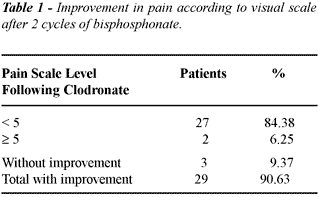
A total of 29 patients (90.6%), responded
to treatment with bisphosphonate. Radiologically, an improvement in metastases
was observed after the first 6 months in 15 patients (46.8%), Table-2.
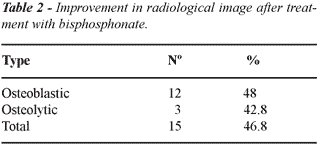
The average value on the visual pain scale
before treatment was 7.7, and after treatment it decreased to 2.1. Of
the 32 treated patients, 29 (90.63%) responded to treatment with bisphosphonate
and the Karnofsky index improved from 42 (range 32 to 58) to 71 (range
50 to 82), Table-3.

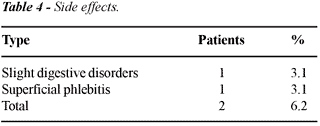
Side effects were minimal, with findings
of epigastralgia and excessive salivation in 1 patient, and superficial
phlebitis in left upper limb in another (Table-4).
DISCUSSION
It
is known those bone metastases are the most frequent ones in advanced
prostate cancer. It is known that approximately 85% of patients who die
with prostate adenocarcinoma have skeletal lesions and complications such
as pain, pathological fractures or spinal compression (4).
Based on clinical and experimental studies,
one can conclude that bone metastasis both in prostate and in breast cancer
have a similar behavior, and in the latter bisphosphonates are widely
employed as an adjuvant treatment with excellent results (7). Recently
a double-blind study was published, involving 1,069 patients with breast
cancer where it was concluded that the use of bisphosphonate clodronate
had a significant influence on the increase of survival (8).
Recent researches demonstrated that in the
physiology of bone metastasis, either in multiple myeloma, or in prostate
or breast cancer, the key to the lesion’s initiation is an increase
in osteoclastic activity promoting a bone lysis. Subsequently an excessive
and disordered deposit of sclerotic bone will occur due to the increase
in osteoblasts activity (osteoblastosis). In the case of prostate cancer,
such deposit is what most often confers the radiological aspect of an
osteoblastic lesion (6).
Cancerous prostatic cell detach from prostate,
reach blood circulation and are attracted to bone by local and distant
chemotactic factors such as metalloproteinases. Among the main local factors
are growth factors and cell-cell and cell-matrix interactions, favoring
thus the installation and growth of metastasis in the bone (6,9-12). The
release of paracrine factors that promote the initial bone absorption
is triggered by osteoclasts activation, initiating the lytic lesion. The
most important factors are: interleukin 1, 6 and 11; a and b tumor necrosis
factor, epidermal growth factor, parathormone-related peptide, prostaglandins
and procalepsin D. Factors that promote the increase of osteoblastic activity
are released subsequently, which will allow the excessive bone deposit
over the initial lytic lesion. Among the most important are the fibroblastic
growth factor, bone morphogenetic protein and insulin-like growth factor
(6,9-11,13).
Bisphosphonates cause a decrease in osteoclasts
activity, inhibiting bone lysis, and act also on osteoblasts preventing
the hyperactivity of these cells (osteoblastosis) that culminates with
excessive bone formation. A direct action over the tumor was also described,
inhibiting angiogenesis and promoting the apoptosis of cancerous cells,
in addition to inhibiting metalloproteases and cytokines (1,7-9,13).
According to their molecular mechanism of
action, bisphosphonates are divided in 2 large groups: amino bisphosphonates
(NBPs) and non-amino bisphosphonates (non-NBPs). Differently from non-NBPs
(clodronate and ethidronate), NBPs (pamidronate, ibandronate, alendronate
and zolendronate) do not have a nitrogen atom in their formulation, what
confers a different mechanism of action as for the molecular aspect. While
NBPs act intracellularly, inhibiting the mevalonate cycle, non-NBPs act
by promoting a direct toxicity over osteoclasts and osteoblasts inducing
the apoptosis and inhibiting the ATP/ADP translocase enzyme (9,15,16).
The differences between the 2 groups’ mechanism of action determine
differences in their effects, such as for instance, their activity over
the inflammatory process. Non-NBPs such as clodronate have anti-inflammatory
action and anti-rheumatic activity that occur with NBPs (16).
Pre-clinical studies demonstrate that osteolytic
lesions always precede the abnormal bone deposit (osteoblastosis), what
confer the osteoblastic aspect to the majority of metastatic skeletal
lesions of prostate cancer (6). It was shown through biopsies of metastatic
skeletal lesions that excessive bone reabsorption occurs at these sites,
similarly to breast cancer (6,7,13). The rational for using bisphosphonates
in prostate cancer comes from studies that demonstrated their beneficial
effects in inhibiting the invasion of prostate cancerous cells as well
as their adherence and lysis of bone matrix. Another advantage of clodronate
over other bisphosphonates is the possibility of using it orally, since
its absorption and effects have been already demonstrated in clinical
use (13).
As we have seen, bisphosphonates are used
in breast cancer and multiple myeloma since the early 80s with excellent
results, however only in the beginning of the 90s the first studies with
bisphosphonates in prostate cancer have appeared (9,15). The first study
with bisphosphonate in prostate cancer was conducted with clodronate by
Adami et al. in 1985 (17), who treated 17 patients with osteoblastic metastasis
by administering 300 mg of daily intravenous clodronate during 14 days
and 3,200 mg orally during the other 4 to 11 weeks. Significant improvement
was observed in pain and in Karnofsky index in 16 patients (94.1%) for
4 to 8 weeks.
In another study, Verreuther (13) administered
to 41 patients with skeletal lesions due to prostate cancer, intravenous
clodronate in a dosage of 300 mg daily for 8 days, along with 1,600 mg
orally. Twenty patients (71%) presented a significant improvement in pain
as soon as in the first 3 to 5 days and 9 remained asymptomatic.
Heidenreich et al. (2001) treated 85 patients
with skeletal complications due to metastatic prostate cancer with 300
mg of daily intravenous clodronate for 8 days, and 1,600 mg daily by oral
route for maintenance. They presented a response with an important decrease
in pain in 64 patients (75%) and 19 (22%) became asymptomatic, with improvement
in Karnofsky index from 45% to 70% (18).
These studies corroborate our results. As
well as in the paper by Adami et al. (17) more than 90% of our patients
had a significant improvement in pain, with 27 of 32 patients staying
below 5 (0 – 10) in the pain visual scale score and improvement
in Karnofsky index from 42% (range 32% to 55%) to 71% (range 50% to 82%),
following treatment with clodronate. In our study we used intravenous
clodronate in bolus, at the posology of 1,500 mg (5 vials containing 300
mg) diluted in 500 ml of saline solution applied during 2 h every 28 days,
and performed at an outpatient basis.
Side effects were observed in only 6.2%
of cases, and those were diarrhea and epigastralgia in one patient and
superficial phlebitis in another, what is close to Verreuther’s
results (13) and is lower than the complication reported by Heidenreich
et al. that is 17% (18). Maybe this fact has occurred due to the association
with oral clodronate used by these authors for maintenance of treatment
and that can lead to slight digestive disorders.
Following administration, 70 to 80% of the
active substance is cleared by urine in up to 24 h. Clodronate’s
advantage relative to other bisphosphonates is the possibility of using
it orally. Smith (19) used oral ethidronate and did not observe patients’
improvement in relation to the placebo group, because this medication
had a very low absorption by this route, becoming ineffective and failing
to produce the desired effect.
Among our patients, 25 (78.12%) had osteoblastic
and 7 (21,8%) osteolytic bone metastasis. Both types responded well to
treatment with clodronate. Pelvic bones were the most affected by single
metastasis, and associated lesions were the predominant (50%). In 15 patients
(46.8%) there was improvement and even disappearance of lesions in radiological
studies. This effect can be explained by the direct action that clodronate
exerts over the metastatic tumorous cell (induction of apoptosis, inhibition
of angiogenesis and cytostatic effect) (8,9,14).
In conclusion, one can verify that clodronate
is an effective drug for palliative treatment of bone complications caused
by hormone refractory prostate cancer, with prompt effects on pain, few
side effects and a significant improvement in the quality of life.
REFERENCES
- Berruti A, Dogliotti L, Bitossi R, Fasolis G, Gorzegno G, Bellina M, et al.: Incidence of skeletal complications in pattents with bone metastatic prostate cancer and hormone refractory disease: predictive role of bone resorption and formation markers evaluated at baseline. J Urol. 2000; 164: 1248-53.
- Greenlee RT, Murray T, Bolden S: Cancer statistics, 2000. American Cancer Society 2000; 50: 6-11.
- Parker SL, Tong T, Bolden S: Cancer statistics 1997. Ca Cancer J Clin. 1997; 47: 5-6.
- Issacs JT: The biology of hormone refractory prostate cancer. Why does it develop? Urol Clin North Am. 1999; 26: 263-9.
- Smith JA Jr., Soloway MS, Young MJ: Complications of advanced prostate cancer. Urology 1999; 54: 8-12.
- Dodwell DJ: Malignant bone resosption: Cellular and biochemical mechanisms. Ann Oncol. 1992; 3: 257-67.
- Guise TA, Mundy GR: Cancer and bone. Endocr Rev. 1998; 19:18-54.
- Diel IJ, Solomayer EF, Costa SD: Reduction in new metastase in breast cancer with adjuvant clodronate treatment. New Engl J Med. 1998; 339:357-63.
- Powles T, Paterson S, Kants JA, McCloskey E, Ashley S, P-Ilkkanen: Controled trial of clodronate in patient with primary operable breast cancer. J Clin Oncol. 2002; 20: 3219-24.
- Orr F, Lee J, Duivenvoorden WC: Pathophysiologic interactions in skeletal metastasis. Cancer 2000; 88 (Suppl 12): 2912-5.
- Sansoni P, Passeri G, Fangnoni F, Mohagheghpour N, Snelli G, Brianti V et al.: Inhibition of antigen-presenting cell function by alendronato in vitro. J Bone Miner Res. 1995; 10: 1719-23.
- Lissoni P, Cazzanigna M, Barni, Derenne S: Acute effect of pamidronato administratton on serum levels of interleukin-6 in advanced solid tumor patients with bone metastase and their possible implications in the immunoterapy of cancer with interleukin-2. Eur J Cancer 1992; 33: 304-8.
- Verreuther R: Bisphosphonates as an adjunct to palliative therapy of bone metastases from prostatic carcinoma. A pilot study on clodronate. Br J Urol. 1993; 72: 792-5.
- Nakashima J, Tachibana M, Horiguchi Y: Serum Interlevkin-6 as a prognostic factor in pacients with prostate cancer. Clin Cancer Res. 2000; 6: 2702-5.
- Munoy GR: Bisphosphosnates and tumor burden. J Clin Oncol. 2002; 20: 3191-2.
- Luckman SP, Huges DE, Loxon FF: Nitrogen containing bisphophonates inhibit the mevalonate pathway and prevent post-translational prenylation of GTP-binoing proteins including. Ras J Bone Miner Res. 1998; 13: 581-9.
- Adami S, Salvagno G, Guarrera G: Dichloromethylene – bisphosphonate in patients with prostatic carcinoma metastatic to the skeleton. J Urol. 1985; 134: 1152-5.
- Heidenreich A, Hofmann R, Engelmann UH: The use of bisphosphonate for the palliative treatment of painful bone metastasis due to hormone refractory prostate cancer. J Urol. 2001; 165: 136-40.
- Smith JA Jr: Palliation of painful bone metastases from prostate cancer using sodium etioronate: Results of randomized, prospective, double-blind placebo controlled study. J Urol. 1989; 141: 85-7.
_______________________
Received: January 14, 2003
Accepted after revision: April 11, 2003
_______________________
Correspondence address:
Dr. Flávio Hering
Rua Teodoro Sampaio, 744 / 84
São Paulo, SP, 05406-000, Brazil
Fax: + 55 11 3064-2989