ESTIMATED
COSTS OF TREATMENT OF BENIGN PROSTATE HYPERPLASIA IN BRAZIL
(
Download pdf )
HAYLTON J. SUAID, MARCO A. GONÇALVES, ANTONIO A. RODRIGUES JR, JOÃO P CUNHA, ADAUTO J. COLOGNA, ANTONIO C.P. MARTINS
Division of Urology, Department of Surgery and Anatomy, Ribeirão Preto Medical School, University of São Paulo, São Paulo, SP, Brazil
ABSTRACT
Introduction:
The treatment of benign prostate hyperplasia (BPH) presents 2 options:
medical or surgical, and there are doubts about what is the best treatment
since 80% of patients who undergo surgery become asymptomatic and 10 to
40% of those under medical regimen undergo surgery within a 5 years period.
It is difficult to assess the actual costs of treating BPH in Brazil due
to several factors, among them regional particularities and the scarcity
of current statistical data.
Patients and Methods: Recently, in the Ribeirão
Preto area, São Paulo, Brazil, the IPSS (International Prostatic
Symptoms Score) and quality of life were verified in 934 volunteers. It
was determined the percentage of individuals with ages ranging from 40
to 79 years with moderate symptoms (score 8-19) and with severe symptoms
(score 20-35), values for which are indicated medical and surgical treatment,
respectively, according to the Brazilian Society of Urology consensus
on BPH. Data on Brazilian population in that age range were obtained from
the Brazilian Institute of Geography and Statistics referent to the year
of 2000. It was determined the number of patients, according to the criteria
above, subjected to either one of the treatments mentioned. Surgical costs
of prostate transurethral resection were researched according to Unified
Health System - SUS tables (US$ 173) and of Brazilian Medical Society
- AMB with a mean cost in 3 hospitals of US$ 933. Drug costs were calculated
by the annual mean price (US$ 355) of 4 alpha-blockers (tamsulosin, alfuzosin,
doxazosin and terazosin).
Results: The estimated population for medical
treatment was 5,397,321 individuals, with a cost corresponding to US$
1,916,489,055.00. The estimated population for surgical treatment was
2,040,299 men, what would represent a cost of US$ 353,291,204.00 based
on the SUS table and of US$ 1,904,279,066.00 based on AMB with hospital
expenses included.
Conclusion: All theses facts induce us to
predict that the treatment of BPH in a not-so-far future can become a
public health problem for Brazilian society, since the current estimate
would be, approximately, costs around 2.26 – 3.83 billion dollars,
added by the yearly increase in the risk population (24.99%) for the group
under medical treatment and over the non-operated amount of the surgical
group.
Key
words: prostate; prostatic hyperplasia; drug therapy; surgery;
treatment costs
Int Braz J Urol. 2003; 29: 234-7
INTRODUCTION
Benign prostate hyperplasia (BPH) is very frequent in men and its prevalence increases with age, reaching figures of 85% to 90% in the age range above 80 years (1). The intensity lower urinary tract symptoms fluctuates with time and may no be consequent to BPH (2). This fact makes the identification of defined criteria difficult for indicating treatment, since about 80% of patients subjected to surgery become asymptomatic (3). Brazilian consensus tried to define some parameters for guidance when indicating any type of treatment for BPH based in IPSS score. Thus, observation was recommended for cases with scores lower than 8. For patients with values between 8 and 19 pharmacological treatment would be indicated, and above these levels (20 to 35) the option would be surgical (4). In the United States of America, transurethral resection of the prostate (TURP) is the second most performed surgical procedure, with an estimated cost between 2 to 3 billion dollars per year. As for costs with pharmacological treatment during a 5-year period, it is expected to range between US$ 1,800.00 and US$ 3,150.00 dollars/patient (5). The purpose of the present work was to estimate, with data from the Brazilian population, which would be the cost of BPH treatment.
MATERIALS AND METHODS
In
1997 it was made a screening for early diagnosis of prostate cancer, where
1,106 volunteers were examined. The IPSS and quality of life were verified
in all patients. To assess the participation of patients only with BPH,
patients presenting cancer, intraepithelial neoplasia or those who refused
biopsies when indicated were excluded, with 934 volunteers remaining for
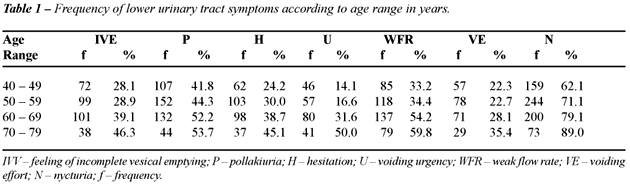
study. The results from this assessment allowed the creation of a table
referent to frequency and distribution of lower urinary tract symptoms
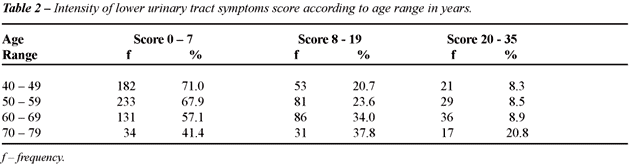
and signs in age ranges between 40 years and 79 years (Table-1), as well
as score classification according to what was determined by the National
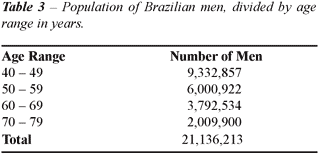
consensus on BPH (6) (Table-2). The number of men pertaining to each age
range existing in Brazil was obtained from the national census of 2000,
conducted by the Brazilian Institute of Geography and Statistics (IBGE)
(7) (Table-3). Having the frequency percentages of IPSS in several ranges
of population under study, the total of risk population in each range
and the criteria for indicating the type of treatment, the estimated number
of individuals subjected to pharmacological and surgical treatments was
obtained. The mean annual cost (September/2002) of drug treatment, based
on prices of alpha-blockers (tamsulosin, alfuzosin, doxazosin and terazosin)
in minimal dosages prescribed, was calculated in US$ 355 per patient.
The surgical cost of TURP as per SUS table was budgeted in US$ 173 per
patient and as per AMB table in US$ 933 per patient including hospital
expenses.
From this data, the costs of drug and surgical
treatments were calculated for each age range, thus obtaining the estimated
total value (Table-6).

RESULTS
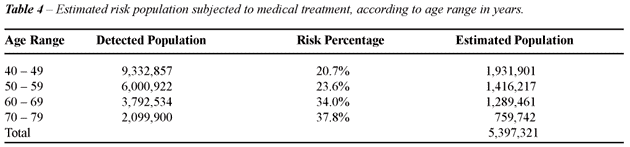
Population
subjected to medical treatment with IPSS of 8 to 19, according to the
age range is presented in Table-4. The value obtained for medical treatment
of the estimated risk population, was determined from calculation: 5,397,321
(patients) x US$ 355.00 = US$ 1,916,489,055.00.
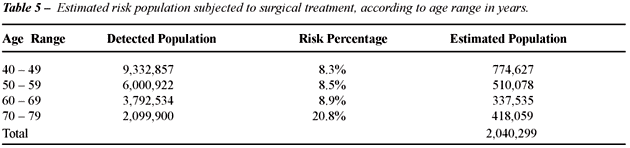
As for surgical treatment the estimated
risk population is presented in Table-5. The value obtained for surgical
treatment of estimated risk population, based on the SUS table, was determined
from calculation: 2,040,299 (patients) x US$ 173.00 = US$ 353,291,204.00.
Estimated cost for surgical treatment based on AMB table’s values
was obtained from calculation: 2,040,299 x US$ 933.00 = US$ 1,904,279,066.00.
Total values found for treatment of BPH
in Brazil are presented in Table-6 and represent the sum of medical and
surgical treatments.
DISCUSSION
In
1999 it was presented a work concerning the estimated costs of BPH treatment
in Brazil. At the time, the estimated population for calculation was obtained
through IBGE data from 1996. We were impressed by the values determined,
especially in reference to costs of medical treatment. Four years later
we decided to reassess those numbers to get an idea about their evolution.
There was a significant increase in risk population both for medical treatment
(52.4%) and for surgical treatment (118.7%). Such data show that Brazilian
population is growing older, with a significant increase in risk population
for BPH treatment. Associated with the population growth is the increase
in the procedure costs. Drugs cost has raised about 21.02%. SUS added
about 69.19% to TURP package, noting the addition of anesthetist’s
medical fees, which were separated from the package. AMB table plus hospital
expenses suffered an increase of 26.6% for TURP. The sum of these factors
has promoted an increased in the costs of annual medical treatment for
the risk population total of US$ 877,292,155.00, that is, 84.5%. On the
other hand, annual SUS cost to finance surgical treatment of risk population
has increased about US$ 258,360,324.00, which means an addition of 270.2%.
As for TURP costs according to AMB table for medical fees plus hospital
costs, it was calculated an addition of US$ 1,216,702,071.00, which represents
an increase of 176.9%.
This work’s intention is not discuss
if such increases could represent substantial gains to urologists or not,
but to analyze the necessary amount to be spent by the community in order
to finance BPH treatment. Obviously, these costs can present variations
with time due to the annual percentage increase in risk population, which
were calculated in 24.99% for both groups. For the medical group this
percentage is added yearly. However for the surgical group this percentage
falls over the non-operated amount.
Another interesting fact is that the total
resources spent with medical treatment are really significant, showing
that the urologist must be moderate in his/her indications so that he/she
will not burden society too much.
All theses facts induce us to foresee that
the treatment of BPH in a not-so-far future can become a public health
problem for Brazilian society, since the current estimate would be of
costs around 2.26 to 3.83 billion dollars, added by the yearly increase
in the risk population (24.99%) for the group under medical treatment
and over the non-operated amount of the surgical group.
REFERENCES
- Claus GR, John DM: Etiology, Pathophysiology, Epidemiology and Natural History of Benign Prostatic Hyperplasia – In: Walsh PC (ed.), Campbell’s Urology. Philadelphia, Saunders. 2002; pp. 1297-1336.
- Bosch JLHR, Hop WCJ, Kirkels WJ, Schroeder FH: The International Prostatic Symptoms in a community-based sample of men between 55 and 74 years of age: prevalence and correlation of symptoms with age, prostate volume, flow rate and residual volume. Br J Urol. 1995; 75: 622-30.
- Malone PR, Cook A, Admonson R, Gill MW, Shearer RJ: Prostatectomy: patients’ perception and long-term follow-up. Br J Urol. 1988; 61: 234-8.
- Rodrigues Netto Jr. N, Zerati Filho M, Ikari O: Treatment of BPH. Criteria for Medical or Surgical Treatment. In: Toledo WP: I Meeting of National Consensus in BPH. Brazilian Society of Urology. BG Cultural, São Paulo. 1996; pp. 65 [in Portuguese].
- Uro News – Internet – Brazilian Society of Information in Urological Pathology. 1996; 5:7 [in Portuguese].
- Martins ACP, Falconi RAR, Suaid HJ, Cologna AJ, Reis AJ, Cortez RR: Benign prostatic hyperplasia (BPH). Some epidemiological data in Ribeirão Preto. Rev Col Bras Cir. 1999; 26 (supl 1): 21 [in Portuguese].
- ibge.gov.br/ - população – censo demográfico 2000 – resultados do universo.
_______________________
Received: October 24, 2002
Accepted after revision: April 11, 2003
_______________________
Correspondence address:
Dr. Haylton Jorge Suaid
Department of Surgery and Anatomy
Sala 934 / 9º andar, Hospital das Clínicas - FMRP
Ribeirão Preto, SP, 14048-900, Brazil
Fax: + 55 15 633-0836