RENAL
CELL CARCINOMA IN CHILDHOOD
(
Download pdf )
LUCIANO R. BARROS, SIDNEY GLINA, LUIZ F. MELLO
Section of Urology, Ipiranga Hospital, São Paulo, SP, Brazil
ABSTRACT
The
renal cell carcinoma (RCC) rarely occurs in childhood. We report here
3 cases of RCC in children.
Two girls and 1 boy aged 14, 8 and 13 years
old, respectively, presented with gross hematuria as their main complaint.
They underwent ultrasonography and computerized tomography, which revealed
unilateral renal tumor with lymph nodal involvement in all 3 cases. They
were treated with radical nephrectomy associated with regional lymphadenectomy,
with histopathology of RCC. Incomplete adjuvant radiotherapy was performed
in 2 cases and no complementary treatment in the other one. All are disease-free
in a period ranging from 9 to 77 months after diagnosis.
Radical nephrectomy associated with regional
lymphadenectomy is the best treatment for RCC in childhood. The disease
appears to have a less aggressive behavior in children.
Key
words: kidney neoplasms; children; carcinoma, renal cell; nephrectomy
Int Braz J Urol. 2004; 30: 227-9
INTRODUCTION
The
incidence of renal cell carcinoma (RCC) is estimated in 0.1% to 0.3% of
all tumors and 1.8% to 6.3% of all malignant renal tumors in childhood
(1).
No proper therapy has been defined for children
with RCC. Surgery constitutes the main treatment and results in cure when
the tumor is localized and completely resected. The importance of radiotherapy
and immunotherapy is not clear and different chemotherapy regimens showed
only minimal activity when tested in clinical trials (1).
The authors report 3 cases of RCC in childhood.
CASE REPORTS
Case
1
Fourteen year-old girl was seen in June
1997 with left renal colic and hematuria for 3 months. The ultrasound
(US) revealed a nodule in the upper pole of the left kidney, measuring
4.3 x 4.0 cm, with enlarged perihilar lymph nodes. The computerized tomography
(CT) confirmed the findings. She underwent radical nephrectomy with regional
lymphadenectomy in July 1997 with histopathological diagnosis of RCC in
left kidney and lymph nodes involvement (4/4). The service of oncology
initially indicated radiotherapy, which was terminated after the fourth
session. The patient has been semestrally followed by US or CT and is
disease-free.
Case
2
Eight years old girl was seen in November
2000 with hematuria for 30 days. A cystoscopy was performed with clot
evacuation. The CT revealed a mass in lower pole of the right kidney with
ureterohydronephrosis. She underwent radical nephrectomy with regional
lymphadenectomy in December 2000, with histopathological diagnosis of
RCC in right kidney with capsular infiltration and the presence of 2 involved
hilar lymph nodes. Radiotherapy was initially indicated by the oncology
service, and terminated after the first session. She is disease-free.
Case
3
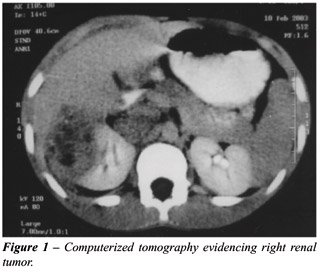
Thirteen years old boy, seen in February
2003 with hematuria for 8 months, hemoglobin of 9.3 mg/dL and US performed
30 days before, showed a right renal tumor, which was confirmed by CT
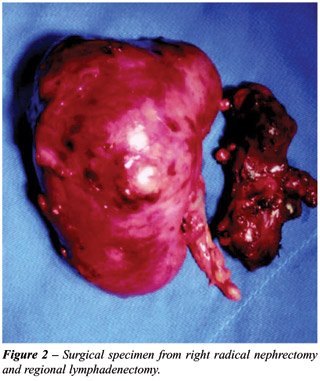
(Figure-1). He underwent radical nephrectomy with regional lymphadenectomy
(Figure-2) in March 2003, with histopathological diagnosis of RCC in right
kidney, with predominance of papillary variant, with lymph node metastasis.
He did not undergo any adjuvant therapy and is disease-free.
DISCUSSION
Recent
studies showed that the RCC corresponds to 1.4% of renal tumors in patients
under 4 years old, 15.2% between 5 and 9 years and 52.6% from 10 to 15
years old (2).
Palpable mass occurs in 38%, hematuria in
38% and abdominal pain in 50%, with the classic triad being found in only
6% of cases (3). Metastases occur in lungs (40-65%), liver (35-57%), bones
(10-42%) or bladder, brain or pleura (7-15%) (2). Surgery constitutes
the main treatment (1).
Tumor staging is the most important prognostic
factor. Overall 5-year survival is approximately 60%, with poor prognosis
(9%) for stage IV (2).
Two of our patients started adjuvant radiotherapy.
Since we did not find in the literature any incentive for such procedure,
we decided jointly with the service of oncology to terminate it. Considering
this fact and the good survival we achieved, we can agree with the unanimous
opinion expressed in the works we reviewed, that radical nephrectomy associated
with regional lymphadenectomy is the best treatment for RCC in childhood.
Our results also suggest a less aggressive behavior of the disease in
this age range.
REFERENCES
- Indolfi P, Terenziani M, Casale F, Carli M, Bisogno G, Schiavetti A, et al.: Renal cell carcinoma in children: A clinicopathologic study. J Clin Oncol. 2003; 21: 530-5.
- Uchiyama M, Iwafuchi M, Yagi M, Inuma Y, Masahiro O, Tomita Y, et al.: Treatment of childhood renal cell carcinoma with lymph node metastasis: Two cases and a review of literature. J Surg Oncol. 2000; 75: 266-9.
- Carcao MD, Taylor GP, Greenberg ML, Bernstein ML, Champagne M, Hershon L, et al.: Renal cell carcinoma in children: A different disorder from its adult counterpart? Med Pediatr Oncol. 1998; 31:153-8.
_________________________
Received: December 12, 2003
Accepted after revision: April 4, 2004
_______________________
Correspondence address:
Dr. Luciano da Rocha Barros
Rua do Arraial, 209 / 24B
São Paulo, SP, 04122-030, Brazil
Fax: + 55 11 6169-9629
E-mail: lucianobarros@terra.com.br
EDITORIAL COMMENT
The
authors present 3 interesting cases of a rare pediatric tumor, that is
renal cell carcinoma. Since the treatment with radiation therapy is not
the standard of care, I do not know why they treated their patients with
this therapy.
The authors say that the tumor has good
prognosis in children, and I do not believe this is what the literature
says. Also, they cannot base their conclusion on their limited experience
with a short term follow up (the authors stated that because one of their
patients had advanced disease and is alive, this point to better prognosis
in children). It is important to note that most patients with renal cell
carcinoma do not have positive nodes, and that in the present series the
incidence was higher than expected (even though again it is a limited
experience). Also, it is important to remember that lymph node disease
is known to significantly worsen the survival of patients with renal cell
carcinoma.
Dr.
E. Tavora Fernandes
Chief of Urology
Department of Veterans Affairs
Minneapolis, Minnesota, USA