STAPLELESS
LAPAROSCOPIC ASSISTED RADICAL CYSTECTOMY WITH ILEAL NEOBLADDER IN A MALE
AND WITH ILEAL LOOP IN A FEMALE: INITIAL REPORT FROM BRAZIL
(
Download pdf )
SIDNEY C. ABREU, ROMULO A. SILVEIRA, JOAO B. CERQUEIRA, ROMMEL P. REGADAS, LUCIO F. GONZAGA, GILVAN N. FONSECA
Sections of Urology, Federal University of Ceara and Federal University of Goias
ABSTRACT
Introduction:
Here, we report our initial experience with laparoscopic assisted radical
cystectomy without the use of surgical staples.
Cases Report: A 70 year old male and a 55
year old female were diagnosed to have T2G3 transitional cell carcinoma
of the bladder with negative metastatic work-out. Both patients were scheduled
and agreed to a laparoscopic assisted radical cystectomy. In both cases,
urinary diversion (orthotopic ileal Studer neobladder in the male and
ileal conduit in the female) was performed extracorporeally following
radical cystectomy. In both cases control of the bladder vascular pediclewas
accomplished with a combination of metallic and hem-o-lock clips. The
total surgical time was 6.5 hours in both cases. Estimated intra-operative
blood loss was 500 cc and 350 cc respectively, however both patients required
postoperative blood transfusions. No intraoperative complications occurred.
In both cases, pathology revealed negative surgical margins.
Conclusions: Extracorporeal creation of
urinary diversion decrease the overall operative time. Laparoscopic pelvic
lymphadenectomy can be performed following the extended template. The
use of surgical clips instead of vascular Endo-GIA titanium staples to
control the bladder vascular pedicles is feasible and safe in selected
patients, thus reducing intraoperative surgical costs. Considerable experience
with laparoscopic radical prostatectomy is necessary before one attempts
laparoscopic radical cystectomy.
Key
words: bladder neoplasms; cystectomy; urinary diversion; lymphadenectomy;
laparoscopy
Int Braz J Urol. 2005; 31: 214-21
INTRODUCTION
The
laparoscopic approach in urology is now an accepted option for kidney,
adrenal, and prostate surgery. Naturally, this minimally invasive technique
has progressed to the only remaining intra-abdominal urological organ
left behind, the bladder. Although the first laparoscopic cystectomy for
a retained bladder was performed over a decade ago (1), only recently,
with the advancements in instrumentation design, and improvement of surgical
techniques, laparoscopic radical cystectomy has regained interest (2).
Although feasible, some argue that radical
cystectomy should not be performed laparoscopically, mainly because of
issues related to a prolonged surgical time, the inability to perform
an adequate lymph node dissection, and to a significant amount of disposables
required, which elevates surgical costs. Recently, Basillote and colleagues
have demonstrated that when cystectomy and pelvic lymph node dissection
are performed laparoscopically and the reconstructive portion of the operation
(ileal neobladder and ureteral re-implantation) is performed open surgically
through a 15 cm Pfannensteil incision, the patient has the benefits of
a minimally invasive approach, including decreased postoperative pain
and faster recovery, without a significant increase in the operative time
(3). Besides, the Cleveland Clinic group, highlighting the importance
of extended pelvic lymphadenectomy in the management of bladder cancer,
has demonstrated that during the laparoscopic procedure one should be
able to perform the node dissection following the extended template, without
compromising the established oncological open surgical principles (4).
Furthermore, in an attempt to decrease surgical costs related to the use
of disposable equipment, Abdel-Hakim et al. reported the use of the harmonic
shears to control the lateral and posterior bladder pedicles, thus avoiding
the use of 9 to 10 vascular loads of Endo-GIA stapler and reducing intraoperative
costs (5).
Based on these promising results, we have
decided to perform in our institution, a laparoscopic assisted radical
cystectomy without the use of surgical staples. To the best of our knowledge,
this is the first report of laparoscopic radical cystectomy with urinary
reservoir in our country, placing Brazil among a selected group of 9 countries
(14 different institutions) that have reported approximately 156 cases
of laparoscopic radical cystectomy during the 2003 Annual Meeting of the
American Urologic Association in Chicago, Illinois and the 2003 World
Congress of Endourology in Montreal, Canada (2). Nonetheless, we do acknowledge
that Mirandolino Mariano and his group have previously presented a video
on laparoscopic cystectomy during the Iguaçu Falls meeting 2003
(6). However, these authors reported a salvage procedure without the construction
of a urinary reservoir, only a bilateral cutaneous ureterostomy (6). Here,
we describe our initial experience, technique and results with stapleless
laparoscopic assisted radical cystectomy with ileal neobladder in a male
and ileal loop in a female.
SURGICAL TECHNIQUE
Laparoscopic
Radical Cystoprostatectomy
The patient was placed in the supine position
with thighs abducted and arms adducted to his sides, the operative table
was set in a 30 - 45° Trendelenburg position and a Foley catheter
was inserted in the bladder after the patient was prepped and draped.
The surgeon was on the left side of the patient. The first assistant was
on the right side of the patient and the second assistant was positioned
next to the surgeon. A five-port transperitoneal approach was used. Following
the creation of a 12 - 15 mmHg of pressure CO2 pneumoperitoneum with a
Verres needle, a primary 10 mm port was placed at the umbilicus
for the 0° laparoscope. Four secondary ports were placed under sight:
a 5-12 mm port to the right and a 5 mm port to the left of the umbilicus,
lateral to the rectus muscle, and two ports (5 mm) in the left and right
lower quadrants, approximately 2 finger-breadths medial to the ipsilateral
anterior superior iliac spines.
The posterior peritoneal fold was incised
at the level of the common iliac vessel, the ureters were identified and
widely mobilized bilaterally downwards close to the bladder wall. Adequate
mobilization of the left ureter was assured to allow subsequent tension-free
retroperitoneal transfer to the right side for the ureteroileal anastomosis.
Subsequently, the peritoneum at the rectovesical pouch was incised in
order to identify and the vas deferens and seminal vesicles, which were
dissected towards the bladder base using the harmonic scalpel. Denonvilliers’
fascia was incised with cold-cut scissors and dissection along the anterior
rectal surface was followed distally towards the prostate apex. Both ureters
were clipped close to the bladder and divided. The lateral and posterior
bladder pedicles were then dissected and clip-ligated with a combination
of metallic and hem-o-lock clips. Using the harmonic scalpel the neurovascular
bundles were transected, leaving the prostate attached posteriorlly only
by the rectourethralis muscles. The bladder was distended with 200 mL
of saline and the parietal peritoneum lateral to the medial umbilical
ligaments was incised and extended anteriorly onto the undersurface of
the abdominal wall to include the entire urachus close to the umbilicus.
The Retzius’ space was entered and the bladder was mobilized keeping
all the extraperitoneal perivesical fat attached to the bladder. The endopelvic
fascia was incised bilaterally and the dorsal venous complex was suture
ligated with 2-0 vicryl stitch on a CT-1 needle. This stitch was placed
in a backhand manner from the right to the left side, distal to the prostate
apex, between the dorsal vein complex and the urethra. In order to avoid
inadvertent transgression of the urethra by the suture, the Foley catheter
was replaced by an 18 Fr metallic urethral sound, which was pushed down
by the assistant, displacing the urethra posteriorly. In an attempt to
achieve a safe ligation, two stitches were placed across the dorsal vein
complex and were fastened secured (7). Using the J-hook electrocautery
the dorsal vein complex was transected. At this point, cold Endoshears
was used to transect the anterior and posterior urethral wall. The rectourethralis
muscles were divided, thus completely freeing-up the surgical specimen,
which was entrapped in a Lapsac for later extraction at the end of the
procedure.
Laparoscopic
Radical Cystectomy in a Female
The same port placement was employed with
the patient in a low-lithotomy, 30 - 45° Trendelenburg position. Since
this patient had a prior pelvic surgery (ovariectomy), initial access
was obtained with the Hasson technique and a 10 mm Blunt-tip balloon port
was used at this site to prevent air leak. Following lise of intraperitoneal
adhesions, the uterus was retracted anteriorly, and the initial peritoneotomy
was made in order to identify the ureters, which were dissected down to
the bladder wall, clip-ligated and transected. The peritoneum at the rectovesical
cul-de-sac was incised and further dissection was performed to develop
a plane anterior to the rectum. The ovary vascular pedicle, the uterine
round and broad ligaments and vesical vascular pedicle were sequentially
ligated with a combination of metallic and hem-o-lock clips and divided.
Similarly to what was described above, the Retzius space was entered and
the bladder was mobilized anteriorly. A sponge stick is inserted into
the vagina to help identifying the vagina. Subsequently, the posterior
vaginal wall was horizontally incised just distal to the uterine cervix
with a J-hook electrocautery. This incision was then extended bilaterally
towards the urethra, removing a strip of the anterior vaginal wall. At
this point, the surgeon standing in between the patient’s legs dissected
the entire urethra circumferentially. The remaining attachments between
the urethra and the anterior vaginal wall were cut and the intact surgical
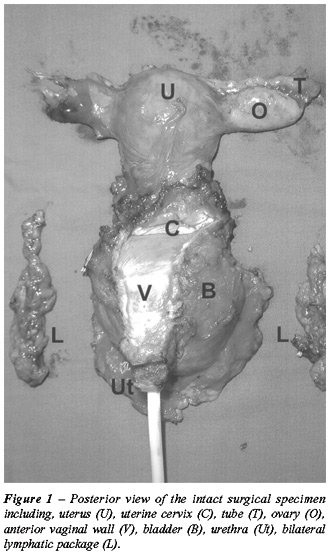
specimen (Figure-1) was extracted through the already open vaginal vault
without the use of any bag. Pneumoperitoneum was re-established and maintained
by keeping moister towels at the vaginal vault. Finally, the vaginal wall
defect was closed laparoscopically with a 0-vicryl running suture.
Laparoscopic
Extended Pelvic Lymph Node Dissection
Bilateral extended pelvic lymphadenectomy
was performed following radical cystectomy, including lymphatic tissue
from the pubic bone distally to the bifurcation of the common iliac artery
proximally and from the genitofemoral nerve laterally and the obturator
nerve inferiorly (4). The lateral border of dissection was developed along
the genitofemoral nerve by dividing the fibro-areolar tissue and exposing
the iliopsoas muscle. The lymphatic tissue packet was completely lifted
en bloc off of the surface of the iliopsoas muscle and swept medially.
The tissue anterior to the external iliac artery (up to the common iliac
artery) and vein was then individually split longitudinally using J hook
electrocautery, skeletonizing the 2 vessels circumferentially. The released
packet was rolled medially posterior to the mobilized external iliac artery
and vein, delivering it into the pelvis. Dissection along the medial aspect
of the packet identified the obturator nerve. The entire specimen was
placed in a Lapsac for further extraction.
Urinary
Diversion
Orthotopic Ileal Neobladder –
Following radical cystoprostatectomy and pelvic lymphadenectomy, a 12
cm Pfannensteil incision was made and the adnominal cavity was entered.
The entrapped surgical specimen was then extracted. Bowel work and handling
including: isolation of the distal ileal segment, creation of the Studer’s
neobladder, bilateral insertion of ureteral double J stents, refluxing
bilateral ureteral re-implantation, and urethral-neobladder anastomosis
over a 20F Foley catheter creation, was easily accomplished using standard
open surgical techniques. Bilateral suction drains were left in the deep
pelvis. No suprapubic cystostomy tube was employed.
Ileal Conduit - Following laparoscopic
closure of the vaginal defect, the left ureter was delivered through the
retroperitoneum to the right side. To facilitate a further identification,
2-0 vicryl stay sutures were placed at the tip of the ureters. Under laparoscopic
control, the distal ileum was identified and grasped with a bowel clamp
inserted though the right side 12 mm working port. Subsequently this port
was removed, the port site incision was extended for 1.5 cm, and the distal
ileum was brought outside the abdominal cavity. A 15 cm ileal segment
was isolated, its distal end was closed with a running suture and bowel
continuity was restored. The mesenteric window was closed and bowel was
re-inserted inside the abdominal cavity, keeping the ileal loop outside.
After gently occluding the right hand port site with 2 finger tips, the
pneumoperitoneum was re-established and both ureters were identified and
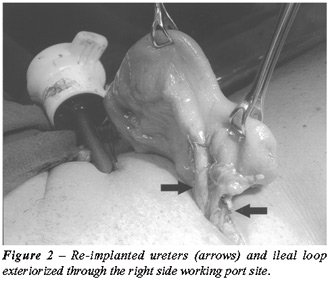
delivered outside the abdomen, through the right side working port site,
under laparoscopic visualization. Standard bilateral stented (8 Fr NG
tubes) ureteral-ileal loop anastomosis were performed open surgically
(Figure-2). The ileal loop along with the re-implanted ureters were re-inserted
into the abdomen and an ileostomy was fashioned at the right hand working
port site. A suction drain was left in the deep pelvis. The “neovagina”
was packed with sterile gauzes.
CASES
REPORT
Case
1
A 70 year old male, BMI of 24, ASA II, was
diagnosed to have a T2G3 bladder transitional cell carcinoma. Metastatic
workout with chest x-ray and abdominal CT were negative. There were no
sins of enlarged pelvic nodes or hydronephrosis. Patient was schedule
and consent to a laparoscopic assisted radical cystoprostatectomy with
orthotopic ileal neobladder.
Total surgical time was 6.5 hours, including
4.0 hours for radical cystectomy and pelvic lymphadenectomy and 2.5 hours
for neobladder creation, intraoperative estimated blood loss was 500 ml.
Nonetheless, patients’ postoperative hemoglobin dropped 4 points
to 8.9 mg/dL; hence he was given 2 units of concentrated red blood cells.
No intraoperative complications occurred. However, the left side suction
drain persisted with a high output of fluid (700 - 1000 cc). A retrograde
cystogram was then performed revealing only a small leakage at the neobladder-urethra
anastomotic site. Measurement of creatinine levels in the drain fluid
were similar to the serum. Biochemical analysis of the drain fluid showed
a high concentration of triglycerides (1015 ng/dL) and cholesterol (238
ng/dL). The patient was treated successfully with dietary measures (high
protein, low fat, medium chain triglyceride diet and salt restriction)
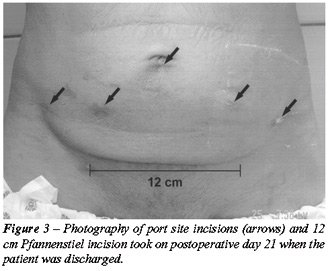
for 3 weeks. At postoperative day 21, the Foley catheter along with the
ureteral stents were removed and the patient was discharged home (Figure-3).
Pathology revealed negative surgical margins.
Case
2
A 55 year old female, BMI 24, ASA II, heavy
smoker, was diagnosed to have a T2G3 bladder transitional cell carcinoma.
Metastatic workout with chest x-ray and abdominal CT were negative. There
were no sins of enlarged pelvic nodes or hydronephrosis. Due to tumor
extension to the bladder neck clearly seem during TURB, the decision was
made to avoid an orthotopic pouch. The patient understood the risks and
consented to a laparoscopic assisted radical cystectomy with total urethrectomy
and ileal loop urinary diversion.
Total surgical time was 6.5 hours, including
5.0 hours for radical cystectomy and pelvic lymphadenectomy and 1.5 hour
for ileal loop creation, estimated blood loss was 350 cc. No intra-operative
complications occurred. Although intra-operative blood loss was low, the
patient had a pre-operative hemoglobin of 10mg/dl (after transfusion of
2 units of red blood cells); therefore we opted to transfuse one more
unit of red blood cell base on a postoperative hemoglobin of 8.5 mg/dL.
Patient resumed fluids and ambulation on postoperative day 2. The suction
drain was removed on postoperative day 4 when the patient was discharged
home.
COMMENTS
Laparoscopy
is facing its last frontier in urological oncology, the surgical treatment
of bladder cancer. As stated by Moinzadeh and Gill, this cutting edge
procedure does offer advantages such as decreased blood loss, decreased
postoperative pain, early return to full activity, and better cosmesis
(2). Nonetheless, issues such as longer OR time, more expensive operation,
and lack of long-term oncological data do represent a downside of this
minimally invasive approach. Based on previous report in the literature,
we have tried to address these cons related to laparoscopic radical cystectomy
using the following strategy: a) In order to decrease the overall surgical
time, we’ve performed the reconstructive part of the operation -
urinary diversion extracorporeally. b) In order to comply with the oncological
principles established in open surgery, we’ve followed an extended
template for pelvic lymphadenectomy. c) In an attempt to reduce the surgical
costs, we’ve avoided the use of laparoscopic surgical staples to
control the bladder vascular pedicle.
Judging the laparoscopic procedure based
on the operative time that is required to perform the same operation open
surgically, we made the decision to fashion the urinary diversion intra
or extracorporeally an important factor. In initial series where the reconstructive
part of the operation (Mainz II sigmoid pouch, ileal conduit, Studer orthotopic
ileal neobladder) performed completely intracorporeally, the total operation
time varies from 7.4 hours to 10.5 hours (8-10). On the other hand, in
our initial two cases, the urinary diversion (Studer neobladder or ileal
loop) was performed extracorporeally, resulting in an overall surgical
time of approximately 6.5 hours. Although this represents our initial
experience with laparoscopic radical cystectomy, our group has familiarity
with major laparoscopic surgery, including more than 25 laparoscopic radical
prostatectomies successfully performed in the past year. This is in line
with the majority of authors that do not recommend laparoscopic radical
cystectomy before the surgeon has properly mastered the technique of laparoscopic
radical prostatectomy (11). Whereas creation of the neobladder following
laparoscopic cystectomy through a 12 cm Pfannensteil incision poses no
significant difference to what is routinely performed during open surgery.
The creation of the ileal loop and ureteral re-implantation through an
extended 3 cm port site incision has inherent problems such as tissue
orientation that could potentially lead to positional distortion. Moreover,
it may be difficult or even impossible to extract the ileum and the ureters
to the skin level in obese patients (12,13).
There is a growing evidence in the literature
supporting a surgical cure rate of 25% to 35% in patients with low volume
lymph node disease. Moreover, recent studies suggest that the anatomical
extent of lymphadenectomy is an important independent factor for the cure
of bladder cancer (14-16). Following these well-established open surgical
principles, Finelli and colleagues demonstrated that during the laparoscopic
procedure one should be able to perform the node dissection following
the extended template (4). Furthermore, these authors listed certain technical
caveats such as, to perform lymphadenectomy after cystectomy so that tissue
planes for laparoscopic cystectomy would not be compromised, to avoid
iatrogenic trauma to any enlarged lymph node and to entrap the lymph node
specimen immediately upon completing lymphadenectomy to minimize local
and/or port site tissue contact (4). In our initial 2 cases, bilateral
pelvic lymphadenectomy was performed without iatrogenic injury to the
iliac vessels or to the obturator nerve (17,18). However, in our first
case a persistent postoperative chylous drainage occurred and was successfully
managed with dietary measures (19). In order to avoid this problem in
our second case, we’ve carefully clip-ligated any larger lymphatic
channel prior to its transaction (4). Although the Cleveland Clinic group
reported 2 cases of deep venous thrombosis (DVT) following laparoscopic
extended pelvic lymphadenectomy (4). We did not experience any DVT in
our 2two cases.
A higher intraoperative surgical cost, mainly
related to the use of disposable equipment, represents a great obstacle
to laparoscopic radical cystectomy gain acceptance, especially in developing
countries (20). Traditionally, the control of the vascular pedicle of
the bladder has been made employing serial Endo-GIA firing (9-10 loads
of vascular 2.5 mm stapler) (5). As described by Abdel-Hakim and colleagues,
the use of the harmonic shears could replace the Endo-GIA stapler for
the control of the lateral and posterior pedicles of the bladder, thus
reducing costs (5). In an attempt to further decrease the intraoperative
costs, we’ve employed a combination of metallic and hem-o-lock clips
to control the bladder vascular pedicle. Although it was safe in our initial
experience, one should be bear in mind that we’ve performed these
operations in selected thin patients, wherein the vascular pedicles of
the bladder were not too thick, allowing precisely placement of surgical
clips. It is also worth noticing that in the first case, following the
removal of the CO2 pneumoperitoneum and cessation of its tamponade effect,
a persistent oozing was observed coming from prostatic neurovascular bundles.
We hypostasize that this continuous oozing persisted for a while after
the procedure been responsible for the significant droop on hemoglobin
levels postoperatively despite a reasonable 500 cc intraoperative blood
loss.
CONCLUSIONS
Extracorporeal creation of urinary diversion may help to decrease the overall operative time. However, a comparison to an intracorporeal diversion arm is required to truly evaluate this matter. Laparoscopic pelvic lymphadenectomy can be performed following the extended template. Use of surgical clips instead of vascular titanium staples to control the bladder vascular pedicle reduces intraoperative surgical costs. Stapleless laparoscopic assisted radical cystectomy with extended bilateral lymphadenectomy is feasible. Long-term oncological and functional follow-up is needed.
REFERENCES
- Parra RO, Andrus CH, Jones JP, Boullier JA: Laparoscopic cystectomy: initial report on a new treatment for the retained bladder. J Urol. 1992; 148: 1140-4.
- Moinzadeh A, Gill IS: Laparoscopic radical cystectomy with urinary diversion. Curr Opin Urol. 2004; 14: 83-7.
- Basillote JB, Abdelshehid C, Ahlering TE, Shanberg AM: Laparoscopic assisted radical cystectomy with ileal neobladder: a comparison with the open approach. J Urol. 2004; 172: 489-93.
- Finelli A, Gill IS, Desai MM, Moinzadeh A, Magi-Galluzzi C, Kaouk JH: Laparoscopic extended pelvic lymphadenectomy for bladder cancer: technique and initial outcomes. J Urol. 2004; 172: 1809-12.
- Abdel-Hakim AM, Bassiouny F, Abdel Azim MS, Rady I, Mohey T, Habib I, et al.: Laparoscopic radical cystectomy with orthotopic neobladder. J Endourol. 2002; 16: 377-81.
- Mariano MB, Tefilli MV, Caldas P, IH Goldraich: Salvage laparoscopic cystoprostatectomy with cutaneous ureterostomy. Internat Braz J Urol. 2003; 29: (suppl. 29): Abst V017, 298.
- Abreu SC, Gill IS: Pertinent issues related to laparoscopic radical prostatectomy. Int Braz J Urol. 2003; 29: 489-96.
- Turk I, Deger S, Winkelmann B, Schonberger B, Loening SA, et al.: Laparoscopic radical cystectomy with continent urinary diversion (rectal sigmoid pouch) performed completely intracorporeally: the initial 5 cases. J Urol. 2001; 165: 1863-6.
- Gill IS, Kaouk JH, Meraney AM, Desai MM, Ulchaker JC, Klein EA, et al.: Laparoscopic radical cystectomy and continent orthotopic ileal neobladder performed completely intracorporeally: the initial experience. J Urol. 2002; 168: 13-8.
- Gill IS, Fergany A, Klein EA, Kaouk JH, Sung GT, Meraney AM, et al.: Laparoscopic radical cystoprostatectomy with ileal conduit performed completely intracorporeally: the initial 2 cases. Urology. 2000; 56: 26-9; discussion 29-30.
- Mariano MB, Tefilli MV: Laparoscopic partial cystectomy in bladder cancer – initial experience. Int Braz J Urol. 2004; 30: 192-8.
- Kozminski M, Partamian K: Case report of ileal loop conduit. J Endourol. 1992; 6: 147-50.
- Sanchez de Badajoz E, Gallego Perales JL, Reche Rosado A, Gutierrez de la Cruz JM, Jimenez Garrido A: Laparoscopic cystectomy and ileal conduit: case report. J Endourol. 1995; 9: 59-62.
- Vieweg J, Gschwend JE, Herr HW, Fair WR: Pelvic lymph node dissection can be curative in patients with node positive bladder cancer. J Urol. 1999; 161: 449-54.
- Stein JP, Lieskovsky G, Cote R, Groshen S, Feng AC, Boyd S, et al.: Radical cystectomy in the treatment of invasive bladder cancer: long-term results in 1,054 patients. J Clin Oncol. 2001; 19: 666-75.
- Skinner DG: Management of invasive bladder cancer: a meticulous pelvic node dissection can make a difference. J Urol. 1982; 128: 34-6.
- Hemal AK, Goel A: External iliac vein injury and its repair during laparoscopic radical cystectomy. JSLS. 2004; 8: 81-3.
- Spaliviero M, Steinberg AP, Kaouk JH, Desai MM, Hammert WC, Gill IS: Laparoscopic injury and repair of obturator nerve during radical prostatectomy. Urology. 2004; 64: 1030.
- Leibovitch I, Mor Y, Golomb J, Ramon J: The diagnosis and management of postoperative chylous ascites. J Urol. 2002; 167: 449-57.
- Abreu SC, Fonseca G, Gadelha JB: Laparoscopic radical cystectomy with intracorporeally constructed Y-shaped ileal neobladder using non-absorbable titanium staples exclusively. Urology (in press), 2005.
________________________
Received: December 7, 2004
Accepted: March 19, 2005
_______________________
Correspondence
address:
Dr. Sidney C. Abreu
Hospital Urológico de Brasília
SEP Sul, Q. 714/914 - Ed. Sta. Maria, térreo
Phone: + 55 61 346-7004
E-mail: sidneyabreu@hotmail.com
The
authors are to be congratulated for the pioneering in Brazil in performing
laparoscopic assisted radical cystectomy and urinary diversion.
There
are some papers published involving laparoscopic procedures over the bladder,
but most of them experimental (1,2). The majority of clinical papers focuses
on the patients benefits of a minimally invasive procedure, but also,
highlights the higher costs, the degree of difficulty and shorter follow-up
when compared with open series (3-9). If one looks with criticism, would
ask: Is there any real and profound advantage, regarding the patient,
between the laparoscopic and open cystectomy? The answer probably would
be no. Beyond the higher costs related to the laparoscopic approach, this
technique still doesn’t achieve the most important goal when cancer
treatment is the subject: follow-up versus cure rate.
Even
with the laparoscopic approach, the surgical morbidity is still high.
The authors reported two cases and, both cases needed hemotransfusion
(100%). One case (50%) remained in-hospital for 21 days, due to a chylous
fistula, probably increasing too much the hospital cost. What can we say
about a laparoscopic radical cystectomy and an open ileal neobladder through
a 12 cm Pfannenstiel incision? Is that logical?
The
authors courageously didn’t use endo-GIA staplers in order to decrease
the costs. But, even using harmonic scalpel, an oozing was left behind,
leading to a hemorrhage and consequently, hemotransfusion. The lateral
bladder pedicles are very thick, maybe preventing only the use of clips,
even Hem-O-Lok®.
It
is very clear that the laparoscopic approach not only was, but still is
the most important acquisition in the field of Urology of the last ten
years. Nevertheless, everyone must bear in mind the limits. So, what and
where is the surgical limit? We don’t know yet, but we already know
the human limit- the patient. Many clinical and double-blinded research
studies should be performed in order to achieve the answer.
So
far, the open radical cystectomy and urinary diversion still is the “gold
standard” treatment of muscle invasive bladder carcinoma.
REFERENCES
- Paterson RF, Lifshitz DA, Beck SDW, Siqueira Jr TM, Cheng L, Lingeman JE, et al.: Multi-layered Small Intestinal Submucosa (MLSIS) is Inferior to Autologous Bowel for Laparoscopic Bladder Augmentation. J Urol. 2002; 168: 2253-7.
- Siqueria Jr TM, Paterson RF, Kuo RL, Kaefer M, Cheng L, Shalhav AL: Laparoscopic Ileocytoplasty and Continent Ileovesicostomy in a Porcine Model. J Endourol. 2003; 17: 301-5.
- Canes D, Triaca V, Tuerk I: Laparoscopic radical cystectomy with continent urinary diversion. Curr Urol Rep. 2005; 6: 109-17.
- van Velthoven RF, Piechaud T: Laparoscopic radical cystectomy with ileal conduit diversion. Curr Urol Rep. 2005; 6: 93-100.
- Simonato A, Gregoria A, Lissiani A: Laparoscopic radical cystectomy and urinary diversion: fad or future? BJU Int. 2004; 94:1399-400.
- DeGer S, Peters R, Roigas J, Wille AH, Tuerk IA, Loening SA: Laparoscopic radical cystectomy with continent urinary diversion (rectosigmoid pouch) performed completely intracorporeally: an intermediate functional and oncologic analysis. Urology. 2004; 64: 935-9.
- Hrouda D, Adeyoju AA, Gill IS: Laparoscopic radical cystectomy and urinary diversion: fad or future? BJU Int. 2004; 94: 501-5.
- Basillote JB, Abdelshehid C, Ahlering TE, Shanberg AM: Laparoscopic assisted radical cystectomy with ileal neobladder: a comparison with the open approach. J Urol. 2004; 172: 489-93.
- Hemal AK, Kumar R, Seth A, Gupta NP: Complications of laparoscopic radical cystectomy during the initial experience. Int J Urol. 2004; 11: 483-8.
Dr. Tibério M. Siqueira Jr.
Getulio Vargas Hospital
Recife, PE, Brazil