LAPAROSCOPIC
LIVE DONOR NEPHRECTOMY IN PATIENTS SURGICALLY TREATED FOR MORBID OBESITY
(
Download pdf )
ANIBAL W. BRANCO, ALCIDES J. BRANCO FILHO, WILLIAM KONDO
Section of Urology and General Surgery, Cruz Vermelha Hospital, Curitiba, Parana, Brazil
ABSTRACT
In the past, morbid obesity was considered a relative contraindication to renal donation; however, more recent publications have shown that laparoscopic renal surgery is safe and effective for obese donor nephrectomy. We report the performance of a bariatric surgery before the kidney donation in 2 patients in order to improve their medical condition and to reduce their surgical risk to the transplantation procedure. After bariatric surgery, both donors lost more than 30% of their initial corporal weight and their donation procedure was successfully performed, with uneventful postoperative courses.
Key
words: laparoscopy; nephrectomy; living donors; morbid obesity;
bariatric surgery
Int Braz J Urol. 2007; 33: 377-9
INTRODUCTION
Patients who are morbid obese are much more likely to have health problems than persons who maintain a healthy weight. Consequently, these individuals need medical treatment, and bariatric surgery is currently the only effective therapy for this disease. In the past, morbid obesity was considered a relative contraindication to renal donation (1); however, more recent publications have shown that laparoscopic renal surgery is safe and effective for obese donor nephrectomy (1,2). We report on 2 patients in whom we preferred to perform the Roux-en-Y gastric bypass before the laparoscopic kidney donation in order to treat their medical condition, reducing their surgical risk to the live donor nephrectomy procedure.
CASE REPORT
Case
1 - A 23-year-old male donor with body mass index (BMI) 40.9 kg/m2
(weight = 121 kg; height = 1.72 m) and no co-morbidities underwent a laparoscopic
Roux-en-Y gastric bypass losing 38 kg, 4 months after the bariatric surgery.
Then, he was scheduled for the left hand-assisted laparoscopic live donor
nephrectomy, which was uneventful, with an operative time (OT) of 75 minutes,
a warm ischemia time (WIT) of 1.8 minutes, and an estimated blood loss
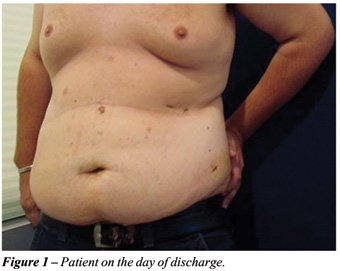
(EBL) of 100 cc. He was discharged in the first postoperative day (Figure-1).
The serum creatinine of the recipient 5 months after the procedure was
1.1 mg/dl and the donor was weighting 76 kg (BMI 25.7 kg/m2).
Case 2 - A 54-year-old female donor with
BMI 48.7 kg/m2 (weight = 120 kg; height = 1.57 m) and mild
hypertension had undergone a laparoscopic bariatric surgery in another
institution, losing only 20 kg in 4 months. She came to our service and
was submitted to a laparoscopic revisional bariatric surgery, reducing
the size of the gastric pouch and increasing the length of the Roux limb.
Three months after surgery her BMI was 32.4 kg/m2 (Weight =
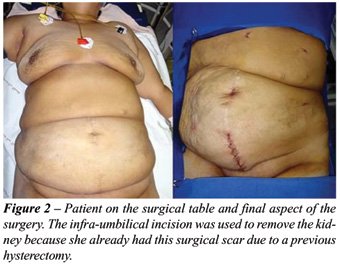
80 kg) and she underwent a pure left laparoscopic donor nephrectomy (Figure-2)
with an OT of 90 minutes, a WIT of 2.2 minutes, and an EBL of 80 cc. She
was discharged in the postoperative day 1. Two months after the kidney
donation, the serum creatinine of the recipient was 1.1 mg/dL and the
BMI of donor was 32 kg/m2, with no need for antihypertensive
medication.
COMMENTS
Morbid
obesity is an important public health problem. It is associated with serious
co-morbidities (hypertension, diabetes, peripheral resistance to insulin,
dyslipidemia, etc.), it shows a high prevalence globally, and it is associated
with a high mortality rate (3). Moreover, when morbid obese patients need
any surgical procedure, they present a significant challenge for the laparoscopic
surgeon. In addition to the technical challenges of positioning and instrumentation,
these patients are reported to have a propensity for postoperative and
anesthetic complications (2).
Population studies have shown that obesity
is associated with increased risk for proteinuria, and the development
of proteinuria signals a marked increased risk to develop renal failure.
Acceptance of obese individuals as living kidney donors is controversial
related to possible increased risk for surgical complications and concern
that obesity may contribute to long-term renal disease (4).
Chow et al. (1) analyzed non-obese (BMI
< 30) and morbidly obese patients (BMI ≥ 30) referred for hand-assisted
donor nephrectomy finding similar shortened hospital stays and surgical
times for both groups. They concluded hand-assisted donor nephrectomy
is safe and effective, not increasing morbidity in morbid obese donors.
Jacobs et al. (2) compared markedly obese
(BMI > 35) and ideal-size control (BMI < 30) donors scheduled for
laparoscopic nephrectomy and they observed the donor operations in the
markedly obese were significantly longer by an average of 40 minutes,
obese donors were more likely to require conversion to open nephrectomy
than ideal-size donors (7.3% vs. 0%) and postoperative complications were
equal in the two groups, although the obese donors’ complications
tended to be cardiopulmonary problems. They concluded that despite the
longer operative time, the increased port size requirement and the higher
conversion rate in the markedly obese group, these differences are fairly
small, and the procedure of laparoscopic donor nephrectomy itself appears
appropriate to consider for the markedly obese renal donor.
CONFLICT OF INTEREST
None declared.
REFERENCES
- Chow GK, Prieto M, Bohorquez HE, Stegall MD: Hand-assisted laparoscopic donor nephrectomy for morbidly obese patients. Transplant Proc. 2002; 34: 728.
- Jacobs SC, Cho E, Dunkin BJ, Bartlett ST, Flowers JL, Jarrell B, et al.: Laparoscopic nephrectomy in the markedly obese living renal donor. Urology. 2000; 56: 926-9.
- Silvestre V, Ruano M, Dominguez Y, Castro R, Garcia-Lescun MC, Rodriguez A, et al.: Morbid obesity and gastric bypass surgery: biochemical profile. Obes Surg. 2004; 14: 1227-32.
- Heimbach JK, Taler SJ, Prieto M, Cosio FG, Textor SC, Kudva YC, et al.: Obesity in living kidney donors: clinical characteristics and outcomes in the era of laparoscopic donor nephrectomy. Am J Transplant. 2005; 5: 1057-64.
____________________
Accepted after revision:
December 15, 2006
_______________________
Correspondence address:
Dr. Anibal Wood Branco
Rua das Palmeiras, 170 Apto. 201
Curitiba, PR, 80620-210, Brazil
Telephone +55 41 242-6543
E-mail: anibal@awbranco.com.br
EDITORIAL COMMENT
Long
term follow-up of renal obese donors is limited, as obesity has been considered
relative exclusion criteria until recently. While obese donors showed
a trend to higher mean arterial pressure and a higher glomerular filtration
rate, there were no significant differences from normal donors (1). Another
aspect is the possibility that they may be at greater risk for developing
type II diabetes mellitus later in life and the unknown impact of nephrectomy
on the obese patients who subsequently develops diabetes or hypertension
(2).
The
idea of performing a bariatric surgery in such group of donors may be
very helpful for not only reducing the morbidity of the donation itself
but also offering some effective therapy for morbid obesity.
This
special group of donors should be submitted to a very strict selection
criterion and who are highly motivated to donate could be accepted. The
selected criteria should be based upon blood pressure, family history
of diabetes and cardiovascular disease and reinforcing the importance
of a careful and long term follow-up.
REFERENCES
- Gracida C, Espinoza R, Cedillo U, Cancino J: Kidney transplantation with living donors: nine years of follow-up of 628 living donors. Transplant Proc. 2003; 35: 946-7.
- Heimbach JK, Taler SJ, Prieto M, Cosio FG, Textor SC, Kudva YC, et al.: Obesity in living kidney donors: clinical characteristics and outcomes in the era of laparoscopic donor nephrectomy. Am J Transplant. 2005; 5: 1057-64.
Dr. William Nahas
Division of Urology
University of Sao Paulo Medical School
Sao Paulo, SP, Brazil
wnahas@uol.com.br