LAPAROSCOPIC-ASSISTED
NEPHROURETERECTOMY AFTER RADICAL CYSTECTOMY FOR TRANSITIONAL CELL CARCINOMA
(
Download pdf )
FREDERICO R. ROMERO, MICHAEL MUNTENER, SOMPOL PERMPONGKOSOL, LOUIS R. KAVOUSSI, THOMAS W. JARRETT
The James Buchanan Brady Urological Institute (FRR, MM), Baltimore, Maryland, Department of Urology, North Shore-LIJ Health System (LRK), Long Island, New York and Department of Urology, The George Washington University Medical Center (TWJ), Washington, DC, USA
ABSTRACT
Objective:
To report our experience with laparoscopic-assisted nephroureterectomy
for upper tract transitional cell carcinomas after radical cystectomy
and urinary diversion.
Materials and Methods: Seven patients (53-72
years-old) underwent laparoscopic-assisted nephroureterectomy 10 to 53
months after radical cystectomy for transitional cell carcinoma at our
institution. Surgical technique, operative results, tumor features, and
outcomes of all patients were retrospectively reviewed.
Results: Mean operative time was 305 minutes
with a significant amount of time spent on the excision of the ureter
from the urinary diversion. Estimate blood loss and length of hospital
stay averaged 180 mL and 10.8 days, respectively. Intraoperative and postoperative
complications occurred in two patients each. There was one conversion
to open surgery. Pathology confirmed upper-tract transitional cell carcinoma
in all cases. Metastatic disease occurred in two patients after a mean
follow-up of 14.6 months.
Conclusions: Nephrouretectomy following
cystectomy is a complex procedure due to the altered anatomy and the presence
of many adhesions. A laparoscopic-assisted approach can be performed safely
in properly selected cases but does not yield the usual benefits seen
with other laparoscopic renal procedures.
Key
words: carcinoma, transitional cell; cystectomy; laparoscopy;
nephrectomy; recurrence; reoperation
Int Braz J Urol. 2006; 32: 631-9
INTRODUCTION
Nephroureterectomy (NU) is the treatment of choice for high grade, invasive, or recurrent transitional cell carcinoma (TCC) of the upper urinary tract (UUT). Since the first laparoscopic NU was performed in 1991, (1) several series have demonstrated the safety and efficacy of the procedure, (2-6) with the benefits of decreased hospitalization, return to activity and pain requirement. Nephroureterectomy following cystectomy is a very complex procedure due to the need for complete ureterectomy in the presence of many adhesions and an altered anatomy. This requires extensive enterolysis and dissection in a previously operated site to allow for removal of the ureter from the urinary diversion. There is limited data on open removal and no published data on laparoscopic NU for UUT TCC following cystectomy and urinary diversion. The objective of this study is to report our experience with laparoscopic-assisted NU for UUT TCC after radical cystectomy.
MATERIALS AND METHODS
In
2003 and 2005, seven patients previously treated with radical cystectomy
underwent laparoscopic-assisted NU for UUT TCC. Individual characteristics
of the patients and the features of the primary bladder tumors are summarized
in Tables-1 and 2, respectively. Cystectomy was performed for BCG-refractory
carcinoma in situ (CIS) of the urinary bladder in four patients, recurrent
superficial high grade TCC in two, and muscle-invasive disease in one.


Evaluation after cystectomy consisted of
physical examination, chest X-ray, and urine cytology every 3-4 months
in the first and second years, and at 6-month intervals for up to 5 years,
followed by yearly exams. The upper tract was surveyed by intravenous
urography (IVU), computed tomography (CT), conduitography and retrograde
pyelography, and/or conduitoscopy and ureteroscopy every 6-12 months in
the first year, and then yearly or when clinically indicated. Patients
with a suspected upper tract tumor were biopsied, and in highly suspicious
cases in which retrograde ureteroscopy was not possible were evaluated
through nephroscopy, and antegrade pyelography and ureteroscopy.
Indications for NU in patients with a normal
contralateral kidney included high-grade biopsy-proven TCC recurrences
in three patients, and persistent positive urinary cytologies in two patients
- one who was non-responsive and another who recurred after mitomycin.
Two patients had solitary kidneys. The first had been submitted to laparoscopic
NU before radical cystectomy for primary UUT TCC, and developed contralateral
UUT recurrence in a non-functioning renal unit. The second developed bilateral,
extensive disease, not amenable to conservative resection, and underwent
open NU followed by contralateral laparoscopic NU.
Laparoscopic-assisted NU was performed in
all patients using a transperitoneal approach. Pneumoperitoneum was achieved
through a Veress needle placed lateral to the rectus abdominalis, away
from the lower midline incision. The Visiport optical trocar (United States
Surgical Corporation, USSC, Norwalk, CT, USA) was used for initial access
to the abdomen. Local adhesions from previous surgery were carefully taken
down with sharp dissection. The colon was then mobilized medially and
the kidney removed in a standard laparoscopic fashion (6). In summary,
a plane was created between the ureter and the aorta or the vena cava
(for left and right-side NU respectively), and this was carried up to
the renal hilum. The renal artery and vein were dissected and sequentially
transected with the use of an endovascular GIA stapler (USSC, Norwalk,
CT, USA). The adrenal gland was routinely spared by entering the Gerota’s
fascia and dissecting it off the upper pole of the kidney. The remaining
of the dissection was carried outside Gerota’s fascia. Following
complete dissection of the kidney and upper ureter, dissection of the
remaining ureter was carried down as far distally as possible. On the
left side, the ureter was dissected to the area where the ureter traversed
the mesentery of the sigmoid colon. On the right, the dissection usually
approached the urinary diversion. A low abdominal incision (in the previous
cystectomy incision site) was then made when the complexity of the dissection
was beyond the limitations of a safe laparoscopic approach. The ureteroenteric
anastomosis was identified and completely excised with a cuff of normal
bowel mucosa. The urinary diversion was closed with running 3-0 polyglactin
suture, and repositioned in its usual anatomic position. In the two cases
with solitary kidney, urinary diversion was removed en bloc with the kidney
and ureter.
Operative results and outcomes of all patients
treated by this technique were retrospectively reviewed and analyzed.
RESULTS
Five
male and two female patients with a median age of 68 years (range 53 to
72 years) developed multifocal recurrent UUT TCC after treatment with
radical cystectomy for bladder cancer. The features of these recurrences
are shown in Table-3.

All patients required extensive lysis of
adhesions due to the previous open surgery, and multiple prior ureteroscopies
and biopsies. One of the patients could not have his entire kidney dissected
laparoscopically due to a prior abdominal aortic aneurysm repair that
resulted in a fibrotic reaction around the renal hilum. The midline incision
was extended and the renal dissection was completed though the extended
open incision.
No intraoperative complications from the
laparoscopic procedure occurred. Two patients had intraoperative complications
during the open stage of the procedure, due to the intense adjacent reactive
process. The first had an inadvertent bowel injury, which was managed
with segmental enterectomy. In the second patient, transection of the
contralateral ureter was recognized intraoperatively, requiring reanastomosis
to the ileal conduit.
All patients had delayed return to bowel
function beyond three days. Other minor post-operative complications occurred
in two patients. One had colonic pseudo-obstruction that resolved with
conservative management, and the other presented with a superficial wound
infection treated with intravenous antibiotics. Two other patients developed
anticipated end-stage renal disease due to previous contralateral NU.
They were started on hemodialysis and required longer hospitalizations
due to instituting dialysis in the setting of no renal function.
The mean operative time was 305.6 minutes
(range 220 to 360 minutes), and estimate blood loss was, in average, 180
mL (range 100 to 250 mL). Mean length of hospital stay was 10.8 days (range
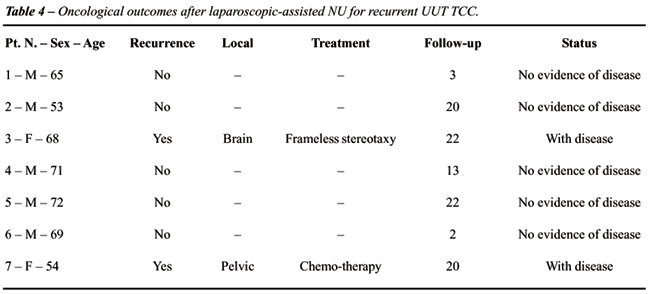
5 to 25 days). Follow-up averaged 14.6 months (range 2 to 22 months),
although two patients were lost to follow-up. The remaining five patients
were regularly followed-up for more than 12 months. Table-4 gives an overview
of the outcomes from each of the cases studied.
COMMENTS
TCC
is a multifocal disease affecting the entire urothelium (7,8) and subsequent
tumors may occur anywhere in the urinary tract after initial diagnosis
(9). While primary UUT TCC is frequently followed by bladder recurrences,
(7,10) and the cumulative incidence of UUT recurrence after bladder cancer
is up to 28% in five years,(11) the incidence of UUT tumors after radical
cystectomy is low (7-9). The incidence of post-cystectomy UUT TCC differs
according to the stage of the bladder tumor. Patients submitted to radical
cystectomy for superficial disease have a higher probability of developing
UUT tumors than those with muscle-invasive disease (8). Other risk factors
responsible for UUT recurrences in these patients include histological
grade, presence of distal ureteric carcinoma at cystectomy, associated
CIS, multifocality, and involvement of the prostatic urethra (8,9,12).
The optimum method of surveillance of the
UUT after cystectomy is questionable. Various regimens with annual or
biannual imaging (IVU or CT), combined with urine cytology, have been
reported (9). Since six (85.7%) of our patients had distal ureteral involvement
by CIS or TCC, we adopted a more aggressive surveillance, similar to that
for superficial bladder tumors, with urine cytology, imaging studies,
and UUT endoscopy.
The role of urinary cytology in the diagnosis
of UUT TCC is controversial, in particular for patients with intestinal
diversions, because of the presence of small bowel cells (7). However,
since most UUT TCC after cystectomy tends to be high grade, sensitivity
is higher in these patients (9). Obtaining urine using ureteral catheterization
further improves the diagnostic yield (13). IVU and CT scans increase
the likelihood of early detection, and help in management decisions, but
the key role in the diagnosis of recurrent UUT TCC is retrograde pyelography
and ureteroscopy with biopsy, with a reported accuracy of 94% (13).
The historic standard of care for high grade
and stage UUT lesions has been open NU, with removal of a cuff of bladder
around the ureteral orifice.(2-6,12-14) Several centers have replaced
the open surgery for laparoscopic NU, given that it has well established
advantages compared to the open approach, (2-6,8,14) and it is equally
effective in terms of oncological outcome.(2-5,14) Following this trend,
after performing over 80 laparoscopic NU at our department, we started
performing laparoscopic-assisted NU for recurrent UUT TCC post-radical
cystectomy in 2003. Surgical technique mirrors traditional open NU, including
the removal of a cuff of bowel at the ureteroenteral anastomosis. All
except one patient had the renal portion of the procedure successfully
accomplished laparoscopically, and all surgeries were completed through
the same previous incision performed for radical cystectomy, including
the patient that required open conversion for marked hilar vessels fibrosis.
In this patient, the incision was extended to the xiphoid process.
Mean operative time was long compared to
standard NU but this was not due to the laparoscopic nephrectomy portion
of the procedure but rather the complex dissection of the urinary diversion
and necessity for complete removal of the ureter with a cuff of the bowel.
In all cases, extensive and tedious lysis of adhesions was necessary to
release the diversion and distal ureter from adjacent bowel. It is not
surprising that delayed recovery of bowel function was seen in these patients,
resulting in a lengthened hospital stay when compared to NU with no prior
cystectomy. In addition, 2 patients had solitary kidneys removed and subsequently
required postoperative dialysis, which made management and hospitalization
more complex. These patients had failed prior attempts at organ sparing
therapy.
The outcome of patients who develop UUT
TCC after cystectomy is usually poor (1,7,12). So far, two of our patients
presented recurrences, although the median follow-up is still limited.
In addition, these patients are at higher risk of TCC in remaining sites
due to the multifocal nature of their disease. Lifelong surveillance for
recurrent disease in remaining urothelial surfaces and distant sites is
necessary.
CONCLUSIONS
Our experience confirms that NU for UUT TCC after radical cystectomy is a complex procedure due to the altered anatomy and the presence of many adhesions. In the present series, a laparoscopic-assisted approach could be performed safely in properly selected cases but did not yield the usual benefits of decreased hospitalization seen with other laparoscopic renal procedures mainly due to patient co-morbidities and the delayed return to bowel function. We even still prefer this approach, as after many years of experience the majority of our surgeons regularly performing renal surgery feel more comfortable with the laparoscopic approach to the kidney. The distal ureter and bowel cuff, however, must still be extracted with open surgery. We recognize that advanced laparoscopic experience is required to achieve even comparable results to an open approach in this technically demanding procedure.
CONFLICT OF INTEREST
None declared.
REFERENCES
- Clayman RV, Kavoussi LR, Figenshau RS, Chandhoke PS, Albala DM: Laparoscopic nephroureterectomy: initial clinical case report. J Laparoendosc Surg. 1991; 1: 343-9.
- Rassweiler JJ, Schulze M, Marrero R, Frede T, Palou Redorta J, Bassi P: Laparoscopic nephroureterectomy for upper urinary tract transitional cell carcinoma: is it better than open surgery? Eur Urol. 2004; 46: 690-7.
- El Fettouh HA, Rassweiler JJ, Schulze M, Salomon L, Allan J, Ramakumar S, et al.: Laparoscopic radical nephroureterectomy: results of an international multicenter study. Eur Urol. 2002; 42: 447-52.
- Shalhav AL, Dunn MD, Portis AJ, Elbahnasy AM, McDougall EM, Clayman RV: Laparoscopic nephroureterectomy for upper tract transitional cell cancer: the Washington University experience. J Urol. 2000; 163: 1100-4.
- Bariol SV, Stewart GD, McNeill SA, Tolley DA: Oncological control following laparoscopic nephroureterectomy: 7-year outcome. J Urol. 2004; 172: 1805-8.
- Jarrett TW, Chan DY, Cadeddu JA, Kavoussi LR: Laparoscopic nephroureterectomy for the treatment of transitional cell carcinoma of the upper urinary tract. Urology. 2001; 57: 448-53.
- Balaji KC, McGuire M, Grotas J, Grimaldi G, Russo P: Upper tract recurrences following radical cystectomy: an analysis of prognostic factors, recurrence pattern and stage at presentation. J Urol. 1999; 162: 1603-6.
- Huguet-Perez J, Palou J, Millan-Rodriguez F, Salvador-Bayarri J, Villavicencio-Mavrich H, Vicente-Rodriguez J: Upper tract transitional cell carcinoma following cystectomy for bladder cancer. Eur Urol. 2001; 40: 318-23.
- Sved PD, Gomez P, Nieder AM, Manoharan M, Kim SS, Soloway MS: Upper tract tumour after radical cystectomy for transitional cell carcinoma of the bladder: incidence and risk factors. BJU Int. 2004; 94: 785-9.
- Abercrombie GF, Eardley I, Payne SR, Walmsley BH, Vinnicombe J: Modified nephro-ureterectomy. Long-term follow-up with particular reference to subsequent bladder tumours. Br J Urol. 1988; 61: 198-200.
- Herr HW: Extravesical tumor relapse in patients with superficial bladder tumors. J Clin Oncol. 1998; 16: 1099-102.
- Solsona E, Iborra I, Rubio J, Casanova J, Dumont R, Monros JL: Late oncological occurrences following radical cystectomy in patients with bladder cancer. Eur Urol. 2003; 43: 489-94.
- Kirkali Z, Tuzel E: Transitional cell carcinoma of the ureter and renal pelvis. Crit Rev Oncol Hematol. 2003; 47: 155-69.
- Canfield SE, Dinney CP, Droller MJ: Surveillance and management of recurrence for upper tract transitional cell carcinoma. Urol Clin North Am. 2003; 30: 791-802.
____________________
Accepted after revision:
July 15, 2006
________________________
Correspondence address:
Dr. Frederico R. Romero
The James Buchanan Brady Urological Institute
600 North Wolfe Street, Suite 161
Jefferson Street Bldg.
Baltimore, MD 21287-8915, USA
Fax: + 1 410 502-7711
E-mail: frederico.romero@gmail.com
EDITORIAL COMMENT
Radical
cystectomy with extended lymph node dissection is the gold standard treatment
for invasive and/or refractory superficial bladder cancer (1). Although
upper tract recurrence after radical cystectomy has a low incidence at
2% to 4%, it is associated with poor prognosis, and a short survival (2).
The disease specific-survival of patients with upper tract transitional
cell carcinoma (TCC) and previous bladder cancer is worse when compared
to patients with no bladder tumor, suggesting more aggressive pattern
when the pan-urothelial disease is present (3). Laparoscopic nephroureterectomy
is routinely used to treat upper tract TCC with low morbidity and complication
rate, and similar oncological outcomes comparable to the open procedure
(4).
The
authors are to be commended for this series of 7 cases of laparoscopic-assisted
nephroureterectomy in patients with previous cystectomy for bladder TCC.
In the cystectomy specimen, all patients had bladder carcinoma in situ
(CIS), with 6 presenting ureteral CIS, and 4 of them presenting positive
margin. These factors may increase the recurrence rate. During the follow-up,
3 patients presented with gross hematuria, but all had positive urinary
cytology. A recent study by Raj et al. (2) showed the relevance of urinary
cytology after radical cystectomy demonstrating not only the higher risk
of recurrence but also the shorter survival; suggesting the need for closer
follow-up and the potential for early adjuvant therapies.
The
morbidity of the procedure in this group of patients was expectedly higher
when compared to standard laparoscopic nephroureterectomy, with longer
operative time, hospital stay, and bowel function recovery. One open conversion,
one bowel and one intraoperative ureteral injury were reported in the
study, with 40% positive margins in the pathological exam.
With
the intention of minimizing the morbidity of the procedure, the retroperitoneal
approach to the nephrectomy part of the procedure may be helpful in avoiding
intra-abdominal adhesions due to the previous cystectomy site; the distal
ureterectomy part of the procedure would be performed as described by
the authors. These are surgically challenging cases in often unhealthy
individuals.
REFERENCES
- Stein JP, Lieskovsky G, Cote R, Groshen S, Feng AC, Boyd S, et al.: Radical cystectomy in the treatment of invasive bladder cancer: long-term results in 1,054 patients. J Clin Oncol. 2001; 19: 666-75.
- Raj GV, Bochner BH, Serio AM, Vickers A, Donat SM, Herr H, et al.: Natural history of positive urinary cytology after radical cystectomy. J Urol. 2006; 176: 2000-5.
- Mullerad M, Russo P, Golijanin D, Chen HN, Tsai HH, Donat SM, et al.: Bladder cancer as a prognostic factor for upper tract transitional cell carcinoma. J Urol. 2004; 172: 2177-81.
- Matin SF: Radical laparoscopic nephroureterectomy for upper urinary tract transitional cell carcinoma: current status. BJU Int. 2005; 95: 68-74.
Dr. Jose R. Colombo Jr. &
Dr. Inderbir S. Gill
Section of Laparoscopic & Robotic Surgery
Glickman Urological Institute,
Cleveland Clinic
Cleveland, Ohio, USA
E-mail: gilli@ccf.org