ALFUZOSIN HYDROCHLORIDE TRANSDERMAL FILMS: EVALUATION OF PHYSICOCHEMICAL,
IN VITRO HUMAN CADAVER SKIN PERMEATION AND THERMODYNAMIC PARAMETERS
(
Download pdf )
doi: 10.1590/S1677-553820090006000010
SATYANARAYAN PATTNAIK, KALPANA SWAIN, PARTHAGAN CHOUDHURY, PRADEEPTA K. ACHARYA, SUBRATA MALLICK
College of Pharmaceutical Sciences (SP, KS, PC, PKA), Mohuda, Berhampur, Orissa, India and School of Pharmaceutical Sciences (SM), SOA University, Ghatikia, Bhubaneswar, Orissa, India
ABSTRACT
Purpose:
The main objective of the investigation was to develop a transdermal therapeutic
system for alfuzosin hydrochloride and to study the effects of polymeric
system and loading dose on the in vitro skin permeation pattern.
Materials and Methods: Principles of experimental
design have been exploited to develop the dosage form. Ratio of ethyl
cellulose (EC) and polyvinyl pyrrolidone (PVP) and loading dose were selected
as independent variables and their influence on the cumulative amount
of alfuzosin hydrochloride permeated per cm2 of human cadaver skin at
24 h (Q24), permeation flux (J) and steady state permeability coefficient
(PSS) were studied using experimental design. Various physicochemical
parameters of the transdermal films were also evaluated. Activation energy
for in vitro transdermal permeation has been estimated.
Results: Ratio of EC and PVP was found to
be the main influential factor for all the dependent variables studied.
Drug loading dose was also found to influence the dependent variables
but to a lesser extent. Physicochemical parameters of the prepared films
were evaluated and found satisfactory. Activation energy for alfuzosin
permeation has also been estimated and reported.
Conclusion: The therapeutic system was found
to be dermatologically non-irritant and hence, a therapeutically effective
amount of alfuzosin hydrochloride can be delivered via a transdermal route.
Key
words: alfuzosin hydrochloride; administration, cutaneous; polymers
Int Braz J Urol. 2009; 35: 716-29
INTRODUCTION
Benign
prostatic hypertrophy (BPH) is a condition characterized by a nodular
enlargement of prostatic tissue leading to obstruction of the urethra.
In a large community-based survey, lower urinary tract symptoms (LUTS)
secondary to BPH were reported in 25% of men aged > 50 years (1). LUTS
including increased urinary frequency, nocturia, incomplete emptying,
and urinary hesitancy are often associated with BPH. These symptoms can
be caused by altered function of the smooth muscle tone that is regulated
by the alpha-1 adrenergic receptors in the prostate and its capsule, the
bladder base and neck, and the prostatic urethra (2). It is thought that
alpha-1 adrenergic receptor antagonists may be implicated in the pathophysiology
of BPH and may cause relaxation of smooth muscles, improvement in urine
flow and reduction in LUTS (3). Consequently, American Health Care Policy
and Research (AHCPR) guidance recommended alpha-blockers as a first-line
therapy for BPH. Alfuzosin, a quinazoline derivative, is a selective and
competitive alpha-1 adrenoceptor antagonist. It distributes preferentially
in the prostate, compared with plasma, and decreases the sympathetically
controlled tone of prostatic smooth muscle. As a result, lower urinary
tract symptoms suggestive of benign prostatic hyperplasia (BPH) are improved
(4).
Alfuzosin hydrochloride is available in
three formulations: an immediate release standard form, typically 2.5
mg three times per day, a 5-mg sustained-release form given twice per
day, and a 10 mg once daily sustained-release form (4,5).The absolute
bioavailability of alfuzosin is about 49% under fed conditions, while
the corresponding value under fasting conditions is approximately 25%
(6). This shows that food has a significant impact on the oral absorption
of alfuzosin. This originates the need for an alternative route of administration,
which can bypass the hepatic first-pass metabolism. Transdermal route
is an alternative choice of route of administration for such drugs. Various
physicochemical parameters like molecular weight, log P value and aqueous
solubility of alfuzosin hydrochloride are 425.92, 1.51 at a pH of 7.4
and > 10% respectively. These favorable parameters make it an ideal
drug candidate for transdermal delivery. Transdermal films offer added
advantages such as maintenance of constant and prolonged drug level, reduced
frequency of dosing, minimization of inter- and intrapatient variability,
self administration, and easy termination of medication, leading to patient
compliance (7).
The transdermal permeation can be treated
as a diffusion process through a selectively permeable membrane. The concentration
of the applied solute species at the surface layers is not usually equal
to but related to its concentration in the applied vehicle in accordance
with the vehicle/stratum corneum sorption isotherm. The linear isotherm
can be defined in terms of the distribution coefficient between the vehicle
and the stratum corneum. It is considered that the transdermal flux is
directly proportional to the concentration difference across the skin
barrier (8). Drug permeation through the skin following transdermal delivery
is also influenced by various design factors such as polymer species,
internal structure of the polymer matrix and drug-loading dose. The effects
of the above-mentioned factors must be elucidated in detail in order to
develop an optimum delivery system, first in vitro and then in vivo. In
the present study, we have assessed the effects of polymeric concentration,
its blend and drug-loading dose on the in vitro permeation pattern of
alfuzosin hydrochloride from its transdermal films.
MATERIALS AND METHODS
Materials
Alfuzosin hydrochloride was obtained as a gift sample from Cipla Ltd. (Mumbai, India). Ethyl Cellulose (EC; ethoxy content 47.5-49%, viscosity 14 cps in 5% w/w solution in 80:20 toluene/ethanol at 250C) was purchased from BDH Chemicals Ltd., (Poole, England). Polyvinylpyrrolidone (PVP; K value: 26-35) and Polyvinylalcohol (PVA) were purchased from HiMedia Laboratories Pvt. Ltd., (Mumbai, India) and S.D. Fine-Chem. Ltd. (Boisar, India), respectively. Di-n- Butylphthalate was purchased from Central Drug House (P) Ltd., (Mumbai, India).
Statistical Experimental
Design
A
32 full factorial design was used in development of dosage form and two
factors were evaluated, each at three levels. In the present investigation,
ratio of EC and PVP (X1) and drug loading dose (X2) were selected as independent
variables. The cumulative amount of alfuzosin hydrochloride permeated
per cm2 of human cadaver skin at 24h (Q24), permeation flux (J) and steady
state permeability coefficient (PSS) were chosen as dependent variables.
Ratio of EC and PVP was evaluated at 30:70(-1), 20:80(0) and 10:90(+1),
while alfuzosin loading dose was evaluated at 30% (-1), 40% (0), and 50%
(+1) of total polymer weight. Design-Expert software (Version. 7.1.3,
Stat-Ease Inc., Minneapolis, USA) was used for the generation and evaluation
of the statistical experimental design.
Preparation of Transdermal Films
Experimental transdermal films were prepared at all possible combinations (Table-1). Films composed of different ratios of EC and PVP containing alfuzosin hydrochloride (~ 1.05 mg/square centimeter film) were prepared by solvent evaporation technique. Di-n-butylphthalate was incorporated as a plasticizer at a concentration of 30% w/w of dry weight of polymers. Alfuzosin hydrochloride was dissolved in chloroform followed by addition of polymers and plasticizer with constant stirring. The matrix was prepared by pouring the homogeneous dispersed solution on 4% PVA backing membrane in a flat bottomed petridish, covered with perforated aluminum foil, and dried at 40°C for 24h. The dry films with drug dissolved in the matrix were removed and kept in desiccators until use.

Evaluation of Physicochemical Parameters
Content Uniformity
Drug content uniformity was determined by dissolving each film in chloroform and filtering with Whatman filter paper (0.45 µm). The filtrate was evaporated and drug residue dissolved in normal saline. The drug content was analyzed at 242 nm using a UV spectrophotometer (Shimadzu, Japan). The experiments were performed in triplicate, and average values were reported.
Moisture Uptake
Accurately weighed films kept in a desiccator at normal room temperature for 24 h were taken out and placed in desiccators containing 100 mL of super saturated solution of potassium chloride to maintain 84% relative humidity until a constant weight for the films were obtained. The percentage of moisture uptake was calculated as the difference between final and initial weight with respect to initial weight (9). The percentage moisture absorption at laboratory ambient condition (300C and 64% RH) was also calculated.
Moisture Content
The prepared films were weighed individually and kept in a desiccator containing activated silica at room temperature until it showed a constant weight. The percentage of moisture content was calculated as a difference between initial and final weight with respect to final weight (9).
Flatness
Longitudinal strips were cut out from the prepared films. The length of each strip was measured, and than variation in the length due to the non-uniformity in flatness was measured. Flatness was calculated by measuring constriction of strips, and a 0% constriction was considered to be 100% flatness (9).
Folding Endurance
This was determined by repeatedly folding the film at the same place until it broke. The number of times the film could be folded at the same place without breaking gave the value of folding endurance.
Fourier Transform Infrared
(FT - IR) Study
The active pharmaceutical ingredient, alfuzosin HCl and mixture of it with the polymers (PVP, EC) were mixed separately with IR grade KBr in the ratio of 100:1 and corresponding pellets were prepared by applying pressure in a hydraulic press. The pellets were scanned over a wave number range of 4000-400 cm-1 in Fourier transform infrared spectrophotometer (Perkin Elmer, Switzerland).
Scanning Electron Microscopy
(SEM)
The surface morphology of the film was recorded with a Jeol Scanning Electron Microscope (Model: JSM 5200, Japan). The samples were mounted on an aluminum stab by using a double-sided adhesive tape. Then it was placed in an ion coater unit (Model: IB-2, Hitachi, Tokyo, Japan) for gold coating (200 Å). During gold coating process the samples were exposed to vacuum of 10-50 mm. Afterwards, an accelerating voltage of 25 kV was applied and the image was photographed by Asia Pentex Camera of 35 mm film.
In-vitro Drug Permeation
Studies
The extent and rate of skin permeation of alfuzosin hydrochloride through the human cadaver skin were carried out using Keshary-Chein diffusion cell. The receptor compartment was filled with 20 mL normal saline (0.9%w/v of NaCl) and its temperature was maintained at 32 ± 50C during the experiment. Exceptionally, during estimation of activation energy for permeability, the permeation study was conducted at various temperatures, i.e. 32°C, 40°C and 45°C. Owing to higher aqueous solubility of alfuzosin HCl, normal saline has been chosen as the receptor fluid. The diffusional area (cross section area) of the diffusion cell was 1.766 cm2. The receptor fluid is constantly agitated at 100 rpm by a Teflon coated magnetic bead. The film (about 1.8 cm2) was applied under occlusion (using Leucoplast® tape) on the epidermal surface of the human cadaver skin fitted between the donor and receptor compartments of the diffusion cell. The whole of the receptor fluid was collected from the sampling port at predetermined time interval and replaced immediately with fresh normal saline. A similar set was run simultaneously using the film (without drug) at the donor compartment as a skin film control system to avoid the influence of inherent extracts from the skin or leaching of any material from the film without drug on the absorbance at 242 nm, at which the sample aliquots were analyzed spectrophotometrically. The amount of drug permeated per square cm at each time interval was estimated and subjected to further data analysis.
Permeation Data Analysis
and Statistics
The flux (µg/cm2.h) of alfuzosin hydrochloride was calculated from the slope of the plot of the cumulative amount of alfuzosin hydrochloride permeated per cm2 of human cadaver skin at steady state against the time using linear regression analysis. The steady state permeability coefficient (PSS) of the drug through human cadaver skin was calculated by using the following equation:
PSS = J/C
Where, J is the flux and C is the initial concentration of alfuzosin hydrochloride in the film. The observed difference in the permeation parameters of alfuzosin hydrochloride in different formulations were compared by using one way analysis of variance (ANOVA) followed by all pair wise multiple comparison procedure such as Holm-Sidak test at overall significance level of 0.05 using SigmaStat software (SigmaStat 3.5, SPSS Inc, Chicago, IL, USA). The permeation data was subjected to Peppas kinetic model fitting. A simple, semi-empirical equation based on the Peppas model can be used to analyze data of controlled release of drugs from polymer matrices.
Mt / M8 = k tn
Where, Mt / M8 is the fraction of drug released up to time t, k is a constant comprising the structural and geometric characteristics of the matrix, and n, the diffusion exponent, is a parameter that depends on and is used to characterize the release mechanism. For the case of cylindrical matrix, in particular, n = 0.45 corresponds to a Fickian diffusion release (case I diffusional), 0.45 < n < 0.89 to an anomalous (non-Fickian) transport, n = 0.89 to a zero-order (case II) release kinetics, and n > 0.89 to a super Case II transport (10).
Estimation of Thermodynamic
Parameter
Activation energy for permeation provides insight into mechanisms of transmembrane mobility of drug molecules (11,12). Activation energy for permeability of alfuzosin hydrochloride from its transdermal system (run 9) across human cadaver skin was estimated by measuring the permeability of drug at various temperatures like 32°C, 40°C and 45°C using the Arrhenius equation:
k = Ae-Ea/RT
where k is the specific reaction rate, A is a constant commonly referred to as the frequency factor, R is the gas constant, and T is temperature. The slope of the plot of log PSS versus 1/T can be related to Ea as follows:
Slope = -Ea / 2.303 R
Primary Skin Irritation Studies
Albino
rabbits each weighing 1.5 to 2.0 kg and 24 months of age were used in
this study (n = 6). The animals were singly housed in suspended stainless
steel caging with mesh floors in the animal unit under controlled temperature
(27 ± 2°C) and 12 hours light/dark cycle. They were fed a standard
laboratory diet and filtered tap water was provided ad libitum. Following
acclimation to the laboratory, a group of animals was prepared by clipping
the dorsal surface of each rabbit’s trunk free of hair. The skin
was cleared with rectified spirit and the transdermal film was secured
using surgical adhesive tape. Elizabethan collars were placed on each
rabbit and they were returned to their designated cages. After 24 hours
of exposure, the films were removed and the animals were examined for
any sign of erythema or edema. The individual dose sites were scored according
to the Draize scoring system (13) at approximately 1, 24, 48 and 72 hours
after film removal. The primary dermal irritation index (PDII) was calculated
by adding the average erythema and edema scores for the 1, 24, 48 and
72 hours scoring intervals and dividing by the number of evaluation intervals
i.e. 4. The test sample is considered non irritating, if PDII is <
0.5; slightly irritating, if PDII is 0.5 - 2.0; moderately irritating,
if PDII is 2.1 - 5.0 and severely irritating, if PDII is > 5.0. Ethical
approval for the handling of experimental animals was obtained from the
Institutional Animal Ethical Committee (IAEC) formed for this purpose.
Stability Studies
A short term stability testing of run 9 was conducted for three months at laboratory ambient conditions (25°C, 60%RH). On completion of the third month, films were retrieved to assay their drug content and physical appearance.
RESULTS AND DISCUSSION
Evaluation of Physicochemical Parameters
A summary of the results of physicochemical studies is presented in Table-2. The drug content in the prepared films was found to be more than 99% and a low standard deviation indicates uniformity in drug content. The result of the moisture uptake (%) and moisture content (%) studies revealed that the moisture uptake/content was found to increase with increasing concentration of hydrophilic polymer PVP. The moisture uptake was increased at higher humidity conditions as compared to at ambient conditions. The low moisture uptake at laboratory ambient condition (3.89 ± 0.91 to 5.33 ± 0.89 %) protects the material from microbial contamination and bulkiness of the films. Again small moisture content (3.13 ± 1.52 to 5.08 ± 1.08 %) in the formulations helps the material to remain stable and from becoming a completely dried and brittle film (14). The results of flatness study showed that none of the formulation had the difference in the strip lengths before and after their cuts, thus indicating 100% flatness. It indicates 0% constriction in the films and thus they could maintain a smooth surface when applied onto the skin leading to intimate contact and hence better drug permeation. Folding endurance study assured about its flexibility.

FT - IR Study
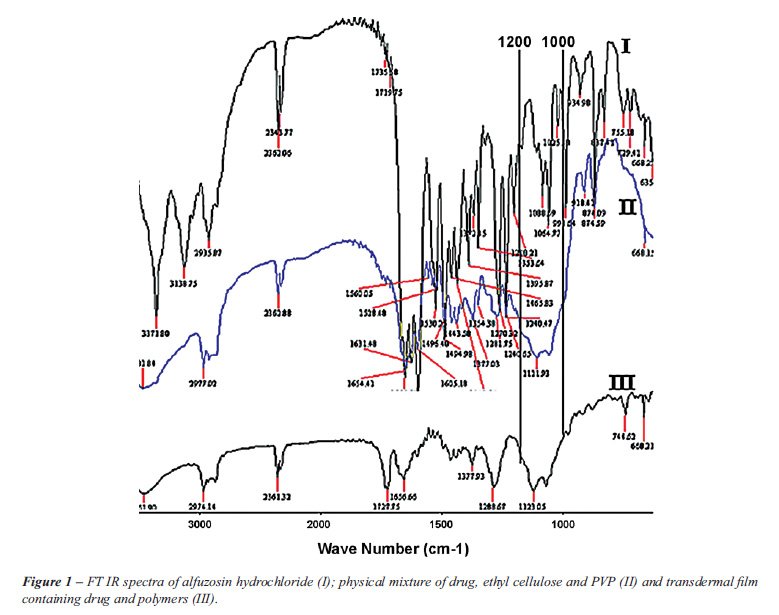
The IR spectra of alfuzosin hydrochloride and physical mixture of drug and polymers showed all characteristic bands of alfuzosin hydrochloride. In case of IR spectra of matrix film (run 9) containing drug and polymers, changes in the area of C-O-C skeletal vibration in 1200 to 1000 cm-1 range (Figure-1) of glucose unit in cellulosed polymer appeared, showing differences of glucose bond orientation solid dispersion. Basically no change of frequency and shape of alfuzosin hydrochloride bands were observed, which suggests no significant redistribution of electronic density in the structure of organic molecule. This indicates no strong interaction between the drug and the polymers, in the film prepared by the solvent casting method.
Scanning Electron Microscopy
(SEM)
The surface morphology of the formulation (run 9) was studied with SEM (Figure-2). Due to fairly good solubility of alfuzosin hydrochloride in the polymeric system, homogenously distributed drug particles were observed.

In vitro Drug Permeation
Studies
Effects of the variables on the in vitro drug permeation from the transdermal films were studied by statistical experimental design. Experimental design has been widely used in pharmaceutical field to study the effect of formulation variables and their interactions on response variables (10,15). In this study, a 32 randomized full factorial design (Table-1) was used. A suitable equation involving the main effects was selected based on the estimation of several statistical parameters, such as the adjusted multiple correlation coefficient (adjusted R2) and the predicted residual error sum of squares (PRESS). As presented in Table-3, the quadratic model was selected as a suitable statistical model because it had the smallest value of PRESS and highest value of adjusted R2. Predicted residual error sum of squares (PRESS) is a measure of the fit of the model to the points in the design. The smaller the PRESS statistic is, the better the model fits to the data points (16). Cubic model has terms that are aliased and hence that model was not selected. Analysis of variance (ANOVA) was applied to estimate the significance of the model at the 5% significance level. The quadratic model generated by the design is given below.
Y = b0 + b1X1 + b2X2 + b12X1X2 + b11X1X1 + b22X2X2

Where, Y is the dependent variable, b0 is the arithmetic mean response of the 9 runs, and bi (b1, b2, b12, b11 and b22) is the estimated coefficient for the corresponding factor Xi (X1, X2, X1X2, X1X1 and X2X2), which represents the average result of changing one factor at a time from its low to high value. The interaction term (X1X2) shows how the response changes when two factors are changed simultaneously. The polynomial terms (X1X1, X2X2) are included to investigate nonlinearity. The final equations obtained in terms of coded factors as follows:
Q24 = +146.07
+19.96X1+7.61X2-2.78X1X2-5.38X12-0.29X22
J=+6.82+0.83 X1+0.32 X2-0.099 X1 X2-0.28 X12-0.043 X22
Pss=+0.006504+0.0008468X1-0.001336X2-0.000319X1 X2-0.0003011X12+0.0002899X22
The permeation profile of all the experimental batches is shown in Figure-3. The coefficient estimate and standardized main effect (SME) values for the responses are listed in Table-4. SME values were calculated by dividing the main effects by the standard error of the main effects. In addition, the contour plots and three-dimensional response surface plots were presented to estimate the effects of the independent variables on each response. Results of multiple regression analysis and standardized main effects (SME) revealed that both ratio of EC: PVP (fraction of PVP) and drug loading had statistically significant influence on all dependent variables (P < 0.05, Table-4).


The influence of ratio of EC: PVP and loading
dose on Q24 is evident from the contour plot and three-dimensional response
surface plot (Figures-4 and 5). Regarding the overall effect of both factors,
it was observed that Q24 was affected more by the levels of fraction of
PVP, which was cleared from the response surface plot (Figure-5), as the
decline of the Q24 value was more extreme on the axis of ratio of EC:
PVP compared with the drug loading. The higher SME value (17.98) of ratio
of EC: PVP level indicated that the effect of ratio of EC: PVP level was
found to be the main influential factor on the Q24 from the transdermal
films in the whole stage permeation. Less or negligible curvature on both
axes in response surface plot indicates little contribution of interaction
terms along with linearity of responses. It was found that the Q24 value
increased with increase in fraction of PVP and drug loading. The addition
of hydrophilic component to an insoluble film former (EC) tends to enhance
the release rates, as reported by Arora et al. (13). The increase in the
rate of drug release could be explained by the ability of the hydrophilic
polymers to absorb water, thereby promoting the dissolution, and hence
the release of drug. Moreover, the hydrophilic polymers would leach out
and, hence, create more pores and channels for the drug to diffuse out
of the films (17). It has also been reported that PVP decreases the crystallinity
of the drug in film, which accounts for the increased release of the drug
with an increase in the PVP concentration in the films (18).
It was also observed that the value of Q24 increased when drug loading
was increased from 30% to 50%. The increased release rate at high drug
loading might partly due to the drug entrapped in the superficial layer
of the film. When the film comes in contact with diffusion medium, the
drug from the surface leaches into the surrounding medium, leaving a more
porous polymer structure, which enables faster drug diffusion from the
matrix. Similar finding of metronidazole release from chitosan inserts
has been reported by Barat et al. (19). Similar linearity of effect has
also been reported by El-Arini et al. (20). One way ANOVA followed by
Holm-Sidak test confirmed significant difference among the Q24 values
of different runs.


Effect of Ratio of EC: PVP (fraction of PVP) and drug loading on J is evident from the contour plot and three-dimensional response surface plot (Figures-6 and 7). The larger SME value of ratio of EC: PVP level compared to SME value of drug loading indicated that the effect of ratio of EC: PVP level is the main influential factor on J. Steady state permeation flux was found to increase linearly when the independent variables were raised from lower level to higher level. A statistically significant difference was observed among all the runs, when subjected to one way ANOVA followed by Holm-Sidak test. A desired flux for alfuzosin hydrochloride from its transdermal system can be calculated from its pharmacokinetic parameters like required plasma concentration and total body clearance. The steady state plasma concentration data of alfuzosin hydrochloride is not available and in this event peak plasma concentration value, which is supposed to be within therapeutic window, may be considered as required plasma concentration for calculation of desired drug input rate. The mean peak plasma concentration (Cmax) of alfuzosin hydrochloride is 13.6 ng/mL and the total clearance (Cl) is 0.3 L/h/kg. Hence, the required rate of drug input can be calculated as follows:
Required rate of drug input = Required plasma concentration × Clearance = 237.6 µg/h.


Since,
the maximum flux achieved with the experimental batch is 7.627 (±
0.19) µg/cm2/h, this indicates requirement of as large as 40 cm2
area film to achieve therapeutic plasma concentration. Though therapeutically
effective amount of drug can be delivered by this delivery system, this
type of large film should contribute towards patient non compliance and
hence, permeation enhancers may be attempted in order to increase the
flux and to decrease the required film size.
Figures-8 and 9 are the response surface
plot and contour plot respectively indicating influence of the independent
variables on PSS. It is cleared from the results of multiple regression
analysis that the ratio of EC: PVP was the main influential factor on
PSS. A statistically significant difference was observed among all the
runs when subjected to one way ANOVA followed by Holm-Sidak test.
The diffusion exponent values obtained after
fitting the permeation data to peppas kinetic model found to range from
1.0632 to 1.291 indicating super case II transport as the mechanism of
drug release from the matrix type transdermal systems.


Activation Energy for
Transdermal Permeability
Good linearity (R2 = 0.9935) observed in the Arrhenius plot indicate that Fick’s law of diffusion is applicable to alfuzosin penetration through the skin, and the temperature dependent penetration is attributed to the passive diffusion. Activation energy (Ea) for permeation was estimated to be of 40.9 kJ/ mol.
Primary Skin Irritation
Studies
Primary skin irritation study should be performed for all dosage forms, which are applied onto the skin to exclude any possibility of potential dermal irritation. A primary dermal irritation index (PDII) of 0.12 (Table-5) for the test transdermal film indicated that the film is non irritating and safe for dermal application.

Stability Studies
The results of the short term stability studies are encouraging with less than 0.5% variation in drug content. The physical appearance of the test film was found unchanged indicating a stable formulation.
CONCLUSION
The physicochemical evaluation indicated that the developed transdermal delivery systems of alfuzosin hydrochloride are technologically satisfactory. Both the independent variables were found to influence the measured in vitro human cadaver skin permeation responses. Although therapeutically effective amount of drug can be delivered by this delivery system, permeation enhancement strategies need to be adopted to decrease the film size, which will contribute towards patient compliance. The prepared formulations were found to be dermatologically non irritant.
CONFLICT OF INTEREST
None declared.
REFERENCES
- Garraway WM, Collins GN, Lee RJ: High prevalence of benign prostatic hypertrophy in the community. Lancet. 1991; 338: 469-71.
- Rossi C, Kortmann BB, Sonke GS, Floratos DL, Kiemeney LA, Wijkstra H, et al.: alpha-Blockade improves symptoms suggestive of bladder outlet obstruction but fails to relieve it. J Urol. 2001; 165: 38-41.
- Djavan B, Marberger M: A meta-analysis on the efficacy and tolerability of alpha1-adrenoceptor antagonists in patients with lower urinary tract symptoms suggestive of benign prostatic obstruction. Eur Urol. 1999; 36: 1-13.
- McKeage K, Plosker GL: Alfuzosin: a review of the therapeutic use of the prolonged-release formulation given once daily in the management of benign prostatic hyperplasia. Drugs. 2002; 62: 633-53.
- Roehrborn CG: Alfuzosin: overview of pharmacokinetics, safety, and efficacy of a clinically uroselective alpha-blocker. Urology. 2001; 58 (6 Suppl 1): 55-63; discussion 63-4.
- Liu Q, Fassihi R: Zero-order delivery of a highly soluble, low dose drug alfuzosin hydrochloride via gastro-retentive system. Int J Pharm. 2008; 348: 27-34.
- Barry BW: Breaching the skin’s barrier to drugs. Nat Biotechnol. 2004; 22: 165-7.
- Ramírez-Campos M, Villafuerte-Roble L: Effect of Formulation Variables on Verapamil Hydrochloride Release from Hydrated HPMC Matrices. Rev Soc Quím Méx. 2004; 48: 326-31.
- Arora P, Mukherjee B: Design, development, physicochemical, and in vitro and in vivo evaluation of transdermal patches containing diclofenac diethylammonium salt. J Pharm Sci. 2002; 91: 2076-89.
- Swain K, Pattnaik S, Mallick S, Chowdary KA: Influence of hydroxypropyl methylcellulose on drug release pattern of a gastroretentive floating drug delivery system using a 3(2) full factorial design. Pharm Dev Technol. 2009; 14: 193-8.
- Grass GM, Robinson JR: Mechanisms of corneal drug penetration. I: In vivo and in vitro kinetics. J Pharm Sci. 1988; 77: 3-14.
- Kawazu K, Midori Y, Shiono H, Ota A: Characterization of the carrier-mediated transport of levofloxacin, a fluoroquinolone antimicrobial agent, in rabbit cornea. J Pharm Pharmacol. 1999; 51: 797-801.
- Draize JH, Woodard G, Calvery HO: Methods for the study of irritation and toxicity of substances applied topically to the skin and mucous membranes. J Pharmacol Exp Ther. 1944; 82: 377-90.
- Arora P, Mukherjee B: Design, development, physicochemical, and in vitro and in vivo evaluation of transdermal patches containing diclofenac diethylammonium salt. J Pharm Sci. 2002; 91: 2076-89.
- Pattnaik S, Swain K, Mallick S: Influence of polymeric system and loading dose on drug release from alfuzosin hydrochloride transdermal films. Lat. Am. J. Pharm. 2009; 28: 62-9.
- Segurola J, Allen NS, Edge M, McMahon A: Design of eutectic photoinitiator blends for UV/visible curable acrylated printing inks and coatings. Prog Org Coat. 1999; 37: 23-37.
- Bodmeier R, Paeratakul O: Evaluation of drug-containing polymer films prepared from aqueous latexes. Pharm Res. 1989; 6: 725-30.
- Guyot M, Fawaz F: Design and in vitro evaluation of adhesive matrix for transdermal delivery of propranolol. Int J Pharm. 2000; 204: 171-82.
- Barat R, Srinatha A, Pandit JK, Anupurba S, Mittal N: Chitosan inserts for periodontitis: influence of drug loading, plasticizer and crosslinking on in vitro metronidazole release. Acta Pharm. 2007; 57: 469-77.
- Bhardwaj SB, Shukla AJ, Collins CC: Effect of varying drug loading on particle size distribution and drug release kinetics of verapamil hydrochloride microspheres prepared with cellulose esters. J Microencapsul. 1995; 12: 71-81.
____________________
Accepted after revision:
July 29, 2009
_______________________
Correspondence address:
Dr. Satyanarayan Pattnaik
Percutaneous Drug Delivery Systems
Department of Pharmaceutics
College of Pharmaceutical Sciences
Mohuda, Berhampur, 760002, Orissa, India
Fax: + 91 0680 2261752.
E-mail: saty3000@yahoo.com