TUMOR
THROMBUS INVOLVING THE INFERIOR VENA CAVA IN RENAL MALIGNANCY: IS THERE
A DIFFERENCE IN CLINICAL PRESENTATION AND OUTCOME AMONG RIGHT AND LEFT
SIDE TUMORS?
(
Download pdf )
doi: 10.1590/S1677-55382009000600003
DEVENDAR KATKOORI, MANOHARAN MURUGESAN, GAETANO CIANCIO, MARK S. SOLOWAY
Department of Urology, Miller School of Medicine, University of Miami, Miami, Florida, USA
ABSTRACT
Purpose:
Renal cell carcinoma (RCC) has a propensity to propagate into the renal
vein and inferior vena cava (IVC). Due to inherent differences in the
venous anatomy of the right and left kidneys, tumor thrombus involvement
of IVC may vary. The aim of this study is to compare clinical presentation
and outcome of right vs. left RCC with IVC thrombus.
Materials and Methods: Patients who underwent
radical nephrectomy and IVC thrombectomy between 1997 and 2008 were identified.
All relevant data were collected and analyzed.
Results: Eight-seven patients were included.
Sixty patients (69%) had a right sided tumor. Mean tumor size was 10.2
(± 4) cm and was not significantly different on either side. Fifty-six
percent of right sided tumors had level-III (intra-hepatic) or higher
tumor thrombus, while 22% of left sided tumors had similar level thrombus
extension (p < 0.0001). Nearly 50% of left sided tumors showed level-I
thrombus compared to 10% of right side tumors. A comparison of age, estimated
blood loss and transfusion rate was not significantly different. The recurrence
free (p = 0.9) and disease specific survival (p = 0.4) were not significantly
different between the right and left side tumors with IVC thrombus.
Conclusion: A level-III IVC tumor thrombus
is more frequently seen with a right side tumor. However, clinical and
operative characteristics among the left and right sided tumors with IVC
thrombus were not different. More significantly, recurrence rate and survival
did not differ with the laterality of the tumor.
Key
words: kidney neoplasms; nephrectomy; vena cava, inferior; thrombectomy
Int Braz J Urol. 2009; 35: 652-7
INTRODUCTION
Renal
cell carcinoma (RCC) accounts for 3.5% of all adult malignant neoplasms
(1,2). Intra-luminal tumor growth into renal venous system is one of the
unique features of RCC. The tumor thrombus can involve the inferior vena
cava(IVC) in 4% to 10% of patients (3). Radical nephrectomy and IVC thrombectomy
offers reasonable long term survival. Although clinico-pathological outcome
of these tumors with IVC thrombus has been well studied, comparisons between
right and left sided tumors have not been previously reported.
Typically, the right renal vein is short
and without any branches whereas the left renal vein is longer and receives
the lumbar, gonadal and adrenal veins before draining into the IVC. Due
to these inherent differences in the renal venous anatomy, the incidence
of IVC involvement and the level of thrombus may vary depending on the
laterality of the tumor. Whether this difference can lead to a significant
difference in outcome for patients with IVC involvement with the tumor
on right versus left has not been assessed. We retrospectively reviewed
our nephrectomy database to see if laterality of the tumor had any bearing
on the clinical presentation and outcome following radical nephrectomy
and IVC thrombectomy.
MATERIALS AND
METHODS
We
retrospectively analyzed patients who underwent radical nephrectomy and
IVC thrombectomy from 1997 to 2008 by our single surgical team. After
obtaining Institutional Review Board approval, all the relevant data were
collected and analyzed. The study variables included age, gender, tumor
size, histological type, nuclear grade, level of IVC thrombus, estimated
blood loss, transfusions, hospital stay and follow-up.
The entire cohort was divided into two groups
based on the laterality of the renal tumor. The level of IVC involvement
was stratified by the distal limit of the tumor thrombus: level-I involving
the IVC at the level of the renal vein; level-II, the infra hepatic IVC;
level-III, the retro-hepatic IVC; level-IV right atrium (4,5). The surgical
technique we use has been described in detail in a previous publication
(6). We followed the patients post-surgery at one month and then every
3 months with a medical history, physical examination, metabolic panel
and liver function test. A chest X-ray was obtained every 6 months and
an abdominal CT scan every year.
Chi-square test and Fisher’s exact
test were used to compare categorical variables. The ANOVA test was used
to compare continuous variables. For survival analysis, Kaplan-Meier method
was used. The log-rank test was used to see for any difference in survival
distributions. A two sided p value = 0.05 was considered statistically
significant. All the analyses were done using the SPSS software (Version
16).
RESULTS
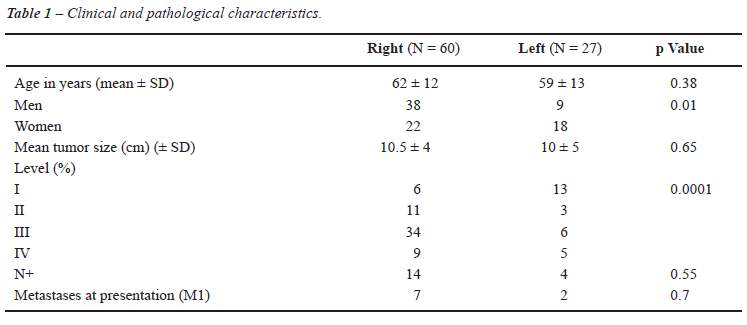
In total 87 patients were included in the study. There were 47 men (54%) and 40 women (46%). Sixty patients (69%) had RCC on the right side. The mean age (61 years) mean tumor size (10.25 ± 4 cm), T stage, lymph node status and metastatic presentation were not significantly different between both groups (Table-1). A level-III or higher IVC thrombus was seen more often with a right sided RCC. Seventy-two of right side tumors compared to 41% of the left side tumors had a level-III or higher IVC thrombus (p < 0.001). Six (10%) of right side tumors had level-I IVC thrombus compared to 13 (48%) of left side tumors.
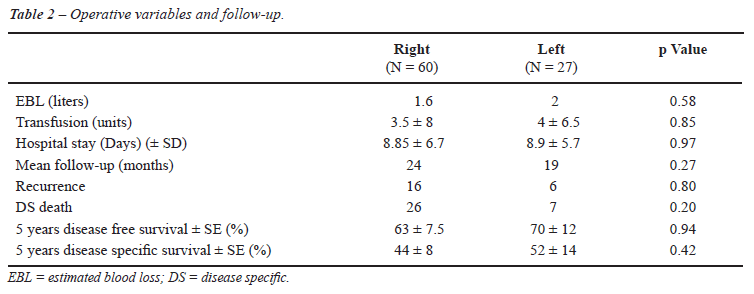
The mean estimated blood loss and the mean
number of blood transfusions was not significantly different between the
groups (Table-2). The mean hospital stay was also similar. There were
two perioperative deaths in the right side group, one due to cardiac arrhythmia
and the other due to hepatic failure. There was one perioperative death
in left side group due to pulmonary failure in a chronic obstructive pulmonary
disease patient.
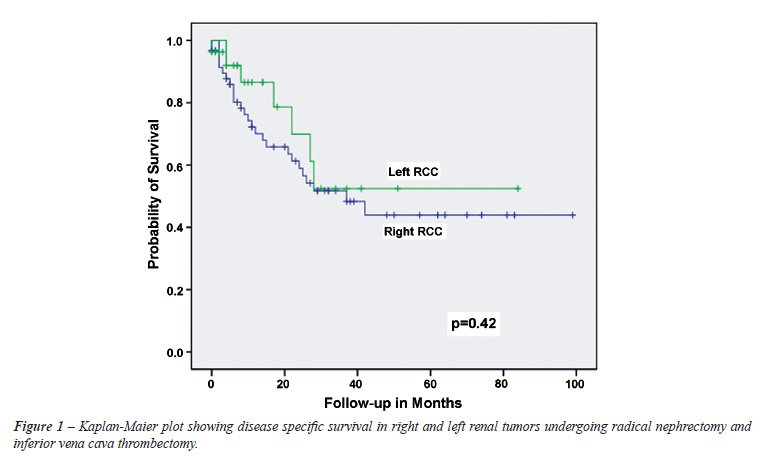
The mean follow-up was 22.5 months (3-99).
There was no significant difference in the disease-free and disease specific
survival between the groups (Table-2) (Figure-1).
COMMENT
Although
the human body displays distinct external symmetry, the internal anatomy
is strikingly asymmetrical. The paired organs are typically asymmetrical
and can differ in mass, position, blood supply, lymphatic drainage and
relation to surrounding organs. This difference can play an important
role in evolution of the disease process. The incidence of cancer itself
may be marginally higher on one side. Breast cancer incidence is relatively
higher on the left side (7). In genitourinary cancers, testicular neoplasms
occur more commonly on the right side. The incidence of renal cancer does
not significantly differ with the laterality of the tumor. The venous
anatomy of the right kidney however is markedly different from the left
kidney.
Most series on IVC thrombectomy have a higher
number of patients with right side RCC. In our series, 69% patients with
IVC thrombus had a right renal tumor. This may be due to an anatomically
short right renal vein (2-4 cm) allowing a shorter path into the IVC and
hence a higher incidence at the time of presentation. In a series of 93
patients with IVC thrombus, Staehler et al. reported that 81% had a right
side renal tumor (8). In another series by Lambert et al. 64% had a right
side tumor (9). In our series, a level-III or higher thrombus was seen
more frequently with a right sided tumor. This can be explained by the
fact that the left renal vein is typically 6-10 cm. Assuming a similar
rate of tumor thrombus growth for both the sides a right sided tumor thrombus
grows into the intra-hepatic IVC earlier. Accurate identification of the
anatomic level of IVC thrombus is important for planning the surgical
approach (6).
At our institution, we have modified our
surgical technique using principles derived from liver transplantation
(6). We use a transabdominal approach with mobilization of the liver,
which gives excellent exposure. When dealing with large left side renal
tumors with IVC involvement we mobilize the stomach, spleen and pancreas
en-bloc (10). Although the surgical procedure is to some extent different
for IVC thrombectomy when the tumor is on right compared to left side,
however in our study we did not find any significant difference in surgical
outcome. The disease free and disease specific survival were also not
significantly different between right and left side tumors. The prognostic
impact of the level of thrombus remains controversial. Majority of current
literature supports the view that the level of tumor thrombus does not
influence survival (11,12). This explains the similar long-term outcome
for right and left sided tumors despite the right side tumors having a
higher anatomic level of tumor thrombus.
Our study has some limitations. It is a
retrospective study and it represents a single center experience.
CONCLUSIONS
Our results show that a level-III tumor thrombus is more frequently seen when the tumor is on right side compared to the left side. However, clinical and operative characteristics among the left and right sided tumors with IVC thrombus were not different. More significantly, recurrence rate and the survival did not differ with the laterality of the tumor.
ACKNOWLEDGEMENTS
Financial support from “CURED” and Mr. Vincent A. Rodriguez.
CONFLICT OF
INTEREST
None declared.
REFERENCES
- Jemal A, Siegel R, Ward E, Hao Y, Xu J, Murray T, et al.: Cancer statistics, 2008. CA Cancer J Clin. 2008; 58: 71-96.
- Wotkowicz C, Wszolek MF, Libertino JA: Resection of renal tumors invading the vena cava. Urol Clin North Am. 2008; 35: 657-71.
- Marshall FF, Dietrick DD, Baumgartner WA, Reitz BA: Surgical management of renal cell carcinoma with intracaval neoplastic extension above the hepatic veins. J Urol. 1988; 139: 1166-72.
- Neves RJ, Zincke H: Surgical treatment of renal cancer with vena cava extension. Br J Urol. 1987; 59: 390-5.
- Ciancio G, Vaidya A, Savoie M, Soloway M: Management of renal cell carcinoma with level III thrombus in the inferior vena cava. J Urol. 2002; 168: 1374-7.
- Ciancio G, Livingstone AS, Soloway M: Surgical management of renal cell carcinoma with tumor thrombus in the renal and inferior vena cava: the University of Miami experience in using liver transplantation techniques. Eur Urol. 2007; 51: 988-94; discussion 994-5.
- Dane S, Yildirim S, Koc M, Aktan M, Gundogdu C: Asymmetries in breast cancer lateralization and both axillary lymph node number and metastatic involvement. Lymphology. 2008; 41: 75-9.
- Staehler G, Brkovic D: The role of radical surgery for renal cell carcinoma with extension into the vena cava. J Urol. 2000; 163: 1671-5.
- Lambert EH, Pierorazio PM, Shabsigh A, Olsson CA, Benson MC, McKiernan JM: Prognostic risk stratification and clinical outcomes in patients undergoing surgical treatment for renal cell carcinoma with vascular tumor thrombus. Urology. 2007; 69: 1054-8.
- Ciancio G, Vaidya A, Shirodkar S, Manoharan M, Hakky T, Soloway M: En Bloc Mobilization of the Pancreas and Spleen to Facilitate Resection of Large Tumors, Primarily Renal and Adrenal, in the Left Upper Quadrant of the Abdomen: Techniques Derived from Multivisceral Transplantation. Eur Urol. 2009; 9. [Epub ahead of print]
- Wagner B, Patard JJ, Méjean A, Bensalah K, Verhoest G, Zigeuner R, et al.: Prognostic value of renal vein and inferior vena cava involvement in renal cell carcinoma. Eur Urol. 2009; 55: 452-9.
- Kirkali Z, Van Poppel H: A critical analysis of surgery for kidney cancer with vena cava invasion. Eur Urol. 2007; 52: 658-62.
____________________
Accepted
after revision:
July 27, 2009
_______________________
Correspondence
address:
Dr. Mark S.
Soloway
Professor and Chairman
Department of Urology
Univ. of Miami Miller Sch. of Medicine
P.O. Box 016960
Miami, FL 33101, USA
Fax: +1 305 243-4653
E-mail: msoloway@med.miami.edu
EDITORIAL COMMENT
The authors retrospectively analyzed patients who underwent
radical nephrectomy and inferior vena cava (IVC) thrombectomy. In total
87 patients were included in the study. There were 47 men (54%) and 40
women (46%) and 60 (69%) patients had RCC on the right side.
The results show that a level-III tumor thrombus is more frequently seen
when the tumor is on right side compared to the left side and more significantly,
recurrence rate and the survival did not differ with the laterality of
the tumor. Clinical and operative characteristics among the left and right
sided tumors with IVC thrombus were not different. More significantly,
recurrence rate and the survival did not differ with the laterality of
the tumor. These results are obvious since the venous anatomy of the right
kidney is markedly different from the left kidney.
Dr.
Antonio Augusto Ornellas
Section of Urology
National Institute of Cancer and
Mario Kroeff Cancer Hospital
Rio de Janeiro, Brazil
E-mail: ornellasa@hotmail.com