STUDY
ON THE INCIDENCE OF TESTICULAR AND EPIDIDYMAL APPENDAGES IN PATIENTS WITH
CRYPTORCHIDISM
(
Download pdf )
LUCIANO A. FAVORITO, ANDRÉ G. L. CAVALCANTE; MARCIO A. BABINSKI
Urogenital Research Unit, State University of Rio de Janeiro, UERJ, and Souza Aguiar Municipal Hospital, Rio de Janeiro, RJ, Brazil
ABSTRACT
Objective:
To study the incidence of testicular and epididymal appendages in patients
with cryptorchidism.
Materials and Methods: We studied 65 patients
with cryptorchidism, totalizing 83 testes and 40 patients who had prostate
adenocarcinoma and hydrocele (control group), totalizing 55 testes. The
following situations were analyzed: I) absence of testicular and epididymal
appendages, II) presence of testicular appendage only, III) presence of
epididymal appendage, IV) presence of testicular and epididymal appendage,
V) presence of 2 epididymal appendages and 1 testicular appendage and
VI) presence of paradidymis or vas aberrans of Haller.
Results: In patients with cryptorchidism
we found testicular appendages in 23 cases (41.8%), epididymal appendages
in 9 (16.3%), testicular and epididymal appendage in 8 (14.5%), 2 epididymal
appendages and 1 testicular in 1 (1.8%) and absence of appendages in 14
(25.4%). In the control group, we found testicular appendages in 29 (34.9%),
epididymal appendages in 19 (22.8%), testicular and epididymal appendage
in 7 (8.4%), and absence of appendages in 28 (33.7%), we did not find
2 epididymal appendages in this group, and none of the patients in the
2 groups presented paradidymis or vas aberrans of Haller.
Conclusion: The occurrence of testicular
and epididymal appendages is quite variable. There was no statistically
significant difference in the incidence and distribution of the testicular
and epididymal appendages between patients with cryptorchidism and those
from the control group.
Key
words: testis; epididymis; cryptorchidism
Int Braz J Urol. 2004; 30: 49-52
INTRODUCTION
Testicular
and epididymal appendages were once considered anatomic anomalies (1),
however some studies report that these structures are present in the majority
of normal individuals (2). Such appendages, when they are too long or
pedunculated, can twist around their own axis, causing very painful symptoms,
simulating torsion of the spermatic cord (3,4). There are also reports
on tumors originated from these structures (5).
The testicular appendage derives from the
upper portion of the paramesonephric duct, and is also known as sessile
hydatid of Morgagni (6). The portion of the mesonephric duct that is cranial
to the testis can form the pedunculated hydatid of Morgagni, currently
known as epididymal appendage.
Other vestigial structures derived from
this portion of the mesonephric duct are the “Haller’s organs”,
located in the fissure between the testis and the epididymis, consisting
of a group of superior and inferior aberrant vessels, and the “Giraldes’
organ”, also called paradidymis or innominate body, located in the
distal portion of the spermatic cord (2,6) (Figure 1).

There are several studies analyzing the
macro and microscopic structure of the testicular and epididymal appendages
in the literature (2,7). The study of the incidence of such structures
in patients with cryptorchidism and the comparison of these findings with
individuals without anomalies in testicular position are rare in the literature.
The objective of this work is to study the
incidence of the testicular and epididymal appendages in patients with
cryptorchidism, using patients who underwent subcapsular orchiectomy or
surgical treatment of hydrocele as a control group.
MATERIALS AND METHODS
In
the period from March 2001 to January 2004, we studied 65 patients having
cryptorchidism, with ages ranging from 1 to 18 years who underwent orchiopexy,
totalizing 83 testes, and 40 patients having prostate adenocarcinoma and
hydrocele (control group), with ages ranging from 5 to 82 years, submitted
to orchiectomy or surgical treatment of hydrocele, totalizing 55 testes.
All patients with cryptorchidism had their testes located in the inguinal
canal and all patients from the control group had their testes located
in the scrotum.
We analyzed the following situations in
the 2 groups, during the surgeries: I) absence of testicular and epididymal
appendages, II) presence of testicular appendage only, III) presence of
epididymal appendage, IV) presence of testicular and epididymal appendage,
V) presence of 2 epididymal appendages and 1 testicular appendage, and
VI) presence of paradidymis or vas aberrans of Haller.
The qui-square statistical test was used
for comparison between the 2 populations (8).
RESULTS
The
results of incidence of testicular and epididymal appendages in patients
with cryptorchidism and in the control group, according to the 6 proposed
situations, are demonstrated in the Table 1.
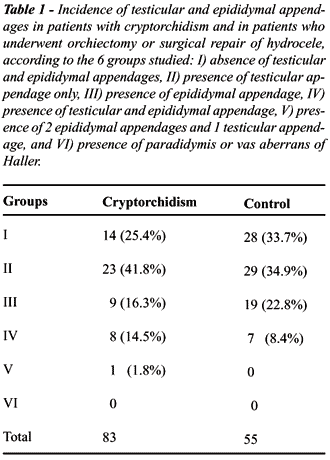
In patients with cryptorchidism we found
testicular appendages in 23 cases (41.8%), epididymal appendage in 9 (16.3%),
testicular and epididymal appendage in 8 (14.5%), 2 epididymal appendages
and 1 testicular in 1 (1.8%), and absence of appendages in 14 (25.4%)
cases. In the control group, we found testicular appendages in 29 (34.9%),
epididymal appendages in 19 (22.8%), testicular and epididymal appendage
in 7 (8.4%), and absence of appendages in 28 (33.7%) cases. We did not
find 2 epididymal appendages and 1 testicular in any case in the control
group. Paradidymis and vas aberrans of Haller were not found in any patient
from either group
There was no statistically significant difference
concerning the incidence and distribution of the testicular and epididymal
appendages in the groups studied.
DISCUSSION
Cryptorchidism
is one of the most common congenital pathologies in males, with an incidence
of 2 to 5% in full-term births, which can reach 30% in premature births
(9-11). A number of anomalies are associated with cryptorchidism, however
the epididymal anomalies and inguinal hernia are among the most frequent
ones (11-13). The epididymal anomalies are associated with cryptorchidism,
with an incidence that ranges from 36 to 79% (14,15). The incidence of
testicular and epididymal appendages is seldom reported in patients with
cryptorchidism.
The knowledge of the presence, shape and
location of the testicular and epididymal appendages is important, due
to the possibility of torsion of such structures, association with anatomical
anomalies, and the possibility of occurrence of tumors in theses structures
(2,5,12).
We found the presence of testicular appendage
in more than 55% of patients with cryptorchidism and in 43% of patients
from the control group. Rolnick et al. (2) in 100 necropsies found the
testicular appendage in 92% of cases. Sundarasivarao (16) found testicular
appendages in 80% of his sample.
In our sample, we detected epididymal appendages
in 32% of patients with cryptorchidism and in 31% in the control group.
Rolnick et al. (2) found this appendage in 34% of their casuistry, and
Sundarasivarao (16) in 23%. The presence of multiple testicular and epididymal
appendages is rare (2,7,16), a fact confirmed by our findings, where this
anomaly was observed in only 1 case.
The occurrence of testicular and epididymal
appendages is quite variable. We found no statistically significant difference
in the incidence and distribution of the testicular and epididymal appendages
between patients with cryptorchidism and those from the control group.
_____________________________________________
Support
by grants from the Rio de Janeiro Foundation
for Research Support (FAPERJ) and National Council
for Scientific and Technological Development (CNPQ).
REFERENCES
- Johansen TEB: Anatomy of the testis and epididymis in cryptorchidism. Andrologia. 1987; 19: 565-9.
- Rolnick D, Kawanoue S, Szanto P, Bush IM: Anatomical incidence of testicular appendages. J Urol. 1968; 100: 755-6.
- Vermeulen CW, Hagerty CS: Torsion of the appendix testis (hydatid of Morgagni): report of two cases with a study of the microscopic anatomy. J Urol. 1945; 54: 459-65.
- Krukowsky ZH, Auld CD: Torsion of the appendix epididymis in a maldescendent testis. Br J Urol. 1983; 55: 244-5.
- Kernohan NM, Coutts AG, Best PV: Cystoadenocarcinoma of appendix testis. Histopathology. 1990, 17: 147-54.
- Noske HD, Kraus SW, Altinkilic BM, Weidner W: Historical milestones regarding torsion of the scrotal organs. J Urol. 1998; 159: 13-16.
- Sahni D, Jit I, Joshi K, Sanjeev: Incidence and structure of the appendices of the testis and epididymis. J Anat. 1996; 189: 3418.
- Sokol RR, Rohlf FJ: Biometry, 3rd ed. New York, Freeman WH, 1995.
- Cendron M, Huff DS, Keating MA, Snyder, III HM, Duckett JW: Anatomical, morphological and volumetric analysis: a review of 759 cases of testicular maldescent. J Urol. 1993; 149: 570-3.
- Kogan S, Hadziselimovic F, Howards SS, Snyder III HM, Huff D: Pediatric Andrology, in Gillenwater JY, Grayhack JT, Howards SS Snyder III HM (eds): Adult and Pediatric Urology. St Louis, Mosby, 1996, 3rd ed, vol 3, pp 2623-2674.
- Gill B, Kogan S: Cryptorchidism. Current concepts. Pediatr Clin North Am. 1997; 44: 1211-27.
- Scorer CG, Farrington GH: Congenital Deformities of the Testis and Epididymis. London, Butter Worths e Co, 1971.
- Marshall FF: Anomalies associated with cryptorchidism. Urol Clin North Amer. 1982; 9: 339-47.
- Mollaeian M, Mehrabi V, Elahi B: Significance of epididymal and ductal anomalies associated with undescended testis: study in 652 cases. Urology. 1994; 43: 857-60.
- Barthold JS, Redman JR: Association of epididymal anomalies with patent processus vaginalis in hernia, hydrocele and cryptorchidism. J Urol. 1996; 156: 2054-6.
- Sundarasivarao D: The Müllerian vestiges and benign epithelial tumours of the epididimys. J Pathol Bacteriol. 1953, 66: 417-32.
_________________________
Received:
December 20, 2003
Accepted: January 17, 2004
_____________________
Correspondence address:
Dr. Luciano A. Favorito
Urogenital Research Unit
Av. 28 de Setembro, 87, fundos, térreo
Rio de Janeiro, RJ, 20562-030, Brazil
Fax: + 55 21 2587-6121
E-mail: favorito@uerj.br