PENILE
LESION FROM GUNSHOT WOUND: A 43-CASE EXPERIENCE
(
Download pdf )
ANDRE G. CAVALCANTI, RENATO KRAMBECK, ALEXANDRE ARAUJO, CARLOS H. MANES, LUCIANO A. FAVORITO
Section of Urology, Souza Aguiar Municipal Hospital, Rio de Janeiro, RJ, Brazil
ABSTRACT
Objective:
To demonstrate the main aspects of diagnosis, treatment and follow-up
of 43 patients with gunshot wounds to the penis.
Materials and Methods: The location of the
lesion, the presence of associated lesions, the performance of complementary
exams, surgical treatment, postoperative complications and long term follow-up
of 43 patients with penile lesions from gunshot wounds were retrospectively
analyzed.
Results: Of 43 cases assessed, 41 were submitted
to surgical exploration (95.3%) and 2 were submitted to conservative treatment
(4.7%). We found penile lesions involving the corpus cavernosum in 37
cases; the remaining 4 patients presented no lesions involving the corpus
cavernosum, urethra or testicles but did in the superficial structures.
Ten cases presented an association with testicular lesions and 14 cases
association with anterior urethral lesions.
Conclusion: Penile lesions from gunshot
wounds should be treated with immediate surgical intervention. In exceptional
situations featuring superficial lesions only conservative treatment may
be applied.
Key
words: penis; urethra; wounds, gunshot; surgical procedures,
operative
Int Braz J Urol. 2006; 32: 56-63
INTRODUCTION
Gunshot
wounds to the genitalia are not frequent (1), however they need to be
immediately investigated to assess the extension of the lesion to reproductive
organs and prevent complications, such as bleeding, infection, penile
curvature, erectile dysfunction and urethral stenosis (2).
The penis can be injured in an isolated
way or in association with scrotal traumatism (3). Even though they are
not frequent, urethral lesions can occur, making uretrocystography mandatory
for some researchers (3.4).
Many studies in the literature analyze diagnoses
and conduct in patients who are victims of gunshot wounds to the genitalia
(5.6); however studies with a significant casuistic that solely analyze
penile lesions are rare (7). Studies that analyze conduct in urethral
gunshot wounds are also rare (6,7).
The objective of the present study is to
demonstrate the main aspects in the diagnosis, treatment and follow-up
of 43 patients with penile lesions from gunshot wounds.
MATERIALS AND METHODS
In
the period between January 1990 and January 2005, 43 patients with penile
lesions from gunshot wounds were retrospectively assessed in our institution.
The patient’s ages varied between 16 and 54 years (mean age 28 years).
The period of time between the trauma and attendance at the hospital varied
from 1 to 4 hours (mean of 2 hours and 30 minutes). The location of the
lesion, the presence of associated lesions, the performance of complementary
exams, surgical treatment, postoperative complications and patient follow-up
were all analyzed.
The main form of diagnosis assessment was
anamnesis and physical examination (Figure-1). In 5 cases (11.6%), there
was a need for complementary exams. Ultrasound was used in 2 cases to
exclude corpus cavernosum lesions, and in 3 cases a cystourethrogram was
performed due to a suspicion of urethral lesions.

The surgical technique employed was a subcoronal
incision with degloving of the penis and exposure of the corpus cavernosum
and urethra.
RESULTS
Of
the 43 cases analyzed, 41 were submitted to surgical exploration (95.3%)
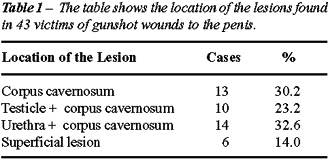
and only 3 received conservative treatment (4.7%). Table-1 outlines the
lesions found during surgical exploration. In 37 cases we found penile
lesions involving the corpus cavernosum; the remaining 4 operated patients
did not present lesions either in the corpus cavernosum, urethra or testicles,
and presented lesions only in superficial structures. Associations to
testicular lesions occurred in 10 cases while association to anterior
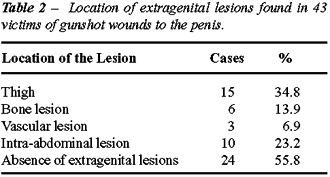
urethra lesions occurred in 14 cases. Extra-genital lesions were present
in 19 patients (44.2%), with thigh lesions appearing most commonly, as
shown in Table-2.
Lesions in the corpus cavernosum were treated
with local debridement and primary closure with absorbable sutures. Testicular
injuries were treated with orchiectomy in 6 cases (60%) and reconstruction
in 4 cases (40%).
Of the 14 cases featuring anterior urethra
lesions, 11 (78.5%) had the lesion diagnosed during surgery. Cystostomy
and reconstruction of the urethra were performed later in 2 cases and
the other 12 cases received immediate treatment of the lesions. In 4 patients
with extended partial lesions (> 2 cm) of the pendular urethra, a primary
suture over a urethral catheter was performed; 3 of these patients (75%)
required a second procedure due to postoperative urethral stenosis, while
1 patient (25%) developed urethral cutaneous fistula which was treated
with prolonged urethral catheterization.
In 3 patients featuring pendular urethra
lesions (1 with a total lesion and 2 with partial lesions), a cutaneous
urethrostomy was performed and a later reconstruction was conducted by
rotating the cutaneous flap; there was no postoperative stenosis or fistulas
in any of the 3 cases. In 5 patients, the lesion was to the bulbar urethra
(distal portion). In 1 case a primary suture was performed over the catheter
and in 4 cases termino-terminal anastomosis was performed, presenting
no postoperative complications. In the 2 patients where the cystostomy
was performed as a primary treatment, late stenosis occurred, requiring
urethral reconstruction.
A greater than 6 month follow-up was possible
in 30 patients – 11 with urethral lesions, 10 with lesions only
in the corpus cavernosum and 9 with testicle and corpus cavernosum lesions.
None of the 30 cases presented penile curvature or erectile dysfunction
determining significant impact on the quality of sexual activity.
COMMENTS
Success
in the treatment of penile lesions from gunshot wounds depends on early
surgical exploration, debridement of the wounded structures and primary
lesion repair (8-10). Conservative treatment in these cases is controversial,
except when clinical evaluation strongly indicates the presence of only
superficial lesions (1). In our study, there was no surgical exploration
in only 4.8% of the cases and clinical indications in those cases were
only of superficial lesions. During physical examination, these patients
presented presence of a minimum hematoma that allowed an adequate palpation
of corpora cavernosa and testicles, with absence of lesions confirmed
by ultrasound. In the other 4 cases (9.5%), the patients were submitted
to surgical exploration based on the findings of physical examination;
however, only lesions in superficial structures were found in these cases.
The use of the injury severity score from
the American Association for the Surgery of Trauma (AAST) is being utilized
to facilitate uniform treatment of genitalia lesions (1,11). According
to this classification, superficial lesions and contusions are classified
as degree I and can be conservatively treated. Lesions classified as degree
II (Buck fascia lacerations without tissue loss), degree III (cutaneous
avulsion or laceration through glands and meatus, or urethral or cavernosum
lesions less than 2 cm in area), degree IV (partial penectomy or urethral
or cavernosum lesions more than 2 cm in area), and degree V (total penectomy)
shall be treated with surgery (1,11).
The majority of patients with penetrating
lesions in the genitalia should be submitted to immediate surgical intervention;
however in doubtful cases of degree I lesions according to AAST, the use
of ultrasound to exclude the lesions of the corpus cavernosum can be useful
even though it is an operator-dependent examination (12-15). In our sample,
both patients that were not submitted to surgical intervention were submitted
to ultrasound, which only confirmed the presence of superficial lesions.
The adequate exploration and reconstruction
of corpora cavernosa seem to prevent the late development of complications,
such as erectile dysfunction and penile curvature. This observation was
support in the wide experience with primary reconstructions in the case
of penile contusion traumatisms (15).
According to the literature, lesions of
the urethra vary from 17 to 22% of the cases of penile lesions from gunshot
wounds (1,10). In our sample, we found lesions of the urethra in 14 patients
(33%). Due to this important percentage, and since this is a low cost,
easily performed and highly precise exam, many authors recommend the performance
of routine cystourethrogram (1,4,16) independently of a doubtful clinical
exam (presence of blood in the meatus, urinary retention, prostatic elevation
upon rectal touch). In our study, we performed a cystourethrogram in only
3 cases where the exam confirmed the lesion, and in 11 cases the lesion
was identified only during surgical intervention.
In cases of suspicion of urethral lesion
at initial admission, retrograde cystourethrogram should be performed
as the patient’s clinical conditions allow. Penile degloving for
surgical exploration should always be performed after urethral catheterization,
as this maneuver will help identify transoperatively the urethral lesions.
In the cases of urethral lesions, primary
repair is the option of choice (6), except in cases where there is an
extended loss of urethral tissue (4), when staged treatment is the best
choice. Of the 14 patients with urethral lesions, we performed cystostomy
and late urethral reconstruction in only 2 cases (14.2%). Lesions of the
pendular urethra (especially in distal and glandar portions) should be
treated in a staged form due to the high frequency of complications.
Performing an urethrostomy as an initial
procedure seems to be an interesting choice since it will allow reconstruction
using tissues where the thermal late lesion of the bullet is already defined.
Termino-terminal anastomosis is possible for bulbar urethral lesions limited
to the penoscrotal junction when there is an extension less than 1.5 cm.
When the urethral lesion is only partial (less than 50% of the urethral
circumference with longitudinal extension less than 1 cm), we believe
that the primary closure of the lesion over a catheter can be done; otherwise
the option of a termino-terminal anastomosis or staged treatment should
be done, depending on the location of the lesion.
In the absence of a trained urological medical
team to reconstruct the lesion, or when the lesion is extended to the
more distal portions of the bulbar urethra or to the posterior urethra,
or when the clinical conditions do not allow exploration of the lesion,
cystostomy shall be performed as a primary treatment.
CONCLUSIONS
Penile lesions from gunshot wounds shall be treated through an immediate surgical intervention, except in cases where there are only superficial lesions that should be confirmed by ultrasound. The primary repair of corpus cavernosum lesions seems to prevent the late development of complications. Urethral lesions should be treated, whenever possible, at the moment of surgical intervention, while cases of extended lesions or those localized in distal portions of the urethra should be submitted to 2-step surgery.
CONFLICT
OF INTEREST
None declared.
REFERENCES
- Mohr AM, Pham AM, Lavery RF, Sifri Z, Bargman V, Livingston DH: Management of trauma to the male external genitalia: the usefulness of American association for the surgery of trauma organ injury scales. J Urol. 2003; 170: 2311-2315.
- Morey AF, Metro MJ, Carney KJ, Miller KS, McAninch JW: Consensus on genitourinary Trauma: external genitalia. BJU Int. 2004; 94: 507-15.
- van der Horst C, Martinez Portillo FJ, Seif C, Groth W, Junemann KP: Male genital injury: diagnostics and treatment. BJU Int. 2004; 93: 927-30.
- Tiguert R, Harb JF, Hurley PM, Gomes De Oliveira J, Castillo-Frontera RJ, Triest JA, et al.: Management of shotgun injuries to the pelvis and lower genitourinary system. Urology. 2000; 55: 193-7.
- Gomez RG, Castanheira AC, McAninch JW: Gunshot wounds to the male external genitalia. J Urol. 1993; 150: 1147-9.
- Husmann DA, Boone TB, Wilson WT: Management of low velocity gunshot wounds to the anterior urethra: the role of primary repair versus urinary diversion alone. J Urol. 1993; 150: 70-2.
- Mydlo JH, Harris CF, Brown JG: Blunt, penetrating and ischemic injuries to the penis. J Urol. 2002; 168: 1433-5.
- Brandes SB, Buckman RF, Chelsky MJ, Hanno PM: External genitalia gunshot wounds: a ten-year experience with fifty-six cases. J Trauma. 1995; 39: 266-71; discussion 271-2.
- Monga M, Moreno T, Hellstrom WJ: Gunshot wounds to the male genitalia. J Trauma. 1995; 38: 855-8.
- Cline KJ, Mata JA, Venable DD, Eastham JA: Penetrating trauma to the male external genitalia. J Trauma. 1998; 44: 492-4.
- Moore EE, Malangoni MA, Cogbill TH, Peterson NE, Champion HR, Jurkovich GJ, et al.: Organ injury scaling VII: cervical vascular, peripheral vascular, adrenal, penis, testis, and scrotum. J Trauma. 1996; 41: 523-4.
- Miller S, McAninch JW: Penile fracture and soft tissue injury. In: Traumatic and Reconstructive Urology. Edited by JW. McAninch. Philadelphia, WB. Saunders. 1996; chapt. 59, pp. 693-8.
- Dierks PR, Hawkins H: Sonography and penile trauma. J Ultrasound Med. 1983; 2: 417-9.
- Martinez Perez E, Arnaiz Esteban F, Perez Arbej JA, Nogueras Gimeno MA, Crespo Mayor V, Espuela Orgaz R: Fracture of the penis: two new cases. Review of the literature. Usefulness of echography. Arch Esp Urol. 1997; 50: 1099-102.
- Koifman L, Cavalcante AG, Manes CH, Filho DR, Favorito LA: Penile fracture – Experience in 56 cases. Int Braz J Urol. 2002; 29: 35-39.
- Hall SJ, Wagner JR, Edelstein RA, Carpinito GA: Management of gunshot injuries to the penis and anterior urethra. J Trauma, 1995; 38: 439-43.
____________________
Accepted after revision:
September 30, 2005
_______________________
Correspondence Address:
Dr. Luciano Alves Favorito
Rua Professor Gabizo 104/201
Rio de Janeiro, RJ, 20271-320, Brazil
Fax: + 55 21 3872-8802
E-mail: favorito@uerj.br
EDITORIAL COMMENT
Gunshot
lesions of penis are often mutilating with a high incidence of aesthetic,
physical, dysfunctional and psychological post-trauma morbidity and urinary
and sexual disability. Most of patients develop significant mental disorders
after trauma in genitalia area and for this reason, when you deal with
this matter, it is mandatory to maintain penis function and cosmesis.
In this issue of the International Braz
J Urol, Cavalcanti and colleagues retrospectively reviewed 43 patients
with a penile lesion by gunshot. Penile lesions involved the corpus cavernosum
in 37 cases and in 14 cases, they found a urethral lesion. Authors stated
that the primary repair of corpus cavernosum lesions is the accepted method
of treatment in patients who have lesions involving the corpora cavernosa,
but not urethra, and this surgical strategy may prevent the late development
of complications, such as penile curvature as well as erectile dysfunction.
Urethral lesion treatment, however, represent
the main challenge for urologists, who have to face with acute trauma
of penis involving urethra. We do agree with Cavalcanti et al., that urethral
lesions should be treated, whenever possible, at the moment of early surgical
exploration but cases of extended lesions or those localized in distal
portions of the urethra with significant loss of tissue should be submitted
to 2-step surgery.
Penile urethroplasty, whether a one stage
or a multistage repair, performed after a gunshot trauma of penis involving
urethra, is intrinsically prone to complications such as hematoma or infection,
which in turn can lead to secondary complications such as fistula, cosmetic
defects and stenosis. Penile urethral stricture always represents a more
difficult challenge in patients with failed primary repair after a trauma.
Generally, it is the consequence of the corpus spongiosum damage (lack
of it or fibrosis) because it represents the basic tissue to provide the
adequate vascular and mechanical support to urethra. Authors did not report
exactly what specific technique of urethroplasty was used in their series
or what material they used as transplanted substitute material. In 3 patients
with pendular urethra lesions (1 with a total lesion and 2 with partial
lesions), a cutaneous urethrostomy was performed and a later reconstruction
was conducted by rotating the cutaneous flap. We would like to advise
that after a gunshot lesion of penis you can have a defect of penis and
preputial skin and it will become scarred after the first surgical intervention.
Therefore, we suggest avoiding the use of skin, and we prefer buccal mucosa
graft when one chooses a multistage procedure.
All patients who underwent urethral repair
after a gunshot trauma should be fully informed that any surgical strategy
might be complicated by stenosis and that more than two surgical steps
could be necessary to restore both urethral potency and acceptable aesthetic
appearance of genitalia. The best strategy to repair urethra after the
gunshot trauma remains unknown, however, it is probably the one with which
the surgeon is most comfortable and it could be appropriately tailored
on the single patient. No single technique is appropriate for all the
complex situations after a penis trauma. It is a useful reminder to readers
that this is a challenging surgery and should not therefore be undertaken
by surgeons who only dabble in this field. In the near future, tissue-engineering
technology could provide a new urethra with normal spongiosum tissue around
the mucosal-urothelium strip, offering urologists a higher quality substitute
material with which to work in selected situation.
Finally, I congratulate the authors in presenting
this informative series and a very candid account of their experience
with gunshot lesions of penis. I think that the reader would fully concur
with my take home message: urethral lesion by a gunshot trauma can be
challenging and difficult to correct, even in the hands of experienced
urethral surgeons.
_________________
Dr. Massimo Lazzeri
Department of Urology
Casa di Cura Santa Chiara
Firenze, Italy
E-mail: lazzeri.m@tiscali.it
EDITORIAL
COMMENT
Gunshot
wounds of the penis can be devastating injuries resulting in soft tissue
loss, severe cosmetic deformities, erectile dysfunction and urethral injury.
Any one of these results can cause tremendous problems for the patient
and they involve urological surgery.
Virtually all of these injuries come from
handguns, which generally are of low velocity, and result in less soft
tissue destruction. Penile tissue is very vascular and debridement should
be very conservative in order to preserve maximal amount of soft tissue.
Lacerations of the tunica albuginea should be closed with absorbable suture
without an attempt to explore or debride the cavernous erectile tissue.
In most cases, this preserves erectile function, as shown by Cavalcanti
and his associates. Operative exploration should be planned in all patients
unless careful examination can demonstrate only superficial skin injury
without any large defect.
I believe that all patients with penile
gunshot injuries should have preoperative retrograde urethrography. Certainly,
most will be detected during operative exploration, as demonstrated by
Cavalcanti and his colleagues. However, retrograde urethrography can accurately
diagnose the injury preoperatively and primary reconstruction can be planned
with initial surgical exploration. Without urethrography, a missed urethral
injury could result in major complications for the patient. This was not
true in Calvalcanti’s series, which indicate the careful evaluation
of the urethra during surgical exploration. In most situations, the urethra
can be repaired at the initial surgery as shown in this series.
Remarkably, these patients usually do extremely
well if managed as shown in this paper. Erectile function and cosmetic
appearance are generally preserved and urethral strictures seldom occur
when proper repair has been done.
This large series of penile gunshot wounds
provides excellent guidelines for diagnosis and management, and demonstrates
the excellent outcomes, which can be achieved.
___________________
Dr. Jack W. McAninch
Department of Urology, University of California
Chair of Urology, San Francisco General Hospital
San Francisco, California, USA
E-mail:jwm@itsa.ucsf.edu
EDITORIAL COMMENT
Large
series describing genital gunshot wounds are rare in the literature. In
the past decade, there are fewer than 6 published reports on the subject,
describing only about 40 patients. This Brazilian report comes from an
area of Rio de Janeiro with a vast and largely untapped experience with
the treatment of genitourinary injuries from gunshot.
Need for urethrogram - In this series, urethrography
was only rarely (7%) used. Caution must be exercised as 33% of patients
ultimately had urethral injury. In the hands of these experienced genitourinary
trauma surgeons, the urethral lesions were detected and repaired, but
in centers with less experience, it is probably prudent to use preoperative
urethrography more liberally than seen in this report. The authors also
always placed a urethral catheter before exploration, and you should too.
Ultrasound - Adjuvant studies to determine
if penile gunshot wounds injured the corpora cavernosa were used rarely
in this report (5%), but this is the first such description of this protocol
that I have seen. In general, it is probably a good idea to avoid exploration
in those penile gunshot wounds that clearly do not breach the corpora,
by either exam or imaging examination. In this series, 10% of patients
had negative exploration, but I would suggest that 10% negative explorations
is preferable to missing corporal or (especially) urethral injuries.
How to repair pendulous urethral injuries?
- A source of continued discussion in the literature is whether or not
primary repair is preferable to merely diverting the urine with suprapubic
tube or urethral catheter. In this series, repair was opted for in a majority
of cases, but only some did well. In those with pendulous urethral injury,
all the 4 primarily repaired patients did poorly (developing fistula or
stricture) while 3 were treated in a staged fashion, as in a Johanson
urethroplasty. Like the authors, we tend to primarily repair those injuries
with limited tissue damage, although in our experience complications were
less common, perhaps because of lower caliber gunshot wounds or other
patient factors. We also do not hesitate to exteriorize the injured urethral
segment and return for definitive repair at a later date, as the authors
did, especially in more severe injuries.
How to repair bulbar urethral injuries?
- All of the 5 repaired bulbar urethral injuries did well, and a 4/5 of
these required anastomotic repair after excision of the injured segment.
This technique is hardly reported in the literature previously, and should
be considered by all those faced with this injury.
____________________
Dr. Richard A. Santucci
Chief of Urology, Detroit Receiving Hospital
Associate Professor, Wayne State University
Detroit, Michigan, USA
E-mail: rsantucc@med.wayne.edu