VESICOURETHRAL
ANASTOMOSIS FACILITATED BY A NEW DISPOSABLE INSTRUMENT
(
Download pdf )
ANTONIO C. DI PIERO
Section of Urology, Municipal Hospital Dr Mário Gatti, Campinas, São Paulo, Brazil
ABSTRACT
The author presents a prototype of a disposable device that enables, in one single movement, the passing of all suture stitches in the urethral stump that will be anastomosed to the bladder or to a neobladder, with the advantage of a regular distribution of these stitches around the urethral circumference. In tests with animals, the device showed to be easily applicable, effective and safe.
Key
words: prostatectomy; cystectomy; vesicourethral anastomosis;
device; pigs
Int Braz J Urol. 2004; 30: 323-6
INTRODUCTION
Since
the pioneer studies by Walsh et al. (1), radical prostatectomy has become
popular throughout the world. However, the vesicourethral anastomosis
is still regarded as the critical part in this surgery. The difficulty
is due to the retraction and collapse of the urethral stump, to the restricted
access, and restricted space at this pelvic site (2). Overcoming such
obstacles would make the procedure less extensive, with a more adequate
anastomosis, reducing the index of complications such as urine extravasation,
prolonged catheterization, stenosis of the anastomosis and urinary incontinence
(3).
Some techniques have been reported aiming
to aid in the reconstruction of the urinary tract, including simultaneous
urethroscopy, maneuvers that push or pull the urogenital diaphragm towards
the bladder neck, special catheters that reveal the urethral lumen and
guide suture needles, specific intrapelvic retractors, modified suture
techniques, special forceps and even organic adhesives (4).
None of these alternative techniques has
been universally established and direct vesicourethral anastomosis is
still the standard method for reconstruction following radical prostatectomy
(3,5).
SURGICAL TECHNIQUE
The
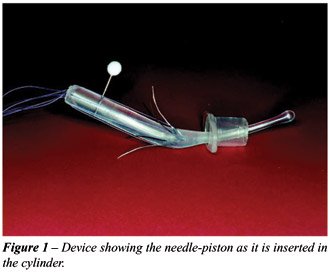
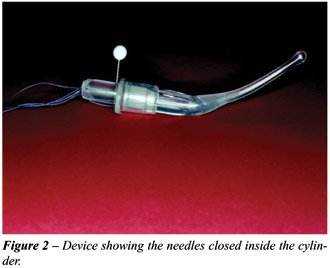
new instrument for passing the stitches on the urethral stump is composed
by a silicone piston with one of the extremities tapered. This piston
has 6 almost straight surgical needles inserted by the extremity that
is connected to the suture around its circumference, in a 45-degree angle.
This silicone is tightly inserted into a cylinder (Figure-1) so that the
6 needles close next to the silicone and inside the cylinder (Figure-2).
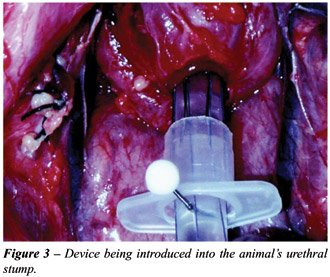
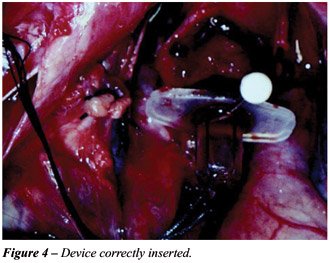
The device is ready to be inserted in the urethral stump (Figure-3) until
the cylinder’s margin (Figure-4). At this moment the lock (pin)
is removed, keeping the cylinder fixed and pushing the silicone piston
until the surgeon can feel the needles opening in the urethral lumen.
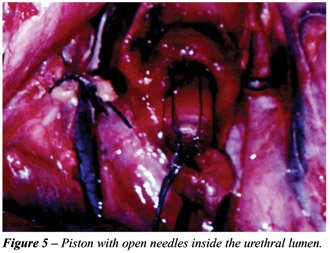
The cylinder is completely removed (Figure-5) and the piston is pulled
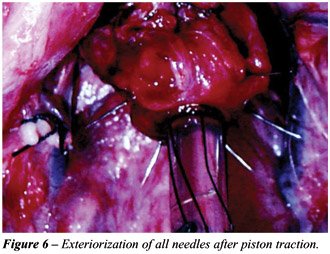
until the 6 needles are exteriorized through the urethral wall (Figure-6).
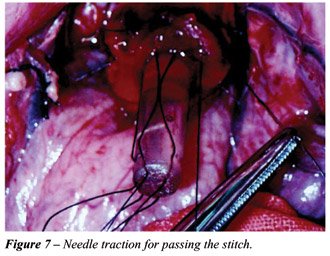
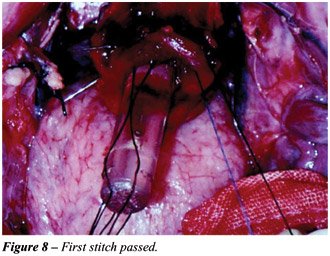
Each needle is pulled (Figure-7), trespassing the corresponding suture
through the urethra (Figure-8). The procedure is repeated with the other
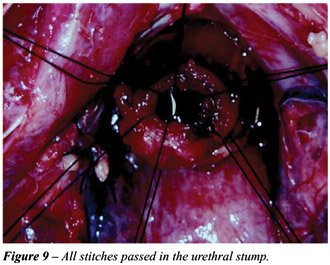
needles until the 6 stitches are completed (Figure-9), when the urethral
stump is then ready to be anastomosed to the bladder or to a neobladder.
This instrument can be useful in laparoscopic
radical prostatectomy as well, since the vesicourethral anastomosis is
performed with great difficulty during this surgery.
In our experiment, the device location in
the urethral stump was easily performed in 10 procedures in pigs, and
in all of them, the mechanism of opening and passing of needles through
the urethra worked as devised by the author.
The prototype used in the animals was manufactured
in a quite simple way. A 4-0 polyglactin needle-suture was used with a
2-cm curve needle, which was manually rectified and inserted in the piston.
In the other extremity of the suture, the use of a separate curve needle
was required for passing the stitch on the bladder neck.
COMMENTS
This device serves only as a vehicle for the 6 surgical needles, using the urethral lumen as access route and enabling the simultaneous passing of all stitches with a regular distribution around the urethral circumference. In animal experiments, this new disposable instrument showed to be easily handled, efficient and safe. With the prototype’s technological improvement, it is expected that those results can be reproduced in humans.
REFERENCES
- Walsh PC, Lepor H, Eggleston JC: Radical prostatectomy with preservation of sexual function: anatomical and pathological considerations. Prostate. 1983; 4: 473-85.
- Selikowitz SM, Albala DM: A method of exposing the vesicourethral anastomotic site during radical retropubic prostatectomy. J Urol. 1995; 154: 1461-2.
- Novicki DE, Larson TR, Andrews PE, Swanson SK, Ferrigni RG: Comparison of the modified vest and the direct anastomosis for radical retropubic prostatectomy. Urology. 1997; 49: 732-6.
- See WA: Council-tip catheter facilitates vesicourethral anastomotic suture placement. Urology. 1995; 46: 401-2.
- Yamada Y, Honda N, Nakamura K, Mitsui K, Hibi H, Taki T, et al.: Vesicourethral anastomotic suture placement during radical prostatectomy using Maniceps. Urol Int. 2003; 70: 181-5.
____________________
Received: April 12, 2004
Accepted after revision: August 12, 2004
________________________
Correspondence address:
Dr. Antonio Celso Di Piero
Rua Francisco Bueno de Lacerda, 220 / 74
Campinas, SP, 13030-210, Brazil
Fax: + 55 19 3231-8992
E-mail: dipiero@ligbr.com.br
EDITORIAL COMMENT
The
author presents an ingenious alternative, which at first site seems useful
and feasible. However, it is important to point that in more delicate
and retracted urethras, the needles could transfix improper sites, and
may include little urethral tissue, eventually even rupturing it, without
an adequate coaptation with the bladder. On the other hand, it may include
excessive urethral tissue, which could involve the sphincteric complex.
The author must be commended and the urologic
community anxiously waits for clinical results.
Dr.
Marcos F. Dall’Oglio
Section of Urology
Federal University of São Paulo, UNIFESP
São Paulo, SP, Brazil