ALTERNATIVES
FOR DISTAL URETER RESECTION IN LAPAROSCOPIC NEPHROURETERECTOMY
(
Download pdf )
M. TOBIAS-MACHADO, MARCELLO A. PINTO, ROBERTO V. JULIANO, MÁRIO H. E. MATTOS, ERIC R. WROCLAWSKI
Division of Urology, ABC Medical School, Santo André, SP, Brazil
ABSTRACT
Objective:
To describe the initial experience of the authors with laparoscopic nephroureterectomy,
and the technical aspects of the distal ureter treatment.
Materials and Methods: We retrospectively
analyzed 6 patients submitted to laparoscopic nephroureterectomy from
February, 2000 to May, 2001. The technical options to access the distal
ureter described in the literature are discussed.
Results: Three patients had TCC (transitional
cell carcinoma), two had chronic renal failure, vesicoureteral reflux
and recurrent urinary tract infection, and one had distal ureteral stone
and renal exclusion. Mean age was 54 years, and mean surgical time was
4 hours and 30 minutes. In 4 patients the nephroureterectomy was performed
through the retroperitoneal access, and in the other 2 patients through
the transperitoneal access, being four on the left side and two on the
right side. In 2 patients the resection of the distal ureter and bladder
cuff was performed through a Gibson incision; in 2, we used a vascular
stapler and, in 2, ureteral intussusception. Mean hospital stay was 4.5
days (3 - 7 days).
Conclusion: The laparoscopic nephroureterectomy
is a feasible procedure. Studies in the literature show its superiority
to the open surgery, because of its advantages as a minimally invasive
surgery. There are many available techniques to remove the distal ureter.
Our access of choice, except in cases of transitional cell carcinoma in
middle and distal ureter, is the technique of ureteral intussusception.
Key words:
kidney; ureter; nephrectomy; laparoscopy; surgery
Braz J Urol, 28: 109-115, 2002
INTRODUCTION
As
from the last decade, laparoscopic surgery has become popular in urology.
Many medical centers are reporting their experience and technological
advances in this type of procedure, mainly on ablative renal surgeries
(1).
Nephroureterectomy with removal of the kidney,
ureter and vesical cuff as a “block” is still the standard procedure
for the treatment of transitional cell carcinoma (TCC). This procedure
demands 2 skin incisions (flank and inferior abdomen), both with considerable
associate surgical morbidity (2).
The first laparoscopic nefroureterectomy
to treat transitional cells carcinoma was described by Clayman et al.
in 1991 (2,3). From then on, many series of nefroureterectomy have been
described (1-6).
In series comparing conventional surgery
to laparoscopic, it was observed that the latter is superior in relation
to morbidity, use of analgesic, hospital stay and return to daily activities.
Oncologic principles are respected in cases of TCC (1,4). In spite of
the fact that there is still no long term follow-up study with TCC patients
(2), some authors have elected laparoscopy their procedure of choice (1,4).
Our objective was to describe our experience
with laparoscopic nephroureterectomy and to comment the technical aspects
of the distal ureter treatment.
MATERIALS AND METHODS
Six
patients were retrospectively analyzed. They had been submitted to laparoscopic
nefroureterectomies from February, 2000 to May, 2001. The following parameters
could be evaluated through the medical register: age, gender, surgical
indication, hospital stay, operative time, analgesic use, postoperative
complications and clinical follow-up.
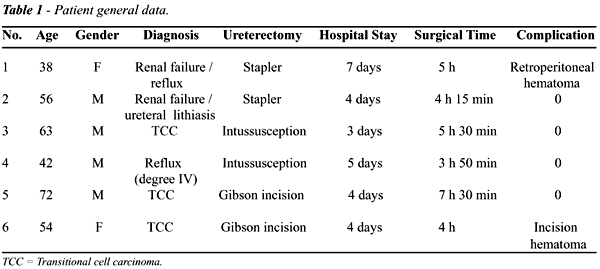
From the 6 patients studied, 4 were men
and 2 women. Age varied from 38 to 72 years (mean = 54 years). Nefroureterectomy
was performed retroperitoneally in 4 patients and transperitoneally in
the others (Table-1).
The options of distal ureter and vesical
cuff removal were analyzed in relation to the access options described
in the literature, emphasizing the advantages and disadvantages of such
procedures found by the authors.
The access option, retroperitoneal or transperitoneal,
was chosen at the time of the surgery in accordance with the surgeon preference.
The treatment option of the distal ureter was done at random, with the
exception of the patients with tumor, when the access choice was based
on the tumor localization.
Patients with TCC suspicion were evaluated
by excretory urography, retrograde pyelography, abdomen and pelvis tomography,
and semi-rigid ureteroscopy.
Pain criteria was subjectively analyzed
by the patient via a questionnaire answered on the day of the surgery
and during clinical follow-up, and by the use of analgesics (number of
doses).
In 4 patients, the nephroureterectomy was
performed through retroperitoneoscopy, according to the description of
Gill (7). Instead of using the commercial balloon, we used digital maneuvers,
Gaur balloon to create working space, and 3 subcostal ports to dissect
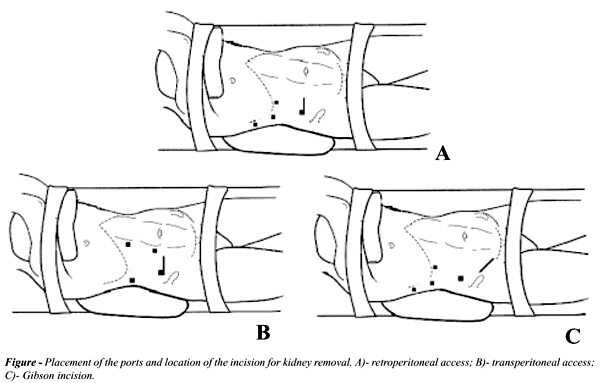
the kidney (3). In the patients submitted to transperitoneal nephroureterectomy,
the procedure was performed with the same number of ports. The kidney
dissection was performed after medial colon detachment. In all cases,
the surgical piece was removed after being placed into a bag through a
6-cm abdominal incision created from the extension of a port incision
(Figure-1).
As for the distal ureter treatment, the
vascular stapler was used in 2 patients after dissecting the ureter down
to the bladder. The vascular stapler was inserted in one of the ports
(12 mm) and the distal ureter was sectioned close to the bladder (Table-1).
In 2 patients, the distal ureter intussusception
technique was used. In patients with TCC, the existence of tumor was evaluated
in the preoperative before choosing this technique. This evaluation is
performed through excretory urography and semi-rigid ureteroscopy, and,
if necessary, with retrograde pyelography and abdomen and pelvis tomography.
In case of suggestive tumor lesion, the surgical approach to remove the
ureter was changed, depending on its localization. After dissecting the
kidney and part of the ureter (down to the illiac vessels), a transverse
incision is made approximately 6 cm above the anterosuperior illiac ridge,
which extended from one of the ports’ incision (Part A of Figure).
The kidney is then exposed. An opening is done in the medial ureter and
a ureteral catheter is passed down to the bladder. This catheter is fixed
to the ureter wall with a transfixing point in the catheter and ureteral
wall. After passing the catheter, the ureter is sectioned and the kidney
is removed. The abdominal wall is then sutured with the ureteral catheter
in the retroperitoneum. The patient is placed in lithotomy position nad
the catheter is pulled, everting the ureter. The vesical cuff is resected
with resection loop or Collins loop. This technique is based on the open
surgery principles proposed by McDonald in 1953 (8) (Table-1).
In the last 2 patients, we used the Gibson
incision to remove the distal ureter and the vesical cuff. After laparoscopically
dissecting the distal ureter down the iliac vessels and ligation of the
renal vessels, the Gibson incision was done. The surgical specimen is
then removed from the vesical cuff and the bladder is sutured. Vesical
catheter is kept for 5 days.
RESULTS
Three
patients presented TCC, one in the medial ureter and 2 in the renal pelvis.
One patient had the tumor on the right side, while in the other 2, it
was on the left side. Two patients presented vesicoureteral reflux, renal
exclusion on the same side and recurrent urinary infection. One patient
presented calculus on the left at the ureterovesical juntion on the left,
hydronephrosis, renal exclusion and lumbar pain which did not improve
with analgesics (Table-1).
Mean operative time was 4 hours and 30 minutes,
varying from 3 hours and 30 minutes in 1 patient with vesicoureteral reflux
to 7 hours and 30 minutes in 1 patient with TCC. Distal ureter removal
time was of 10 minutes in the patients submitted to ureteral intussusception,
of 30 minutes in the patients submitted to Gibson incision, and of approximately
45 minutes in the patients submitted to laparoscopic distal ureter dissection.
The time to change patients’ position during surgery was not taken
into account.
Hospital stay varied from 3 to 7 days, with
a mean of 4.5 days. Postoperative analgesia was obtained through minor
analgesic (acetaminophen) until the second postoperative day. There was
no need of blood transfusion.
There were no major intraoperatory complications
or conversion need. One patient developed lumbar pain until the 5th postoperative
day due to a retroperitoneum autolimited hematoma diagnosed by ultrasonography.
One patient presented hematoma at the Gibson incision.
The pathological study of the TCC patients
reveled stage II tumor in 2 patients and stage III in 1. All tumors were
PT2N0M0 staging with margins free of neoplasia.
Patients with TCC diagnosis were clinically
followed with excretory urography, abdomen and pelvis tomography, oncotic
cytology, chest plain film and cystoscopy with biopsy. So far, none of
them presented local or distant recidivation. Mean follow-up was of 6
months (4 - 12 months).
DISCUSSION
Since
1991, when Clayman et al. described the laparoscopic access to nephrouretectomy
(3), it has become an option of feasible access and has been performed
in many centers (1-6), both retroperitoneally and transperitoneally. It
has also been performed by the hand-assisted surgery (4) and by the surgery
without gas (5).
Gill et al. observed that the laparoscopic
surgery has more advantages than the open surgery. It presents shorter
hospital stay, lower morbidity and sooner return to daily activities (1,3).
Operative time in our series was similar
to the results reported in the literature. The long operative time (7
hours and 30 minutes) of one patient was justified by the TCC diagnosis
inherent care. In this case, the operative time was also longer due to
the use of the Gibson incision to remove the distal ureter This fact did
not influence the use of analgesics or the hospital stay.
The longest hospital stay was due to the
patient’s lumbar pain, which lasted until the 6th postoperative day.
The pain was caused by an autolimited hematoma in the retroperitoneum.
The use of analgesics (acetaminophen) and
return to daily activities was as expected for patients submitted to major
laparoscopic surgeries (1).
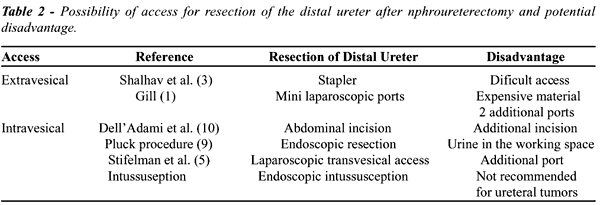
Many distal ureter treatment options have
been described in the literature (Table-2). Clayman et al. described the
nephoureterectomy using a stapler to remove the distal ureter and vesical
cuff (3). We have used this technique in 2 patients, one with distal ureter
calculus and another with reflux (Table-1). We had great difficulty to
access the distal ureter and the vesical cuff and the ligature of the
bladder superior pedicle was necessary. Clayman et al. had already reported
this difficulty to handle the distal ureter with this technique (3).
There are other options to remove the distal
ureter, such as the one described by the Western General Hospital (Pluck
procedure). In this technique, the ureteral meatus is endoscopically resected
until the perivesical fat previous to the nephroureterectomy. This technique
is fast, easy, and allows the simple cranial traction of the ureter to
set it free from the bladder. The main disadvantage of this technique
is the possibility of neoplastic cells dissemination in the surgical site
(9).
Gill et al. have used transvesical technique
to dissect the ureteral meatus through 2 mini-laparoscopic accesses in
the bladder and one endoloop to avoid retroperitoneum contamination with
urine (1,2). This technique is limited to some medical centers where they
have mini-laparoscopy material. Stifelman et al. use this same principle
of transvesical access; however, with one 5-mm laparoscopic port to insert
the endoloop and the resectoscope to resect the ureter (5). The technique
described by Stifelman et al. (5), despite using the same principles described
by Gill et al. (1), has the advantage of using the regular material used
by the laparoscopic urologist.
We have used the Gibson incision to access
the distal ureter in 2 patients with TCC (3). The advantage of this technique
was the easy removal of the distal ureter and vesical cuff. Besides, it
was possible to avoid any possibility of neoplastic cells dissemination
in the surgical site. Dell’Adami et al. (10) used a suprapubic transverse
incision to transvesically access the ureteral meatus, as a measure to
avoid the dissemination of neoplastic cells in the retroperitoneum. We
believe that the techniques which use an incision to access the ureter
are effective to avoid the dissemination of neoplastic cells. However,
they have the disadvantage of needing an additional incision.
In the other 2 patients, one with a localized
TCC in the renal pelvis and the other with stage IV reflux (Table-1),
we have used the distal ureter intussusception technique described previously.
The advantages of this technique are: there is no need of an additional
incision and the procedure is fast, once it avoids ureter dissection to
the vesical cope, which is a place of difficult laparoscopic access. It
is also a good option because it can be performed with daily use material.
It respects the oncologic principles as it does not allow neoplastic cells
exposition in the surgical site, even with the ureter section, once it
does not allow urine leakage. The disadvantage of this technique is that
it is not recommended in patients with medial and distal ureter TCC, due
to the possibility of ureter section in the tumor site.
REFERENCES
- Gill IS, Sung GT, Hobart MG, Savage SJ, Meraney AM, Schweizer DK, et al.: Laparoscopic radical nephroureterectomy for upper tract transitional cell carcinoma: the Cleveland clinic experience. J Urol, 164: 1513-1522, 2000.
- Kaouk JD, Savage SJ, Gill IS: Retroperitoneal laparoscopic nephroureterectomy and management options for the distal ureter. J Endourol, 15: 385-390, 2001.
- Shalhav AL, Portis AJ, McDougall EM, Patel M, Clayman RV: Laparoscopic nephroureterectomy: a new standard for the surgical management of upper tract transitional cell cancer. Urol Clin North Am, 27: 761-773, 2000.
- Jarret TW, Chan DY, Cadeddu JA, Kavoussi LR: Laparoscopic nephroureterectomy for the treatment of transitional cell carcinoma of the upper urinary tract. Urology, 57: 448-453, 2001.
- Stifelman MD, Sosa RE, Andrade A, Trantino A, Shichman SJ: Hand-assisted laparoscopic nephroureterectomy for the treatment of transitional cell carcinoma of the upper urinary tract. Urology, 56: 741-747, 2000.
- Igarashe T, Tobe T, Mikami K, Suzuki H, Ichikawa T, Ito H: Gasless, hand-assisted retroperitoneoscopic nephroureterectomy for urothelial cancer of the upper urinary tract. Urology, 56: 851-853, 2000.
- Gill IS: Retroperitoneal laparoscopic nephrectomy. Urol Clin North Am, 25: 343-360, 1998.
- McDonald DF: Intussuception ureterectomy: a method of removal of the ureteral stump at time of nephroureterectomy without an additional incision. Surg Gynecol Obstet, 97: 565-568, 1953.
- Stephenson RN, Sharama NK, Tolley DA: Laparoscopic nephroureterectomy: a comparison with open surgery. J Endourol, 9 (supp 1): 99, 1995.
- Dell’Adami G, Breda G: Transureteral or endoscopic ureterectomy. Eur Urol, 2: 156-157, 1976.
____________________
Received: June 27, 2001
Accepted after revision: February 8, 2002
_______________________
Correspondence address:
Dr. Marcello Alves Pinto
Rua São Paulo Antigo, 500 / 191C
São Paulo, SP, 05684-011, Brazil
Fax: + + (55) (11) 3758-9851
E-mail:dmalvesp@terra.com.br
EDITORIAL
COMMENT
The
authors report their initial experience with 6 cases of laparoscopic nephroureterectomy
in the treatment of benign pathologies and upper tract transitional cell
carcinoma (TCC). In 4 patients, the retroperitoneoscopy was used, being
transperitoneal in 2 cases. Total operative time, hospital stay and complications
were acceptable and similar to other series described in the literature.
The short hospital stay and absence of major complications reflect the
benefits offered by the minimally invasive technique when compared to
the open surgery, despite the apparent longer operative time.
Different alternatives in the distal ureter
and vesical cuff handling after laparoscopic nephrectomy were used by
the authors, including the use of laparoscopic stapler, ureteral intussusception
and open surgery (through Gibson incision) at the end of the procedure.
Even though the number of cases and parameters checked in the study do
not allow direct comparison to the techniques used in the distal ureter,
the authors considered the ureteral intussusception their choice due to
its facility. An appropriate revision about the several existent alternatives
is presented by the authors.
The ideal ureter distal/cuff vesical approach
during the radical laparoscopic nephroureterectomy is still under development
(1). The preoccupation of reproducing with efficacy the oncologic principles
of the open surgery prioritizes the alternatives with distal ureter oclusion
– particularly the transvesical technique (Cleveland Clinic), open
technique (Gibson or suprapubic incision) or the use of laparoscopic stapler
(Washington University). Despite the good results in the literature, the
latter presents a high risk of vesical calculus formation secondary to
the titanium clamps in the long term, as there is still no absorbable
laparoscopic staplers.
The actual laparoscopic nephroureterectomy
results, both trans and retroperitoneal, even though requiring specific
ability and training, characterize this minimally invasive procedure as
the most beneficial and of greater impact in the urologic laparoscopy.
The data in this series of cases are in accordance with this impression.
The substitution of 2 simultaneous incisions (lumbotomy and Gibson) or
extensive single incision (xiphopubic median) by 1.5 – 2 cm incisions
and small incision (6 – 7 cm) in the inferior abdomen to extract
the specimen intact, mainly in TCC cases, is a huge technical advance.
Once confirmed the oncologic adequacy of the method in a long term follow-up
(> 5 years), it has the potential of becoming the treatment of choice.
Reference
- Kaouk
JH, Savage SJ, Gill IS: Retroperitoneal laparoscopic nephroureterectomy
and management options for the distal ureter. J Endourol, 15: 385-391,
2001.
Dr.
Eduardo Franco Carvalhal
Section of Urology, São Lucas Hospital,
Catholic University
Porto Alegre, RS, Brazil