RENAL
SPARING SURGERY FOR PERIRENAL LIPOSARCOMA: 24 MONTHS RECURRENCE FREE FOLLOW
UP
(
Download pdf )
NARMADA P. GUPTA, RAJIV YADAV
Department of Urology, All India Institute of Medical Sciences, New Delhi, India
ABSTRACT
Liposarcoma is the most common pathology seen in the soft tissue sarcoma of retroperitoneum. These tumors have been traditionally treated with radical surgery sacrificing adjacent organs to achieve clear margins. We have reported our experience of renal sparing surgery for perirenal liposarcoma in two patients with more than 24 month disease free survival.
Key
words: retroperitoneal neoplasm; liposarcoma; surgery
Int Braz J Urol. 2007; 33: 181-92
INTRODUCTION
Soft-tissue sarcomas of the retroperitoneum are relatively uncommon tumors with an incidence of 2 in 100,000 (1). Liposarcoma is the most common pathology seen in the soft tissue sarcoma of retroperitoneum (61%); 79% of which are low grade (2). In general, the biological behavior and prognosis of liposarcomas (LPS) are more favorable compared to most soft tissue sarcomas (STS) but the prognosis can vary widely depending on tumor characteristics, especially histological subtype and tumor grade (3). Emphasizing the importance of radical resection and tumor negative surgical margins for disease specific survival, these tumors have traditionally been treated with radical surgery sacrificing adjacent organs (1,3-5). Multiple trials of chemotherapy and radiation therapy have shown no survival benefit. We report our experience of renal sparing surgery for perirenal liposarcoma in two patients with an excellent postoperative outcome and more than 24 month disease free survival.
CASES PRESENTATION
Case
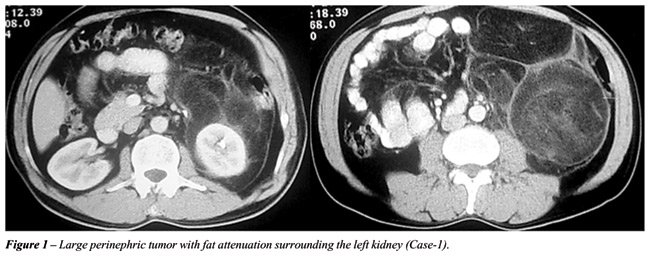
1: A fifty-year diabetic and hypertensive male presented with a lump in
the left side of upper abdomen and 3-month dull aching pain of. He had
no history of any lower urinary tract symptoms, lithiasis or operative
intervention in past. His blood sugar and blood pressure was normal with
oral medication. He had normal renal function and hemogram. Computed tomography
of abdomen and pelvis revealed a 12x10 centimeter mass with lipomatous
density involving the perirenal fat without infiltrating surrounding organs.
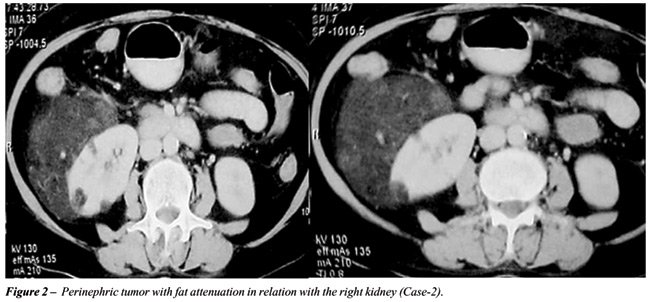
Case 2: Fifty seven year old woman presented
with a 2-month right flank pain with no other urinary symptoms. Clinically
examination revealed right hypochondrial renal swelling. Computed tomography
of abdomen and pelvis revealed 10x8 centimeter perinephric lesion with
fat attenuation surrounding the upper and mid polar region.
The preoperative imaging study was suggestive
of a close association of tumor with the kidneys in both the cases (Figures-1
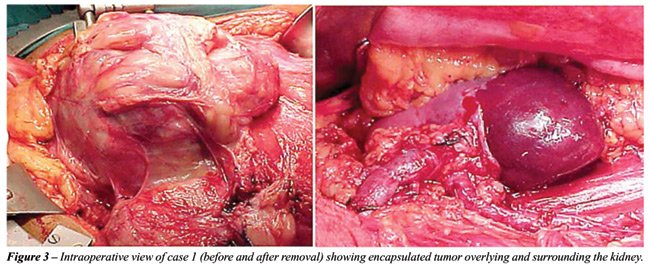
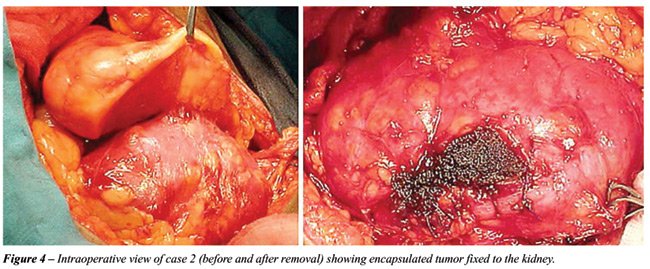
and 2) but intraoperative assessment resulted a plan of renal sparing
approach in both the situations. Intraoperatively, a well encapsulated
lipomatous tumor was found to extend from the upper pole to the lower
pole draping the surface of the renal capsule and infiltrating the renal
capsule in one of the locations over 1 cm diameter region (Figures-3 and
4). Complete tumor resection was achieved after wedge resection of renal
parenchyma with 1 cm margin.
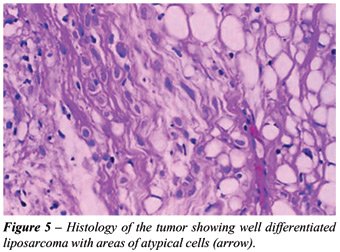
Histopathology revealed well-differentiated
liposarcoma with focal invasion of the renal capsule in both cases (Figure-5).
Dissected margins were free of tumor.
Both patients were discharged after 72 hours
postoperatively without any complication. Patients were kept on a three
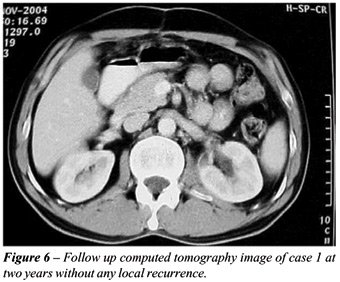
monthly follow-up. Computed tomography images were repeated at 6 month
intervals for two years. At present, both patients are completely asymptomatic,
free of local recurrence (Figure-6) or distant metastases.
COMMENTS
Subsequent
to the first description of renal sparing surgery for treatment of renal
tumor in 1890, considerable advances in renal imaging and surgical experience
has resulted in good long term survival with such treatment in appropriately
selected patients. Regarding the management of retroperitoneal liposarcoma,
surgery plays a dominant role in the initial and subsequent treatment.
Gronchi et al. (6), in a retrospective study involving 167 consecutive
patients who underwent surgery for retroperitoneal soft tissue sarcoma
over a 20 year span, assessed long-term prognosis and patterns of failure
in these patients. Only a minority of patients developed distant metastases.
Histological subtype appeared to influence the pattern of recurrence,
which was mainly local for patients with liposarcoma. Several authors
have noted that tumor negative surgical margins are associated with a
reduced risk of local recurrence and improved disease specific survival,
especially in patients with low-grade retroperitoneal LPS (1,3,4). In
both our case only limited involvement of renal parenchyma was observed
at the time of surgery, which made renal sparing surgery a feasible option
without compromising the oncological principle of tumor free margins.
We believe that the principle of achieving the tumor free margins may
be respected by renal sparing surgery in select cases of liposarcoma.
The decision to perform nephrectomy should be made based on intraoperative
findings rather than solely on preoperative imaging studies.
In conclusion, renal sparing approach in
perirenal liposarcoma is a feasible option in select cases with good recurrence
free survival.
CONFLICT OF INTEREST
None declared.
REFERENCES
- Voros D, Theodorou D, Ventouri K, Prachalias A, Danias N, Gouliamos A: Retroperitoneal tumors: do the satellite tumors mean something? J Surg Oncol. 1998; 68: 30-3.
- Bautista N, Su W, O’Connell TX: Retroperitoneal soft-tissue sarcomas: prognosis and treatment of primary and recurrent disease. Am Surg. 2000; 66: 832-6.
- Nijhuis PH, Sars PR, Plaat BE, Molenaar WM, Sluiter WJ, Hoekstra HJ: Clinico-pathological data and prognostic factors in completely resected AJCC stage I-III liposarcomas. Ann Surg Oncol. 2000; 7: 535-43.
- Malerba M, Doglietto GB, Pacelli F, Carriero C, Caprino P, Piccioni E, et al: Primary retroperitoneal soft tissue sarcomas: results of aggressive surgical treatment. World J Surg. 1999; 23: 670-5.
- Neuhaus SJ, Barry P, Clark MA, Hayes AJ, Fisher C, Thomas JM: Surgical management of primary and recurrent retroperitoneal liposarcoma. Br J Surg. 2005; 92: 246-52.
- Gronchi A, Casali PG, Fiore M, Mariani L, Lo Vullo S, Bertulli R, et al.: Retroperitoneal soft tissue sarcomas: patterns of recurrence in 167 patients treated at a single institution. Cancer. 2004; 100: 2448-55.
____________________
Accepted after revision:
October 10, 2006
________________________
Correspondence
address:
Dr. Narmada P Gupta
Head, Department of Urology
All India Institute of Medical Sciences
Ansari Nagar, New Delhi, 110029, India
E-mail: narmadagupta@hotmail.com
This
is a case report of renal sparing surgery for liposarcoma. The conclusion
that this surgery is feasible in selected cases may be premature based
on two cases with two year follow-up.
Well
differentiated sarcomas may recur years later. Also, at time of surgery,
one cannot ever assess aggressiveness with frozen section. While this
approach may be successful, a longer experience should be gathered with
larger follow-up prior to make these conclusions.
Dr. Yair
Lotan
Professor of Urology
University of Texas Southwestern Med Ctr
Dallas, Texas, USA
E-mail: yair.lotan@utsouthwestern.edu
EDITORIAL COMMENT
The concept is interesting only because it relates to a tumor rarely encountered. The goal with surgery for retroperitoneal sarcomas is complete resection at the time of surgery. Sparing of organs is important as long as oncological principles are not compromised.
Dr. R.
Houston Thompson
Professor of Urology
Mayo Medical School, Mayo Clinic
Rochester, Minnesota, USA
E-mail: thompson.robert@mayo.edu
EDITORIAL COMMENT
This is an interesting report of two patients who underwent nephron-sparing surgery to effect excision of a perirenal liposarcoma. The unusual application of nephron-sparing in this setting renders this report novel and of interest to urological practitioners. The short-term outcome in these patients appears to have been satisfactory with no evidence of tumor recurrence at two years postoperatively.
Dr. Andrew
C. Novick
Chair of Urology, Glickman Urological Institute
Cleveland Clinic Foundation
Cleveland, Ohio, USA
E-mail: novicka@ccf.org