STRUCTURAL
ANALYSIS OF GUBERNACULUM TESTIS IN CRYPTORCHID PATIENTS SUBMITTED TO TREATMENT
WITH HUMAN CHORIONIC GONADOTROPHIN
(
Download pdf )
CHARBEL S. EL ZOGHBI, LUCIANO A. FAVORITO, WALDEMAR S. COSTA, FRANCISCO J. B. SAMPAIO
Urogenital Research Unit, State University of Rio de Janeiro, Rio de Janeiro, RJ, Brazil
ABSTRACT
Objectives:
To make a histological and stereological analysis of gubernaculum testis
elastic system fibers, collagen and striated muscle cells in patients
with cryptorchidism treated with human chorionic gonadotrophin (hCG).
Materials and Methods: Gubernacula tissue
samples were obtained from 12 patients with cryptorchidism. Patients’
ages ranged from 1 to 3 years (mean 1.8). Of the 12 patients, 6 were treated
with hCG. The samples were stained with Masson’s trichrome to highlight
muscle fibers and collagen, and Weigert’s resorcin-fuchsin to highlight
the elastic system fibers. The volumetric density of these components
was determined by stereological methods.
Results: The volumetric density of collagen
was increased in patients treated with hCG, ranging from 85.62% to 94.48%,
while in patients not submitted to hCG treatment the volume density ranged
from 52.12% to 89.46% (p = 0.0052). The volumetric density of the elastic
system fibers was higher in patients treated with hCG, ranging from 9.62%
to 19.62%, while patients not submitted to hCG treatment the volume density
of elastic system fibers was between 10.38% and 12.38% (p = 0.0030). The
volume density of striated muscle fibers in patients treated with hCG
ranged from 4.76% to 39.16%, while and in patients not treated hCG it
ranged from 3.24% to 11.14% (p = 0.0052).
Conclusion: Gubernacular components alter
significantly when submitted to treatment with hCG. Patients who underwent
hCG treatment and had no complete testicular migration had an increase
in the concentration of elastic and striated muscle fibers and a decrease
in the volumetric density of collagen.
Key
words: testis; cryptorchidism; human chorionic gonadotrophin;
connective tissue; muscle
Int Braz J Urol. 2007; 33: 223-30
INTRODUCTION
Cryptorchidism
is one of the most common developmental defects in human males, with an
incidence of 2 to 5% in full-term newborns (1). The treatment is surgical
(2); however, there are reports on several cases of testis migration after
hormonal treatment with human chorionic gonadotrophin (hCG) or gonadotrophin
releasing factor (GnRH) (1).
The gubernaculum testis seems to be the
most important structure involved in testicular migration (3). The gubernaculum
is a mesenchymal structure attached superiorly to the inferior pole of
the testis and the epididymal tail (testicular portion) and attached inferiorly
in the inguinal canal or scrotum (scrotal portion) (4,5).
Histologically, the gubernaculum is composed
of an abundant extracellular matrix that is rich in glycosaminoglycans
and mesenchymal cells, such as fibroblasts (6-8). The role of gubernaculum
in testicular migration is especially due to its ability to dilate and
shorten, thus facilitating the testis course through the inguinal canal
(6-8).
Gubernacular remodeling during fetal period
is influenced by direct androgenic stimulation and by the action of the
genitofemoral nerve (9,10). The existence of androgenic receptors in the
gubernaculum was assessed in experimental studies carried out in rats
(11). The existence of these androgenic receptors in human gubernacula
is also suggested (10). The role of hCG in the treatment of cryptorchidism
is to stimulate testosterone secretion, which induces an increase of androgenic
receptors in the gubernaculum (1,11,12).
To our knowledge, there has been no previous
study on the structural changes in the gubernaculum testis elastic system
fibers, collagen and muscle fibers in patients with cryptorchidism submitted
to treatment with hCG, as compared to a control group not submitted to
treatment with hCG. Therefore, the aim of this study is to make a histological
and stereological analysis of these structures in both groups.
MATERIALS AND METHODS
We
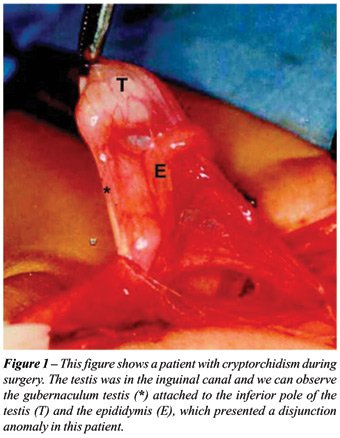
studied 12 gubernacula (Figure-1) from 12 patients with cryptorchidism,
ranging in age from 1 to 3 years (mean, 1.8). All patients were submitted
to surgical orchidopexy in the period from April 2004 to July 2005. The
12 patients studied were divided according to previous use or not use
of hCG.
The hCG treatment doses were delivered according
to the World Health Organization recommendations (1), that is, twice a
week for a five-week period, according to age, children up to 2 years
old received intramuscular doses of 250 UI (total of 2500 UI), children
older than 2 years received intramuscular doses of 500 UI (total of 5000
UI). This study was evaluated and approved by the institutional review
board at our institution.
Gubernaculum samples were fixed in buffered
formalin (pH = 7.2), dehydrated in alcoholic solution, clarified in xylol
and embedded in paraffin. From each fragment of gubernaculum, we obtained
20 different 5 micrometers thick sections, 5 of these sections were selected
and stained with the following histochemical methods. Masson’s trichrome
to highlight muscle fibers and collagen, and Weigert’s resorcin-fuchsin
with and without previous oxidation with oxone to highlight the fibers
of the elastic system. Metalloproteinase I and III immunohistochemical
techniques were used to assess a likelihood of damage to collagen fibers.
Five sections from each sample were selected
for the quantitative analysis. We studied 5 microscopic fields chosen
at random, totaling 25 test areas studied for each gubernaculum, to a
total of 1200 test areas for the complete study.
Imaging for the analysis and quantification
of the gubernaculum were obtained in a X400 magnification, under an Olympus
optical microscope, coupled to a Sony CCD video camera connected to a
Sony KX14-CP1 video monitor. Results for each field were obtained through
the quantification assessment method, by superposing an M42 test grid
(multipurpose test system) on the video monitor screen (13).
The arithmetic mean of the quantification
in 5 fields of each section was determined. Afterwards, we obtained the
mean quantification value for the 5 sections studied from each gubernaculum
(total of 25 test areas). General means of each studied gubernaculum was
divided by 42 (number of grid points used in the stereological assessment)
and the percent value of fibers per gubernaculum was calculated.
The structures were analyzed and compared
through Kolmogorov-Smirnov test. Student’s t test, not paired, was
used to test if the difference in the means and the standard deviations
between the 2 groups was significant (14).
RESULTS
Patient
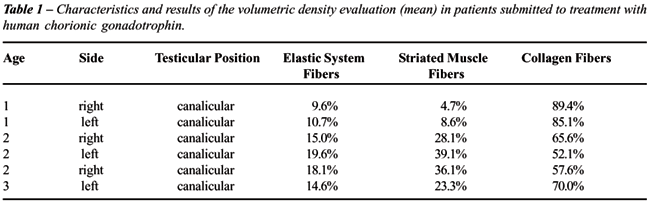
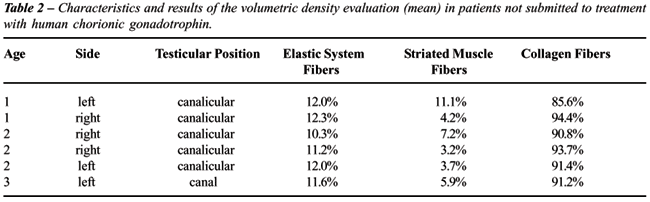
age, cryptorchid testis position and the mean volumetric density of collagen,
striated muscle and elastic system fibers are shown in Table-1 for patients
that used hCG and in Table-2 for patients that did not use hCG. In our
sample, all patients had unilateral cryptorchidism and their testes were
located in the inguinal canal.
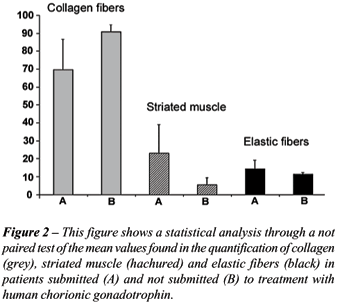
The statistical analysis for volumetric density
of collagen, striated muscle and elastic system fibers of the studied
gubernacula are shown in Figure-2. Of the three elements, independently
of hCG use or not, collagen fibers are present in largest amount in the
gubernaculum of the studied patients, and the mean concentration of collagen
was more than two times the mean concentration of the elastic system fibers
and striated muscle fibers.
The volumetric density of collagen was higher
in patients submitted to treatment with hCG and ranged from 85.62% to
94.48%, whereas in patients not treated with hCG the collagen density
ranged from 52.12% to 89.46% (statistically significant, p = 0.0052).
Figure-3 shows the histological aspect of collagen distribution in patients
submitted and not submitted to hCG treatment previous to surgery. We can
observe a lower concentration of collagen in patients submitted to hCG
treatment.

The volumetric density of elastic system
fibers was higher in patients submitted to treatment with hCG and ranged
from 9.62% to 19.62%, whereas in patients not submitted to treatment with
hCG the volumetric density of elastic system fibers ranged from 10.38%
to 12.38% (statistically significant, p = 0.0030). Figure-4 shows the
distribution of elastic system fibers in patients submitted and not submitted
to hCG treatment previous to surgery. We can observe a high concentration
of elastic system fibers in a patient treated with hCG (Figure-4A) when
compared to a patient not treated with hCG (Figure-4B).

The volumetric density of striated muscle
fibers was higher in patients submitted to treatment with hCG and ranged
from 4.76% to 39.16%, whereas in patients not submitted to treatment with
hCG the volumetric density of striated muscle ranged from 3.24% to 11.14%
(statistically significant, p = 0.0052). Figure-5 shows the histological
distribution of striated muscle fibers in patients treated and not treated
with hCG.

COMMENTS
The
gubernacular structure undergoes major changes during the human fetal
period. The gubernaculum grows in volume during the second trimester of
pregnancy and undergoes a decrease in its turgidity and a shortening after
the passage of the testicle through the inguinal canal (7,8,11,15). The
hormones would have an important role in this reshaping, stimulating the
fibroblasts to secrete metalloproteinases, which would act in the modifications
of the gubernaculum extracellular matrix (11,16).
The use of hormones (hCG and GNRH) is the
only known clinical treatment for cryptorchidism, with a success rate
ranging from 15% to 50% (1). The histological changes caused by the use
of hCG in the germinative epithelium and in testicular collagen fibers
are well known (17,18), however, the structural changes in the gubernaculum,
caused by the use of hCG are not described in details.
A hypothesis that could explain the migration
process of the testicle after using hCG, would be the increase in the
amount of testosterone, inducing the appearance of androgenic receptors
on the fibroblasts of the gubernaculum which would degrade the extracellular
matrix and would stimulate the contraction of the muscle fibers in the
gubernaculum, thus determining its shortening (11). Since the hCG acts
through receptors coupled to G proteins, the signals initiated after hCG
administration may play a role in these findings. Structures associated
with undescended testis reveals evidence of subjecting to less sympathetic,
but more parasympathetic tonuses. This signaling activates phospholipase
C, however, binding of hCG activates adenyl cyclase. Those differences
may provide basis for less volume density of collagen and higher volume
density of elastic fibers in gubernaculums during testicular migration
(19,20). This theory explains the presence of striated muscles in the
gubernaculum (10,11). In our study, we have noticed that patients who
have undergone the treatment with hCG had a concentration of striated
muscle fibers much higher than patients who had not taken the hormone,
which may reinforce the theory that the use of hCG induces an increase
in the gubernaculum ability to contract.
The only report in the literature that analyzes
the elements of the gubernaculum in patients with cryptorchidism submitted
to clinical treatment with hCG (21) does not refer to a control group
(patients not treated) and shows a lack of glycosaminoglycans and muscle
tissue in cryptorchid gubernacula (21).
The elastic system fibers, present in small
amounts at the beginning of human fetal period, grow larger in fetuses’
gubernaculum older than 25 weeks (8). In fetuses with 28 and 29 weeks
of age, whose testicles have already completed their migration (located
in the scrotum), the elastic system fibers were present in great quantity,
mainly in the distal portion of the gubernaculum (8).
The elastic system fibers are structures
that change a lot in the gubernaculum, and are responsible for the shortening
of the gubernaculum and its later change into a band of connective tissue
(8). The expression of androgenic receptors stimulated by testosterone
induces a reshape of the extracellular matrix, so that the gubernaculum
gets shorter through the contraction originated in the striated muscle
fibers as well as in the increase of elastic system fibers concentration
(11). We have noticed, in our study, that the volumetric density of the
elastic system fibers in the gubernaculum was much higher in patients
with cryptorchid testes who received hCG, which would be another evidence
that would support the theory of the expression of androgenic receptors.
During the period of testicular migration,
the connective tissue of the gubernaculum undergo an important reshape
and becomes, at the end of the migration, a fibrous structure essentially
rich in collagen tissue (8). Of the 3 structural elements of the gubernaculum
that had been studied here, the collagen was the one that had been present
in greater concentration, independently of the use of hCG.
The increase in the volumetric density of
collagen, even in patients with cryptorchidism, shows that structural
reshape of the gubernaculum extracellular matrix took place, nevertheless,
this reshape would not result in complete testicular migration (22). We
have noticed in our study that the volumetric density of collagen was
much higher in patients who had not taken hCG. These findings may suggest
that patients who used the hormone kept a reshape of the gubernaculum
connective tissue, causing a decrease in the volumetric density of collagen
fibers, possibly indicating an increase in the activity of the metalloproteinases.
Patients who were studied here have not shown a complete migration of
the cryptorchid testicle, which may indicate a failure of the factors
that stimulated the complete reshape, such as, for instance, a deficiency
of the androgenic receptors on the gubernaculum.
We concluded that the histological constituents
of the gubernaculum undertake a major change when submitted to treatment
with hCG. Patients that received hCG and did not experience complete testicle
migration, showed an increase in the concentration of elastic and striated
muscle fibers and a decrease in the relative concentration of collagen.
These changes could be related to the stimulation that testosterone exerts
on the androgenic receptors causing the shortening of the gubernaculum.
ACKNOWLEDGMENT
Research supported by FAPERJ (Rio de Janeiro Foundation for Research Support) and CNPQ (National Council for Scientific and Technological Development), Brazil.
CONFLICT OF INTEREST
None declared.
REFERENCES
- Gill B, Kogan S: Cryptorchidism. Current concepts. Pediatr Clin North Am. 1997; 44: 1211-27.
- Cendron M, Huff DS, Keating MA, Snyder HM 3rd, Duckett JW: Anatomical, morphological and volumetric analysis: a review of 759 cases of testicular maldescent. J Urol. 1993; 149: 570-3.
- Heyns CF, Hutson JM: Historical review of theories on testicular descent. J Urol. 1995; 153: 754-67.
- Favorito LA, Sampaio FJ, Javaroni V, Cardoso LE, Costa WS: Proximal insertion of gubernaculum testis in normal human fetuses and in boys with cryptorchidism. J Urol. 2000; 164: 792-4.
- Favorito LA, Klojda CA, Costa WS, Sampaio FJ: Is there a relationship with anomalous insertions of the distal gubernaculum testis and testicular ectopia? Analysis in human fetuses and patients with cryptorchidism. J Urol. 2003; 170: 554-7.
- Backhouse KM: Embryology of testicular descent and maldescent. Urol Clin North Am. 1982; 9: 315-25.
- Heyns CF: The gubernaculum during testicular descent in the human fetus. J Anat. 1987; 153: 93-112.
- Costa WS, Sampaio FJ, Favorito LA, Cardoso LE: Testicular migration: remodeling of connective tissue and muscle cells in human gubernaculum testis. J Urol. 2002; 167: 2171-6.
- Beasley SW, Hutson JM: The role of the gubernaculum in testicular descent. J Urol. 1988; 140: 1191-3.
- Hosie S, Wessel L, Waag KL: Could testicular descent in humans be promoted by direct androgen stimulation of the gubernaculum testis? Eur J Pediatr Surg. 1999; 9: 37-41.
- Vigueras RM, Reyes G, Moreno-Mendoza N, Merchant-Larios H: Gubernacular fibroblasts express the androgen receptor during testis descent in cryptorchid rats treated with human chorionic gonadotrophin. Urol Res. 2004; 32: 386-90.
- Elder JS, Isaacs JT, Walsh PC: Androgenic sensitivity of the gubernaculum testis: evidence for hormonal/mechanical interactions in testicular descent. J Urol. 1982; 127: 170-6.
- Weibel ER, Kistler GS, Scherle WF: Practical stereological methods for morphometric cytology. J Cell Biol. 1966; 30: 23-38.
- Sokol RR, Rohlf FJ: Biometry. Third edition. New York, Freeman WH. 1995.
- Heyns CF, Human HJ, De Klerk DP: Hyperplasia and hypertrophy of the gubernaculum during testicular descent in the fetus. J Urol. 1986; 135: 1043-7.
- Shono T, Suita S, Kai H, Yamaguchi Y: The effect of a prenatal androgen disruptor, vinclozolin, on gubernacular migration and testicular descent in rats. J Pediatr Surg. 2004; 39: 213-6.
- Lackgren G, Ploen L: The influence of human chorionic gonadotrophin (hCG) on the morphology of the prepubertal human undescended testis. Int J Androl. 1984; 7: 39-52.
- Kaleva M, Arsalo A, Louhimo I, Rapola J, Perheentupa J, Henriksen K, et al.: Treatment with human chorionic gonadotrophin for cryptorchidism: clinical and histological effects. Int J Androl. 1996; 19: 293-8.
- Shenker NS, Huynh J, Farmer PJ, Hutson JM: A new role for androgen in testicular descent: permitting gubernacular cell proliferation in response to the neuropeptide, calcitonin gene-related peptide. J Pediatr Surg. 2006; 41: 407-12.
- Tomiyama H, Hutson JM: Contractility of rat gubernacula affected by calcitonin gene-related peptide and beta-agonist. J Pediatr Surg. 2005; 40: 683-7.
- Johansen TE, Blom GP: Histological studies of gubernaculum testis taken during orchiopexies. Scand J Urol Nephrol. 1988; 22: 107-8.
- Soito I, Sampaio FJ, Cardoso LE: Collagen and glycosaminoglycan composition in gubernacula from human fetuses at different gestational ages, and from cryptorchid children. BJU Int. 2003; 91 Suppl 1: 76.
____________________
Accepted after revision:
December 04, 2006
_______________________
Correspondence address:
Dr. Luciano Alves Favorito
Urogenital Research Unit - UERJ
Av. 28 de Setembro, 87, Fundos - FCM - Térreo
Rio de Janeiro, RJ, 20551-030, Brazil
Fax: + 55 21 2587-6121
E-mail: favorito@uerj.br
The
role of gubernaculum in descent is written to be through dilating and
shortening. This explanation is very controversial. Since the hCG acts
through receptors coupled to G proteins, the signals that initiate after
hCG administration may play role in those findings. Structures associated
with undescended testis reveals evidence of subjecting to less sympathetic,
but more parasympathetic tonuses. This signaling activates phospholipase
C, however, binding of hCG activates adenyl cyclase. Those differences
may provide basis for less volumetric density of collagen and higher volume
density of elastic fibers.
The
concepts that formed the basis of the manuscript were very different from
my concepts of testicular descent. I think that the gubernaculum, which
represents the primitive mesenchymal tissue ceases to exist after giving
rise to muscles (1). The structures accepted to represent the postnatal
gubernaculum are the remnants of processus vaginalis (2). The remnants
of processus vaginalis contain smooth muscle. We
have some reports on this issue in the literature (3-6). Since structures
in boys with undescended testis reveal evidence of being subjected to
more parasympathetic tonus, and hCG activates adenyl cyclase through receptors
coupled to G proteins, those signaling mechanisms may actually provide
basis for the findings encountered in this study (7,8).
REFERENCES
- Tanyel FC, Talim B, Atilla P, Muftuoglu S, Kale G: Myogenesis within the human gubernaculum: histological and immunohistological evaluation. Eur J Pediatr Surg. 2005, 15: 175-9.
- Tanyel FC, Talim B, Kale G, Buyukpamukcu N: A re-evaluation of the structures accepted to represent the postnatal gubernaculum. Urol Int. 2002; 69: 116-9.
- Tanyel FC, Dagdeviren A, Muftuoglu S, Gursoy MH, Yoruker S, Buyukpamukçu N: Inguinal hernia revisited through comparative evaluation of peritoneum, processus vaginalis, and sacs obtained from children with hernia, hydrocele and undescended testis. J Pediatr Surg. 1999; 34: 552-5.
- Tanyel FC, Sara Y, Ertunc M, Onur R, Buyukpamukcu N: Lack of carbachol response indicates the absence of cholinergic receptors in sacs associated with undescended testis. J Pediatr Surg. 1999; 34: 1339-44.
- Tanyel FC, Talim B, Kale G, Buyukpamukcu N: Differences in the morphology of the processus vaginalis with sex and underlying disease condition. Pathol Res Pract. 2000; 196: 767-70.
- Tanyel FC, Muftuoglu S, Dagdeviren A, Kaymaz F, Buyukpamukcu N: Myofibroblasts defined by electron microscopy suggest the dedifferentiation of smooth muscle within the sac walls associated with congenital inguinal hernia. BJU Int. 2001; 87: 251-5.
- Tanyel FC: The descent of testis and reason for failed descent. Turk J Pediatr. 2004; 46 (suppl.): 7-17.
- Tanyel FC: Obliteration of processus vaginalis: aberrations in the regulatory mechanism result in an inguinal hernia, hydrocele or undescended testis. Turk J Pediatr. 2004; 46 (suppl.): 18-27.
Dr. Feridun
Cahit Tanyel
Department of Pediatric Surgery
Hacettepe University Faculty of Medicine
Ankara, Turkey
E-mail: ctanyel@hacettepe.edu.tr