METABOLIC
INVESTIGATION OF PATIENTS WITH STAGHORN CALCULUS: IS IT NECESSARY?
(
Download pdf )
doi: 10.1590/S1677-55382009000600004
CARMEN R. P. AMARO, JOSE GOLDBERG, APARECIDO D. AGOSTINHO, PATRICIA DAMASIO, PAULO R. KAWANO, OSCAR E. H. FUGITA, JOAO L. AMARO
Lithotripsy Service (CRPA, PD) and Department of Urology (JG, ADA, PRK, OEHF, JLA), School of Medicine, UNESP, Botucatu, Brazil
ABSTRACT
Objective:
To evaluate the prevalence of metabolic disorders in patients with staghorn
calculi treated at the Regional Center of Lithiasis Metabolic Studies
in central region of São Paulo State, Brazil.
Materials and Methods: Between February
2000 and February 2008, 630 patients with urinary calculi were evaluated
in the lithiasis outpatient clinic. Thirty-seven of them had staghorn
calculi (35 women and 2 men). The inclusion criteria for the metabolic
investigation included the absence of urological manipulation 30 days
before the examination, negative urine culture and creatinine clearance
> 60 mL/min. The protocol for metabolic investigation consisted of
qualitative search for cystinuria. Two non-consecutive 24-hour urine samples
collected to measure calcium, phosphorus, uric acid, sodium, potassium,
magnesium, oxalate and citrate, and serum calcium levels , phosphorus,
uric acid, sodium, potassium, magnesium, chloride, parathormone and urine
pH.
Results: Among patients with lithiasis,
5.9% (37/ 630) had staghorn calculus and in 48.6% (18/37) were diagnosed
with urinary infection. The females were predominant for 94.5% of cases.
The calculi were unilateral in 31 of cases and bilateral in six. Metabolic
abnormalities were found in 68.2% of patients with hypercalciuria (64.2%)
and hypocitraturia (53.3%) being the most common disorders.
Conclusions: The presence of metabolic disorders
in nearly 70% of patients with staghorn calculus reinforces the necessity
for evaluation of these patients. The diagnosis and treatment of identified
metabolic abnormalities can contribute to the prevention of recurrent
staghorn calculi.
Key
words: lithiasis; calculus; metabolism; staghorn; evaluation
Int Braz J Urol. 2009; 35: 658-63
INTRODUCTION
Nephrolithiasis
can develop as a result of metabolic abnormalities or anatomic malformations
of the urinary tract and infection, as well as environmental and nutritional
factors.
Staghorn calculus represents 10 to 20% of all nephrolithiasis cases. However,
currently, in developed countries, this incidence has decreased considerably
(4%) due to early prevention and treatment of urinary infections (1).
Its etiology is associated with urinary tract infection (UTI) caused by
bacteria which produce ureases. It is characterized, in most cases, for
having magnesium ammonium phosphate (struvite) or carbonate apatite in
its composition (2), and for being more frequent in women. Besides urinary
infection, other factors, which play an important role in the staghorn
calculi formation, are anatomic alterations of the urinary tract such
as stenosis of the pyeloureteral junction and neurogenic bladder, which
cause lithiasis due to urinary stasis.
Oxalate or calcium phosphate calculi can
initially occur in the kidney calices; and later take up the whole renal
pelvis. This fact may be associated with no diagnosed and untreated metabolic
disorders. In most cases, the optimal therapy is the complete eradication
of calculus and urinary infection, correction of metabolic risk factors
and any anatomic abnormalities (1). Our aim was to evaluate the likely
metabolic alterations involved in staghorn calculi formation.
MATERIALS AND METHODS
Between
February 2000 and February 2008, 630 lithiasic patients were prospectively
evaluated in the outpatient clinic of metabolism of the Lithotripsy Service.
Thirty-seven patients had staghorn calculus. A prospective protocol of
urinary lithiasis investigation was used and the study was performed at
least 30 days after any urological procedure. Complete staghorn calculi
was considered when it occupied the renal pelvis and all calices systems,
and incomplete when there was one in the pelvis and at least in one calyx.
This study was approved by the Bioethics Commission of the School of Medicine
- UNESP, Botucatu.
The inclusion criteria were normal renal
function defined as creatinine clearance > 60 mL/min and negative urine
culture during the study period. Previous urinary infections, urinary
tract malformation, family history of lithiasis and urological procedures
to treat staghorn calculus were obtained through the registered clinical
history.
The protocol of metabolic investigation
consisted of qualitative search for cystinuria and two non-consecutive
24-hour urine samples collected to measure calcium, phosphorus, uric acid,
sodium, potassium, magnesium, oxalate and citrate, in addition to serum
levels of calcium, phosphorus, uric acid, sodium, potassium, magnesium,
chloride, parathormone and fasting urine pH. The protocol did not include
calculus analysis.
Serum and urinary levels were performed
at the Central Clinical Laboratory of the Clinic Hospital of the Medical
School of Botucatu (UNESP).
The serum level was obtained from blood
collected in dry tube with separator gel; after 30 minutes, it was centrifuged
for 10 minutes at 300 rpm. The urinary pH was obtained through the pHmeter,
Micronal B371.
RESULTS
Among
the patients with lithiasis, 37 (5.8%) were diagnosed with staghorn calculus.
The mean age was 44.2 years (range 25 to 68 years), there were 35 women
and 2 men. Six patients presented bilateral calculi, and 31 unilateral
cases.
Ten patients underwent a unilateral nephrectomy
due to obstructive and infectious complications of staghorn calculus.
In one case, stenosis of the pyeloureteral junction may have caused this
calculus.
Fifteen patients, out of 37, presented complete
staghorn calculus and underwent percutaneous nephrolithotomy or open surgery.
Twenty-seven patients with incomplete calculi were submitted to extracorporeal
shock wave lithotripsy.
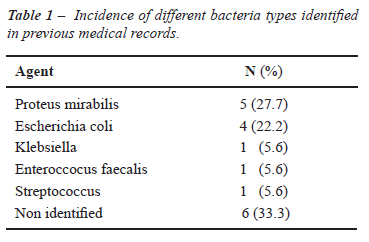
Nearly half of them, 18 (48.6%), presented
clinical history of urinary tract infection, and only five were taking
prophylactic antibiotics as a therapeutic measure. Bacteria found in previous
medical records are shown in Table-1.
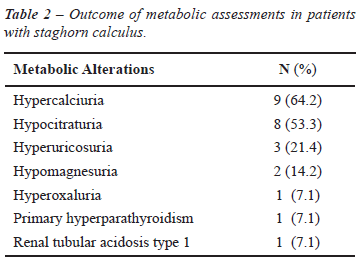
Twenty-two patients with staghorn calculus,
who fulfilled the inclusion criteria, underwent metabolic investigation.
Urinary pH mean was 6.25 (range 5.3 - 7.0), and the mean of 24-hour urinary
volume was 1,914 mL (range 830 - 3,500). Metabolic alterations (Table-2)
were observed in 68.18% of patients (15/22), and 9 of them presented concomitant
history of urinary tract infection.
COMMENTS
Staghorn
calculus is the most severe presentation of urinary tract lithiasis. Although
UTI plays an important role in its formation, there are several other
contributory factors, especially metabolic disorders. However, these disorders
are not routinely investigated in these patients, and its frequency varies
widely according to ethnical and environmental factors. Different studies
of metabolic assessment in patients with urinary lithiasis have reported
a high incidence of metabolic disorders as a causal factor (3,4). Recently,
Akagashi and others (5) evaluated 82 Japanese patients with staghorn calculus
and found the following metabolic alterations: hypercalciuria in 37.8%
and cistinuria in 2.4%. Only 24.4% of patients had UTI, which is lower
than the data from Western countries. As for gender, there was no difference,
contradicting reports that show female predominance due to higher susceptibility
of urinary tract infection.
Resnick and others (6) reported that, in
Western countries, metabolic alterations correspond to 52.9% in men and
40.7% in women with staghorn calculus. These findings suggest that, in
these countries, metabolic disorders usually coexist with urinary tract
infection.
A Thai random study of 5,445 lithiasic patients
observed frequent complete staghorn calculus in 86 of them (1.6%). Positive
urine culture was identified in 59.3% of patients, and hyperurecemia,
the most common metabolic disorder, was found in 61.8% of patients with
this calculus (7).
Staghorn calculus in children is usually
related to congenial malformations of the urinary tract associated with
infection and also metabolic diseases such as cystinuria, renal tubular
acidosis and alterations like hypercalciuria and hyperuricosuria.
Ali and Rifat (8) studied 204 children with urinary lithiasis in Iraq,
and identified the etiology in 189 (92.6%), and the others were considered
idiopathic. Twenty-nine patients (14.2%) had staghorn calculus; 27 had
history of urinary infection, and 25 had urinary tract malformation. Metabolic
disorders were the most common cause, found in 106 children, and in 52
(25.5%) they were associated with infection. Although metabolic disorders
are the most frequent cause, its diagnosis can be difficult due to urinary
tract infection.
As for patients with staghorn calculi and
urinary tract infection, it is important to distinguish whether the infection
was caused by ureases-producing bacteria that lead to calculus formation,
especially the struvite, or just a complication due to metabolic disorders.
Former reports have shown that 50% of patients with calculus associated
with infection presented metabolic disorders which are responsible for
the initial calculus formation (5), showing the importance of metabolic
investigation.
A study that evaluated biochemical risk
factors concluded that the metabolic evaluation of patients with staghorn
calculus seems to be important in the follow-up after surgical treatment
(9).
There are limited publications related to
the metabolic aspects of staghorn calculus formation and there are no
Brazilian scientific publications focusing on the evaluation of this problem
in our country. Our experience, from a regional reference center for calculi
treatment, found 5.8% of patients with staghorn calculus from the total
number sent for investigation of metabolic disorders. Because patients
are not routinely sent for metabolic evaluation, this statistic may have
been underestimated in our Service. There was female predominance due
to characteristic factors related to their urinary tract. There were 27%
(10/37) cases of nephectomies caused by lithiasis complications, and 18
(48.6%) patients had a previous history of urinary tract infection. There
was only one case of stenosis of the pyeloureteral junction.
Metabolic alterations were identified in
15 (68.2%) of 22 patients evaluated, corroborating its importance as a
contributing factor to staghorn calculus etiology. Thus, the presence
of metabolic disorders in more than half of patients with this calculus
highlights the importance of metabolic evaluation protocols. It is fundamental
to correct metabolic disorders and control urinary infection in order
to prevent recurrence of these calculi. Prevention is particularly difficult
in these patients with recurrent infections. Therefore, they need careful
follow-up with routine antibiotic therapy and urinary acidification control.
CONCLUSION
Metabolic analysis is important to be done mainly in the cases of staghorn calculus without urinary infection, however, this may not be the isolated etiology of these calculi. Thus, the clinical treatment of this disorder may be the only way to prevent its recurrence.
CONFLICT OF INTEREST
None declared.
REFERENCES
- Rieu P: Infective lithiasis. Ann Urol (Paris). 2005; 39: 16-29.
- Segura JW: Staghorn calculi. Urol Clin North Am. 1997; 24: 71-80.
- Peres LA, Molina AS, Galles MH: Metabolic investigation of patients with urolithiasis in a specific region. Int Braz J Urol. 2003; 29: 217-20.
- Amaro CR, Goldberg J, Amaro JL, Padovani CR: Metabolic assessment in patients with urinary lithiasis. Int Braz J Urol. 2005; 31: 29-33.
- Akagashi K, Tanda H, Kato S, Ohnishi S, Nakajima H, Nanbu A, et al.: Characteristics of patients with staghorn calculi in our experience. Int J Urol. 2004; 11: 276-81.
- Resnick MI, Boyce WH: Bilateral staghorn calculi--patient evaluation and management. J Urol. 1980; 123: 338-41.
- Tanthanuch M: Staghorn calculi in southern Thailand. J Med Assoc Thai. 2006; 89: 2086-90.
- Ali SH, Rifat UN: Etiological and clinical patterns of childhood urolithiasis in Iraq. Pediatr Nephrol. 2005; 20: 1453-7.
- Wall I, Hellgren E, Larsson L, Tiselius HG: Biochemical risk factors in patients with renal staghorn stone disease. Urology. 1986; 28: 377-80.
____________________
Accepted
after revision:
June 15, 2009
_______________________
Correspondence
address:
Dr. João Luiz Amaro
Departamento de Urologia
Faculdade de Medicina de Botucatu
Botucatu, SP, 18618-970, Brazil
E-mail: jamaro@fmb.unesp.br
EDITORIAL COMMENT
Etiologic
investigation on urolithiasis is always of great interest because urologists
often do not observe that the stone is a symptom and not a disease.
This Brazilian study underlines the high
percentage of metabolic disorder (nearly 70%) in patients with staghorn
stones. This aspect is really interesting because usually we associate
complex lithiasis with infection without classifying if the infection
is established before or after stone formation.
The authors did not perform stone examination
and we therefore assume that this aspect is integrated in the metabolic
study of lithiasis, because for example the major presence of calcium
oxalate or calcium phosphate (brushite) in a stone may orientate towards
a metabolic alteration instead of an infectious cause like in a struvite
or apatite stone. We must remember that this does not always have a simple
interpretation because often stones are irregularly mixed.
Another important aspect that is the presence
of metabolic alteration in patients who have undergone nephrectomies because
if this is the case in most of them it suggests that a metabolic study
should be mandatory.
In conclusion, we think that a metabolic study is necessary in all patients
at risk for relapse like young, recidivated, multiple or bilateral lithiasis,
familiarity, congenital or acquired solitary kidney and of course in patients
with complex stones where often kidney function is reduced and we need
to reduce possibility to develop a stone in contralateral kidney.
We hope that this field of study will not be abandoned because it may
reduce patient suffering and health expenses due to relapse reduction.
Dr.
Mario Motta & Dr. Alberto Saita
Department Urology
University of Catania, Italy
E-mail: mmotta @unict.it
EDITORIAL COMMENT
Most of the recent publications regarding staghorn calculi have focused
on management issues. Thus, the study by Amaro et al. “Metabolic
investigation of patients with staghorn calculi: Is it necessary?”
is a welcome reminder that the cornerstone of therapy for recurrent nephrolithiasis
is prevention. The authors screened a large population of adult stone
patients, identifying 37 of 630 or 5.8% as having staghorn calculus. Half
had a history of urinary tract infection. The overwhelming majority were
women, a statistic that has been shown in previous epidemiologic studies
of staghorn calculus. Of 22 patients who underwent metabolic evaluation,
nearly 70% had a demonstrable metabolic abnormality including hypercalciuria,
hypocitraturia, hypomagnesuria, and hyperuricosuria. This percentage is
reasonably close to the percentage of patients identified with a metabolic
abnormality in the non-staghorn population of stone patients (1). Why,
then, would some individuals develop staghorn calculi and others not?
It is possible that abnormal solute excretion is a risk factor for stone
formation but that other factors determine the growth and presentation
of the stones. Thus, some individuals may have a single stone, others
have multiple bilateral stones, still others have enormous space-filling
staghorn calculi. One of these factors may be the occurrence and bacteriology
of urinary tract infections. Another possibility is that the characteristics
of the uroepithelium or urine contents of patients who develop urinary
tract infections are similar to those with patients who develop stones.
Uromodulin abnormalities, for example, have been implicated in the development
of both stones and urinary tract infections (2).
It would have been of interest to know the
composition of the staghorn calculi and to determine the correlation between
staghorn stone composition and the urinary metabolic analysis. For example,
was hypercalciuria seen in patients who had only calcium oxalate or calcium
phosphate stones or was it also associated with the development of struvite
stones? Despite the absence of these data, this study reminds us that
stones develop as a result of abnormal supersaturation and that prevention
depends in large part on limiting urine solute excretion and/or concentration.
While we are looking for the ideal techniques for management of this very
challenging condition, let us not forget the basics of prevention.
REFERENCES
- Maloney ME, Springhart WP, Ekeruo WO, Young MD, Enemchukwu CU, Preminger GM: Ethnic background has minimal impact on the etiology of nephrolithiasis. J Urol. 2005; 173: 2001-4.
- Serafini-Cessi F, Malagolini N, Cavallone D: Tamm-Horsfall glycoprotein: biology and clinical relevance. Am J Kidney Dis. 2003; 42: 658-76.
Dr.
Eleanor D. Lederer
Director, Nephrology Training Program
Kidney Disease Program, University of Louisville
Louisville, Kentucky, USA
E-mail: e.lederer@louisville.edu