ANATOMIC
ASPECTS OF EPIDIDYMIS AND TUNICA VAGINALIS IN PATIENTS WITH TESTICULAR
TORSION
(
Download pdf )
LUCIANO A. FAVORITO, ANDRÉ G. CAVALCANTE, WALDEMAR S. COSTA
Urogenital Research Unit, State University of Rio de Janeiro, and Service of Urology, Souza Aguiar Municipal Hospital, Rio de Janeiro, Brazil
ABSTRACT
Objective:
To analyze the morphology of epididymis and tunica vaginalis as well as
their anatomical anomalies in patients with testicular torsion.
Materials and Methods: We studied 25 patients
(50 testes) aged between 12 and 23 years (mean 15.6). Torsion length ranged
from 2 hours to 2 days (mean 8 hours). Epididymal anatomy was classified
in 6 groups: Type I - epididymis united to the testis by its head and
tail; Type II - epididymis totally united to the testis; Type III - disjunction
of epididymal tail; Type IV - disjunction of epididymal head; Type V -
total disjunction between testis and epididymis, and Type VI - epididymal
atresia. The type of torsion was classified in 3 groups: Group A –
intravaginal torsion; Group B – extravaginal torsion and Group C
– torsion due to long mesorchium.
Results: Of the 50 analyzed testes, 40 (80%)
presented bell clapper deformity (with 21 presenting intravaginal torsion);
8 testes (16%) had long mesorchium (4 with torsion), and only 2 (4%) presented
normal anatomy in the tunica vaginalis. The most frequently found anatomical
relationship between testis and epididymis was Type I - 38 cases (76%);
Type II relationship was found in 6 cases (12%) and Type III relationship
was found in 6 cases (12%).
Conclusions: Intravaginal torsion is the
most frequent type, and torsion due to long mesorchium is associated with
cryptorchism. The most frequently found anatomical relation between testis
and epididymis in the study group was Type I.
Key
words: testis; epididymis; spermatic cord torsion; cryptorchidism
Int Braz J Urol. 2004; 30: 420-4
INTRODUCTION
Testicular
torsion is a urologic urgency. The testis will present irreversible damage
if the torsion is not resolved within up to 6 hours. Testicular torsion
can occur at any age; however, it is more frequent in teenagers and young
adults (1). This pathology is responsible for approximately 90% of acute
testicular pain in patients between 13 and 21 years old (2).
Signs and symptoms of torsion include acute
scrotal pain and testicular ascent, and the testis can lie horizontally
with or without inflammatory signs (3). The diagnosis is made mainly through
clinical examination, however, in doubtful cases Doppler ultrasonography
of the spermatic cord and testicular scintigraphy can be used to assess
testicular perfusion (4). Often these tests are not promptly available,
thus in doubtful cases following clinical examination, when complementary
exams cannot be performed, urgency scrotal exploration is the treatment
of choice (3).
The testicular torsion is an anomaly resulting
from changes in the implantation of the tunica vaginalis or epididymal
disjunction (5). Normally, the testis is united to the tunica vaginalis,
and if the tunica is implanted too high, the testis can present excessive
mobility (bell clapper testis) (5). Mesorchium is the ligament that unites
the testis to the epididymis (5,6). In cases of epididymal disjunction
or elongated epididymis, conditions that are highly frequent in cryptorchism
(7-10) the mesorchium is long and can contribute to the testicular torsion
(6).
Several clinical and experimental studies
on testicular torsion are described in the literature (1-4,11). Studies
on the anatomic aspects of the tunica vaginalis and the association with
epididymal anatomy and its anomalies in patients with testicular torsion
are scarce (5,12). The objective of this work is to analyze the morphology
of epididymis and tunica vaginalis, as well as their anatomic anomalies
in patients with testicular torsion.
MATERIALS AND METHODS
In
the period from May 2002 to May 2004 we studied 25 patients (50 testes
and epididymis) with testicular torsion. All patients were admitted to
our institution with symptoms of testicular pain. Following the clinical
examination, a Doppler ultrasonography of the scrotal region was performed,
in order to confirm the diagnosis. Patients were aged between 12 and 23
years (mean 15.6) and torsion duration ranged from 2 hours to 2 days (mean
8 hours).
All cases were operated by the same surgeon,
who performed orchiopexy (or orchiectomy) in the twisted testis and orchiopexy
in the contralateral testis. During surgical exploration, the anatomy
of the tunica vaginalis and the relationships between testis and epididymis
were classified according to the following system, previously described
(6,12-14): Type I - epididymis united to the testis by its head and tail;
Type II - epididymis totally united to the testis; Type III - disjunction
of epididymal tail; Type IV – disjunction of epididymal head; Type
V - total disjunction between epididymis and testis and Type VI –
epididymal atresia.
The type of testicular torsion was classified
in 3 groups according to the anatomy of the tunica vaginalis and the relationship
between testis and epididymis (Figure-1): Group A – bell clapper
testicular deformity (leading to intravaginal torsion); Group B –
torsion of spermatic cord (leading to extravaginal torsion) and Group
C – torsion due to long mesorchium.

We used qui-square statistical tests for
contingency analysis of the populations under study (p < 0.05).
RESULTS
The
type of testicular torsion found in the 25 patients is shown in (Table-1).
Of the 25 studied patients, 13 (52%) presented torsion of the right testis
and 12 (48%) of the left one, with no significant difference between the
side of torsion. We did not find bilateral testicular torsion in any patient.

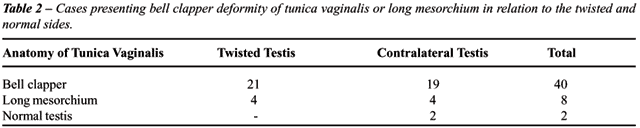
Of the 50 analyzed testes, 40 (80%) presented
bell clapper deformity (with 21 presenting intravaginal torsion); 8 testes
(16%) presented long mesorchium (4 with torsion), and only 2 (4%) of the
50 testes under analysis, presented normal anatomy of the tunica vaginalis.
These data are exposed in (Table-2). Among the 25 cases of torsion, orchiectomy
was performed in 8 cases, testis fixation was performed in the remainder.
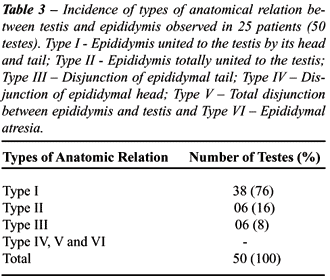
The most frequently found anatomic relation
between testis and epididymis was type I - 38 cases (76%); type II relation
was found in 6 cases (12%) and type III relation was found in 6 cases
(12%) (Table-3).
Of the 8 cases with long mesorchium, 3 testes
(37.5%) were cryptorchid. One patient with torsion due to long mesorchium
presented bilateral cryptorchism and elongated epididymis bilaterally.
In another case, the patient presented unilateral cryptorchism with disjunction
of epididymal tail. A third patient with torsion due to long mesorchium
presented disjunction of the epididymal tail in the twisted testis. This
patient presented normal epididymal anatomy and normal layering of tunica
vaginalis in the testis without torsion. Two patients presented bilateral
disjunction of epididymal tail.
COMMENTS
Testes
present a normal layering of tunica vaginalis. They are involved by this
structure on both sides and on their upper portion. The posterior region
of testis is not covered by tunica vaginalis. United to the lower pole
region of the testis and the epididymal tail, there is the testicular
gubernaculum or its remnant, the testicular ligament, which is covered
by tunica vaginalis only in its anterior and lateral portions (6). Intravaginal
testicular torsion does not occur in testes presenting normal anatomy
as described above, because the posterior testicular segment is firmly
united to the scrotum, preventing the organ to move (5,6).
Testicular torsion occurs due to anatomic
anomalies of tunica vaginalis or epididymis that allow excessive testicular
mobility inside the scrotum. Due to this excessive mobility, testis can
present medial rotation that ranges from 360º to 720º in its
own axis, which can cause interruption of the organ’s vascularization
(2).
Based on our findings, a normal anatomy
of tunica vaginalis or epididymis at the side contralateral to the torsion
is rare (2 cases - 4%), and anatomic anomalies occur bilaterally in the
vast majority of cases. These findings stress the need for bilateral orchiopexy
in cases of testicular torsion.
Bell clapper deformity (intravaginal torsion)
was the most commonly found type of anomaly (80%). The relation between
the presence of full covering of testis and spermatic cord by tunica vaginalis
(bell clapper deformity) and testicular torsion is well known. Parker
& Robinson (5) in a study conducted with 40 patients found this deformity
in 35% of studied cases.
Cases of torsion due to long mesorchium
most often occur as a consequence of anomalies of epididymal disjunction
or elongated epididymis, conditions that are highly frequent in cryptorchism
(5-10). Of the 8 cases with long mesorchium, 3 (37.5%) had cryptorchid
testes. These findings are similar to those of Parker & Robinson (5)
who found long mesorchium in 33% of studied cases.
Approximately 20% of cases of testicular
torsion occur in patients with cryptorchism (6). Epididymal anomalies
associated with long mesorchium are frequent in patients with cryptorchism,
with an incidence ranging from (36 to 72%) (7-10) and rare in individuals
with topic testes (less than 4%) (14). Due to these changes in mesorchial
region, the possibility of testicular torsion must be considered in cryptorchid
patients presenting acute scrotal or inguinal pain.
Anatomical relations between testis and
epididymis in patients with testicular torsion evidenced a pattern that
is not different from patients without anomalies (12, 13-15). Type I and
type II relations were observed in approximately 90% of cases of testicular
torsion. In 2 patients with torsion with long mesorchium found in type
I anatomy with elongated epididymis.
Elongated epididymis is a condition included
in type I, according to the classification used in this paper (6,13-15).
However it is known that patients with cryptorchism present a high index
of epididymal anomalies (Types III, IV and V), as well as elongated epididymis
(7-10). However, the present classification includes elongated epididymis
in the normal group. Probably a subdivision of type I anatomic relation
with elongated epididymis in a separate group will be necessary in the
future.
We concluded that intravaginal torsion (bell
clapper tunica vaginalis) is the most frequent type of torsion, and torsion
due to long mesorchium is associated with cryptorchism. The most frequently
found anatomical relation between testis and epididymis in the study group
was type I (epididymis united to the testis by its head and tail).
The present research was supported by Rio de Janeiro
Foundation
for Research Support (FAPERJ) and
National Council for Scientific and Technological
Development (CNPQ).
REFERENCES
- Cummings JM, Boullier JA, Sekhon D, Bose K: Adult testicular torsion. J Urol. 2002; 167: 2109-10.
- Ben-Chaim J, Leibovitch I, Ramon J, Winberg D, Goldwasser B: Etiology of acute scrotum at surgical exploration in children, adolescents and adults. Eur Urol. 1992; 21: 45-7.
- Kass EJ, Stone KT, Cacciarelli AA, Mitchell B: Do all children with an acute scrotum require exploration? J Urol. 1993; 150: 667-9.
- Middleton WD, Siegel BA, Melson GL, Yates CK, Andriole GL: Acute scrotal disorders: prospective comparison of color Doppler US and testicular scintigraphy. Radiology. 1990; 177: 177-81.
- Parker RM, Robison JR: Anatomy and diagnosis of torsion of the testicle. J Urol. 1971; 106: 243-7.
- Scorer CG, Farrington GH: Congenital Deformities of the Testis and Epididymis. London, Butter Worths e Co, 1971.
- Elder JS: Epididymal anomalies associated with hydrocele/hernia and cryptorchidism: implications regarding testicular descent. J Urol. 1992; 148: 624-6.
- Gill B, Kogan S, Starr S, Reda E, Levitt S: Significance of epididymal and ductal anomalies associated with testicular maldescent. J Urol. 1989; 142: 556-8; discussion 572.
- Gill B, Kogan S: Cryptorchidism. Current concepts. Pediatr Clin North Amer. 1997; 44: 1211-27.
- Marshall FF: Anomalies associated with cryptorchidism. Urol Clin North Amer. 1982; 9: 339-47.
- Noske HD, Kraus SW, Altinkilic BM, Weidner W: Historical milestones regarding torsion of the scrotal organs. J Urol. 1998; 159:13-6.
- Caesar RE, Kaplan GW: Incidence of the bell-clapper deformity in an autopsy series. Urology. 1994; 44: 114-6.
- Favorito LA, Sampaio FJ: Anatomical relationships between testis and epididymis during the fetal period in humans (10-36 weeks postconception). Eur Urol. 1998; 33: 121-3.
- Turek PJ, Ewalt DH, Snyder HM 3rd, Duckett JW: Normal epididymal anatomy in boys. J Urol. 1994; 151: 726-7.
- Favorito LA, Sampaio FJ, Javaroni V, Cardoso LE, Costa WS: Proximal insertion of gubernaculum testis in normal human fetuses and in boys with cryptorchidism. J Urol. 2000; 164: 792-4.
___________________
Received: July 6, 2004
Accepted after revision: October 13, 2004
_______________________
Correspondence address:
Dr. Luciano Alves Favorito
Unidade de Pesquisa Urogenital
Universidade do Estado do Rio de Janeiro
Av. 28 de Setembro, 87, fundos, FCM, térreo
Rio de Janeiro, RJ, 20551-030, Brazil
Fax: + 55 21 2587-6121
E-mail: favorito@uerj.br